
A maze of lanes that twist past temples old,
A stepwell whose legends have never been told.
Devotion carved in stone, Meera Bai's song still rings,
Welcome to Amer town — beyond the fort of kings.

Discover the walking tour of Amer town with stories and a map to plan your own self-guided one. Learn about the various attractions of Amer town like the Panna Meena ka Kund, Jagat Shiromani temple and other historic structures.
If you ask most visitors what to see in Amer, they will say the fort. And they wouldn’t be wrong — the Amer Fort is magnificent, a UNESCO world heritage Hill Fort of Rajasthan that deserves every hour you give it. But here’s the thing most visitors miss entirely. The town that wraps around the fort’s feet is older, quieter, and far more layered than the fortress that overshadowed it. As I discovered, it is here — in the lanes of Amer town, Jaipur — that the real story of this place lives.
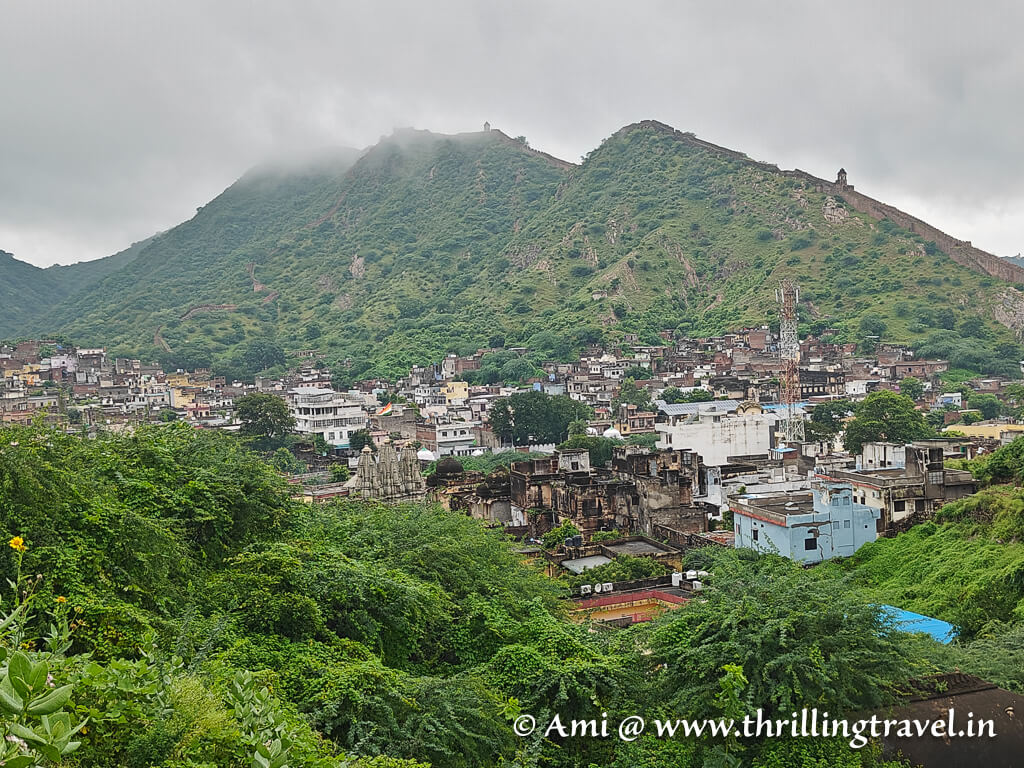
I had my eyes on this town from my first visit to Amer fort. On my way to the fort, I found myself intrigued by many sights. For one, there was the Jagat Shiromani mandir, its intricate carvings glowing in the early light and then there were majestic havelis and whispers of one of the stunning stepwells of Jaipur. It took one walking trail in Amer to discover these and more – including the geometric stepwell of Panna Meena Ka Kund, the subterranean Shiva linga of Ambikeshwar Mahadev Temple and the ancient Amer wall with its sweeping views of the Aravalli hills. This was that one time, that I chose to ignore the fort and make the most of discovering the various places to see near Amer Fort.
This post is my attempt to recreate that walk for you. I have put together a Amer walking tour that takes you through its most compelling landmarks — with the history, the legends and the practical details you need to explore it on your own. I have even included a few cultural things to do in Amer, to make this walking tour even more immersive. If you are looking for a guided Amer town walk, I have a few suggestions on where you can find them, and how to book these tours.
All in all, this is your complete guide to an offbeat Jaipur trail – rather Amer town attractions.
Quick links for the Amer walking tour
- Booking.com has several good Jaipur stays listed on their site. These range from luxury hotels to mid-prices havelis, homestays and hostels. I have also got this post on the localities and areas where you can plan to stay for your Jaipur visit.
- GetYourGuide is a good resource with tons of Jaipur tours including heritage walks and cycling tours. You can check these five related that could work for you –
- Viator.com is another online resource for booking walking tours, transfers and guided tours in Jaipur. They seem to have more options for the Heritage walking tour of Amer town. Here are five that you might want to consider for this visit.
- For any of your travel needs or general shopping, consider using Amazon through this link.
Disclaimer: This article includes affiliate links. This means that at no cost to you, I will receive a small commission if you purchase through my link. Thank you for supporting me with this.
Amer town history
I would say that the history of Amer town is, in many ways, the history of Rajputana itself. Long before Jaipur existed or was conceived, Amer was the seat of power of the Kachwaha Rajputs — a dynasty that shaped the political and cultural landscape of this entire region for nearly seven centuries.
But the story of Amer begins even before the Kachwahas arrived.

The original inhabitants of this valley, cradled between the Aravalli hills and the still waters of Maota Lake, were the Meenas — a tribal community who had settled here long before Rajput clans moved into Rajasthan. The town they built was believed to have built by Raja Alan Singh in the 10th century. Some historical accounts mention that its original name was Ambikeshwara, the origin of which is a subject of debate. The most widely accepted theory traces it to Ambikeshwar — one of the names of Lord Shiva, whose ancient Ambikeshwar Mahadev temple still stands in the heart of the town. Some locals who have lived here for generations believe that the name comes from Amba, the mother goddess whose temple is the one built along the Cheel ka Teela summit of the Aravalis.

It became the capital of Dhundhar in the 11th century, when the Kachwaha Rajput chief Dulha Raja wrested control of the region from the Meenas. It was a conquest that, depending on which local elder you ask, was either an act of military brilliance or a story of betrayal. I will share the folklore of this tale of betrayal later as we explore the attractions of Amer Heritage Walk.
For now, let’s continue with how the new rule of the Kachwahas gradually transformed a small settlement into a fortified capital of the kingdom of Dhundhar. The Kachwaha kings built temples, palaces, stepwells and walls. They established trade routes and patronised art and architecture. Ambikeshwara (if that was the original name) became Amber town or Amer town.
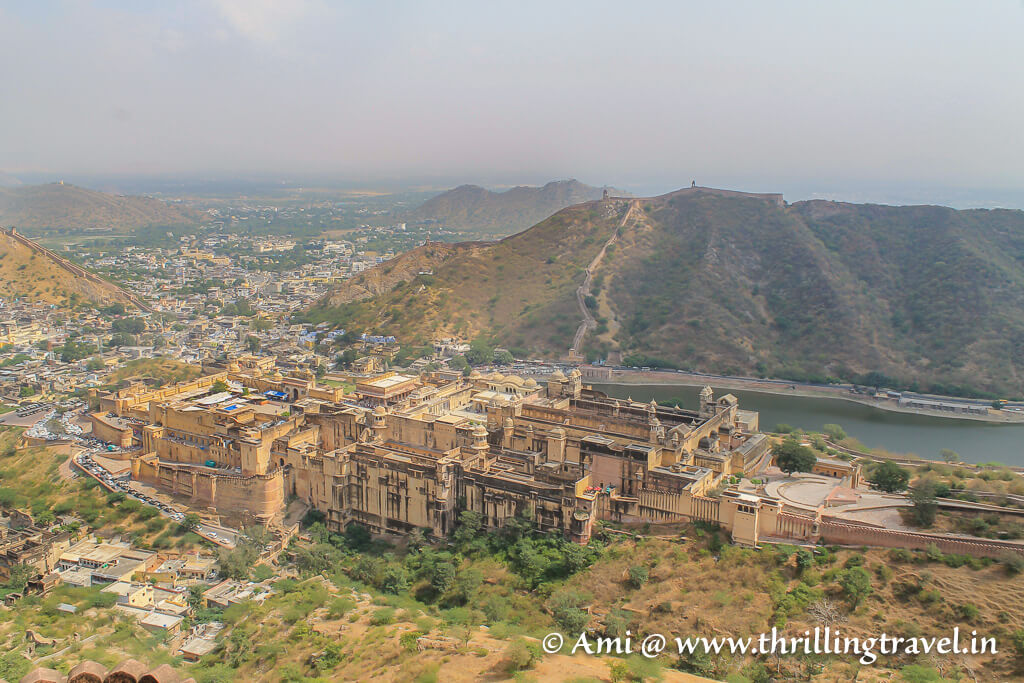
Over generations, Amer grew prosperous and powerful — and you will still see a glimpse of this prosperity on this walking trail today. When talking of the history of Amer town, Jaipur, you cannot ignore the most popular of the Kachwaha king, Raja Man Singh I, who ruled in the 16th century. A general of extraordinary military ability, he served as one of Emperor Akbar’s most trusted Navaratnas — the nine jewels of his court. His conquests brought immense wealth to Amer.
It was during his time that the gorgeous Jagat Shiromani Temple was built. The temple carries within it one of the most beloved stories in all of Indian devotional history, connected to the poet-saint Meera Bai. I will come to that when we reach the temple on our Amer heritage and cultural tour.

Amer remained the capital of the Kachwaha kingdom until 1727, when Sawai Jai Singh I decided that Amer had simply run out of space. He moved the capital 11 km south and built an entirely new city from scratch, planned on a grid, painted pink for a royal visit. That city was Jaipur – which you can uncover with this Old Jaipur heritage walk
Amer was not abandoned so much as it was quietly overtaken. The merchants and nobles followed the new capital. The grand families moved. The town settled into a gentler rhythm — its temples still active, its lanes still lived in, but no longer the centre of anything. In a way, that is exactly what makes it so extraordinary to walk through today.
What are the different types of Amer walking tours available?
Amer heritage walking tours are an offbeat offering to regular Jaipur tours. One key reason is that most people tend to focus on the Amer fort and often leave out the Amer town. That is why the sightseeing points on the Amer heritage trail are not well developed compared to the attractions of Amer Fort. A couple of caveats –
- The Amer town attractions do not have well-documented information available with sign boards or written leaflets.
- There are no guides available on the spot. The ones that you might stumble upon do not have in-depth information about the place.
- Amer is a very old town with narrow lanes that merge into each other. There are no path markers but the locals are friendly enough to help you.
At this point, you have two options for your Amer heritage walk – a guided tour that needs to be booked online and a do-it-yourself walk. There are no cycle tours or free guided tours at this point. I have done a bit of both these options, where I was invited to a walk and on my later visits, I explored the town on my own and got some stories from the locals of Amer.
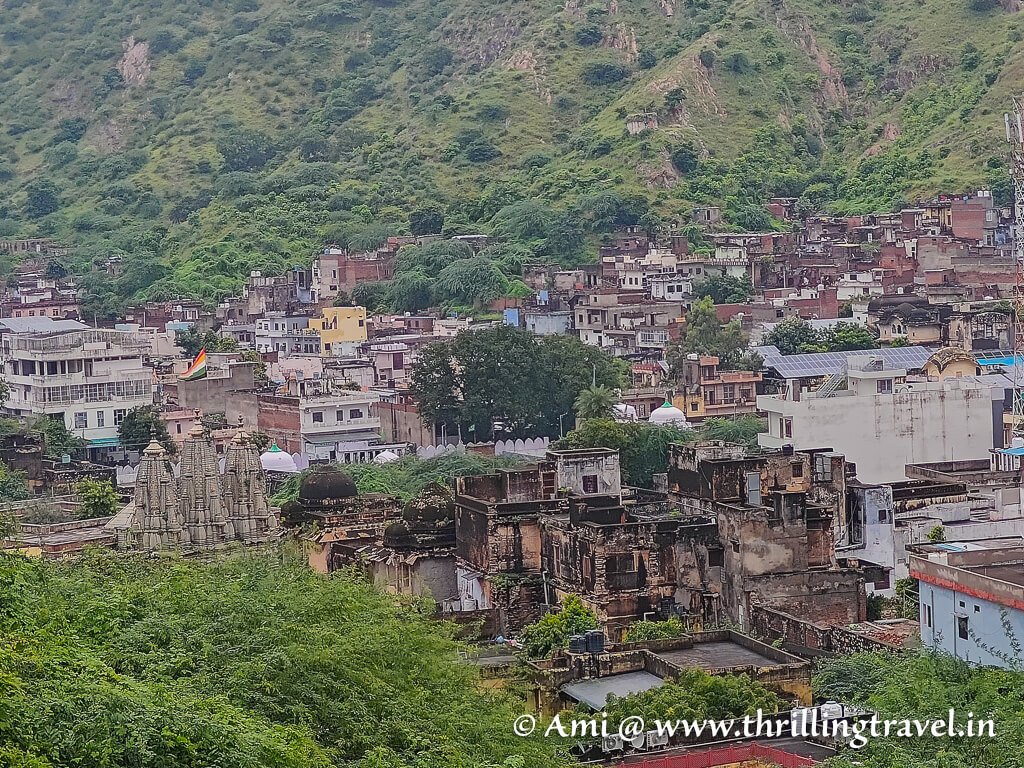
Guided Amer town walk
My quick links section has a few options that you can consider if you want a good guided walking tour of Amer town. The reviews on the links by various travelers are quite encouraging and they seem to mostly follow the same Amer walking trail map that I have shared in this blog post.
Self-guided walking trail of Amer town, Jaipur
I personally loved doing this trail on my own. It gave me enough time to linger around various places — sit at the edge of Panna Meena Ka Kund watching the geometry of it, or spend time in the Jagat Shiromani temple without a group moving you along or chat with the resident priest of Ambikeshwar temple courtyard on the various folklores and mythological stories attached to the town and the temple itself. I even found interesting places – oft ignored by the guides.
This is why I found that a self-guided walk is genuinely the best option in Amer town.

Unlike some heritage walking routes where navigation is genuinely tricky, Amer town is simple and manageable. The key landmarks of Amer are within easy walking distance of each other and the lanes, while narrow, are not a labyrinth. With a good itinerary, a map and a willingness to occasionally ask a local the way, you can easily do this walk on your own.
Which is where the next section comes in. I have put together a complete self-guided walking trail of Amer town — the same route I followed — with details on each stop, the stories behind them and a map you can follow on your phone. Whether you are doing this entirely on your own or using it to cross-check the stops on a guided tour, it will serve you well.
One practical note before we set off — wear comfortable shoes. The lanes are cobblestone and uneven in places, and the approach to the Amer wall involves a gentle uphill stretch. Amer town rewards the unhurried walker.
My recommended Amer walking trail itinerary (Places to visit near Amer Fort, Jaipur)
The map clearly gives you the key landmarks of Amer and you can just use it to navigate around. Compared to the Old Jaipur city heritage walk, the Amer town walking tour route is fairly straightforward and smaller. There is one major route with a few alternates (in the lone purple markers) to extend the walk. I have given you all the options that you can use.
Also, note that you can the whole trail can be reversed based on your convenience.
- If you are already at Amer Fort for a visit, then you can do this tour in the reverse order
- If you are only doing the Amer heritage and cultural walking tour, then I recommend an extended tour starting at Kheri gate (the extended version) and ending at Jaigarh Fort.
- In case you plan do visit Amer fort at the end, start at the Panna Meena stepwell, end at Jagat Shiromani temple, visit Amer Fort and then come down into the town covering the Choor Singh ki haveli to end at the Ganesh chowk (sweets and snacks shop)
Without much ado, let’s get started on this offbeat Amer town walk.
Panna Meena ka Kund or the Panna Meena stepwell

Stepwells across Rajasthan and Gujarat are more than just a water storage system. It is a community space where women would exchange their gossip for the day and men would have their important meetings. Everyone in town knew the “meeting spot”. In case of Amer, this is the Panna Meena Baori (Baori = well) .
You can disembark anywhere in Amer and you will find all roads lead to Panna Meena step well. Whether from the famous fort or through the narrow lanes filled with gorgeous havelis, or the long forgotten gate of Amer wall, you will land at this stepwell.
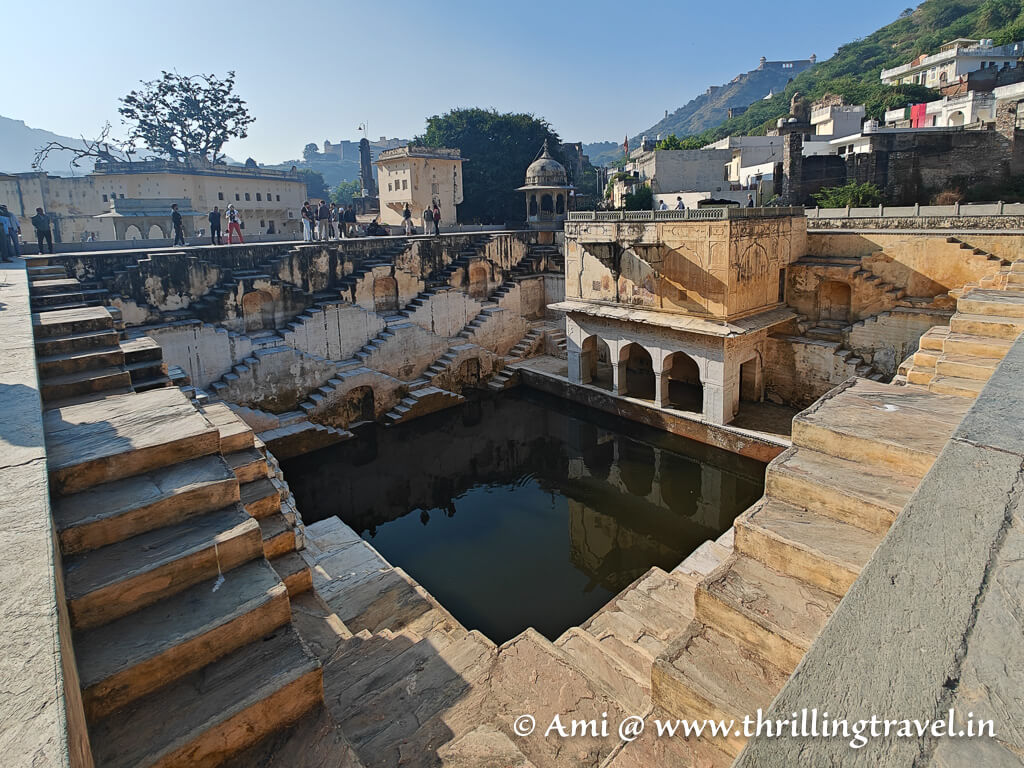
Now I have been to some stunning step wells like the Adalaj ni vav and Rani ki vav of Gujarat that are filled with carvings. Compared to those, Panna Meena ka kund seems simplistic. However, there is something mesmerizing about the symmetry of this one.
The crisscrossed staircase leading to the bottom is like a geometric puzzle that you can keep analyzing and trying to solve. For one, the estimated number of steps down to the base of this 200-feet-deep stepwell is between 1800 – 2000. No one has been able to count it for sure – naturally because it is confusing. In fact, there is a lore attached to this very feature of the step well – they say you can never come up the same way as you went down. The folklore has it as a bad omen or a curse but the reality is that, given the zig-zag nature, no one actually remembered the exact path they used.
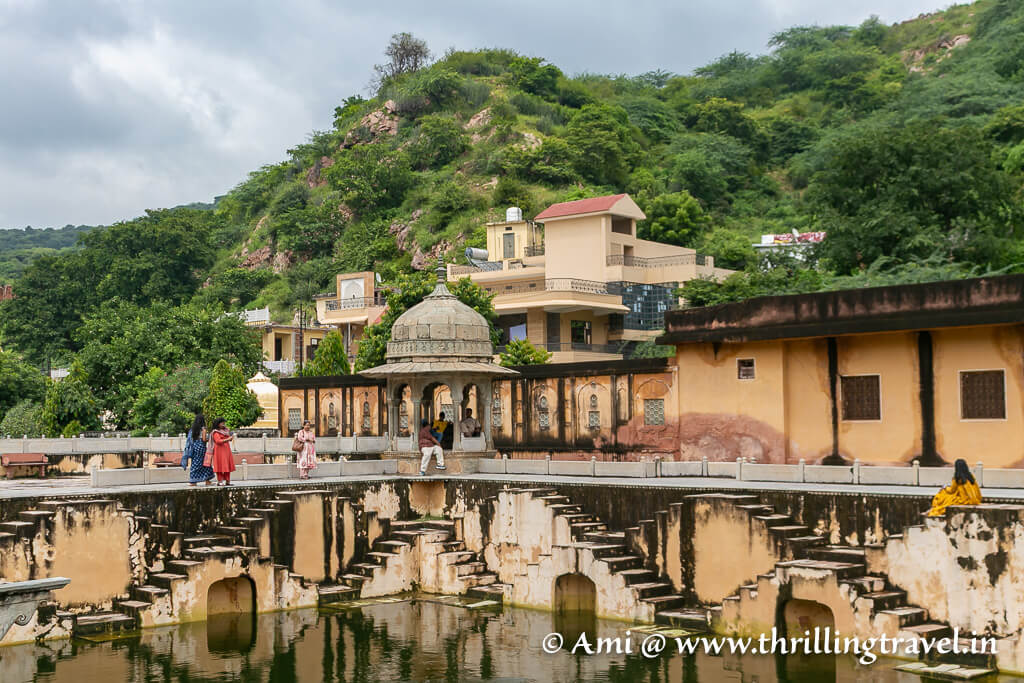
There are nine levels to the bottom, each with alcoves used for oil lamps. Four gorgeous chattris – one on each corner add to the beauty of this landmark, At one end of the square well, you will see a structure that doubles up as resting center, a space for religious ceremonies or even as changing rooms. Interesting, if you come during monsoons, they are barely visible as the water fills up – right to the second or third level of the stepwell.
The Panna Meena ka kund was built in the 16th century but local legends say that it existed even before that. The history as well as the name – Panna Meena step well is a local debate, and depending on who you ask in Amer, you will get a slightly different version of the story.
One of these stories is that Panna was a Meena chieftain, while another says that the Panna Mian, who served the royal household and was given this land as a reward. He built this stepwell and its actual name is Panna Miyah ka kund.
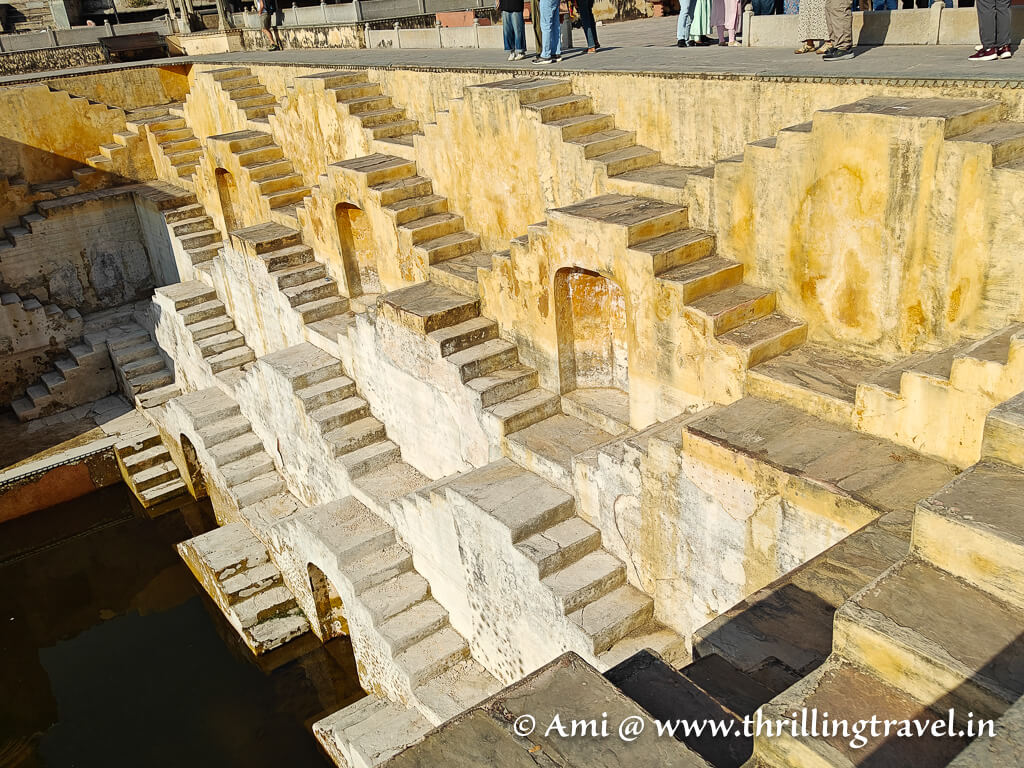
Another tale that is an eternal debate between truth and fiction is that this stepwell was where the Meena clan was defeated by the Kachwahas. I dropped this as a hint in the Amer town history and as the story goes, Meenas were basically warriors and had a tradition to lay down their weapons on Diwali. Upon discovering this tradition, the Kachwahas chose this day to attack them when they were taking their sacred dip in the stepwell and finally, overpowered them.
Some say that this story is a myth and the incident did not even take place here. There is no historical evidence of it either but well – that adds to the mystical nature of this first stop of our Amer walking tour.
If you are Bollywood buff, you can recall movies like Dhadak (2018) and Dabangg 3 that were shot here. And even if you are, you can create one of your own memorable frames at this picturesque old well.
Remember though, that you are not allowed to go down as the steps as they are uneven and slippery.
Laxminarayan Bihari Ji Temple – another intriguing Amer town story

Right across the Panna Meena stepwell, you will spot your next stop on this Amer heritage trail. At first glance, it will seem like the ruins of an old temple. On a raised platform, it stands with its weathered stone facade, a quiet courtyard and an undisturbed air. Also called the Lakshmi Narayan Bihari Ji Temple, this temple has been watching over the Kund from across the street for four hundred years.
Most visitors to Panna Meena Ka Kund just enjoy the stepwell, and move on, with barely a glimpse at the temple. This is a shame, because the Bihari ji mandir is an ode to court poet who cured a besotted king, and finally wrote seven hundred verses of poetry that became one of the great works of Hindi literature.
Let me first share the story behind the name of the temple. In the early 17th century, there was a brilliant poet – Bihari Lal Chaube, who got recognized by the Mughal emperor Shah Jahan in Agra. The then Kachwaha king, Mirza Raja Jai Singh I (not the same as the founder of Jaipur – Sawai Jai Singh) was quite impressed by him when he met him in Agra and invited him to join his court in Amer. Bihari ji shifted here and life went on.

Mirza Raja Jai Singh I got married the 2nd time and found himself completely besotted by his new wife, so much that for almost a year he ignored the affairs of the state. To jolt him out of his reverie, Bihari ji composed a poetry, hid it in a tray of roses and sent it to him. Upon reading it, the King got back to his senses – much to the relief of the courtiers and his senior queen.
The King then announced that for every poem presented by Bihari ji, he would reward him. What it resulted in was a book of 700 poems in Braj language called the Satasai – which till date remains one of the most precious contributions in literature. It is believed to honor the poet, Sawai Jai Singh I named the temple dedicated to Lakshmi and Narayan after the poet.
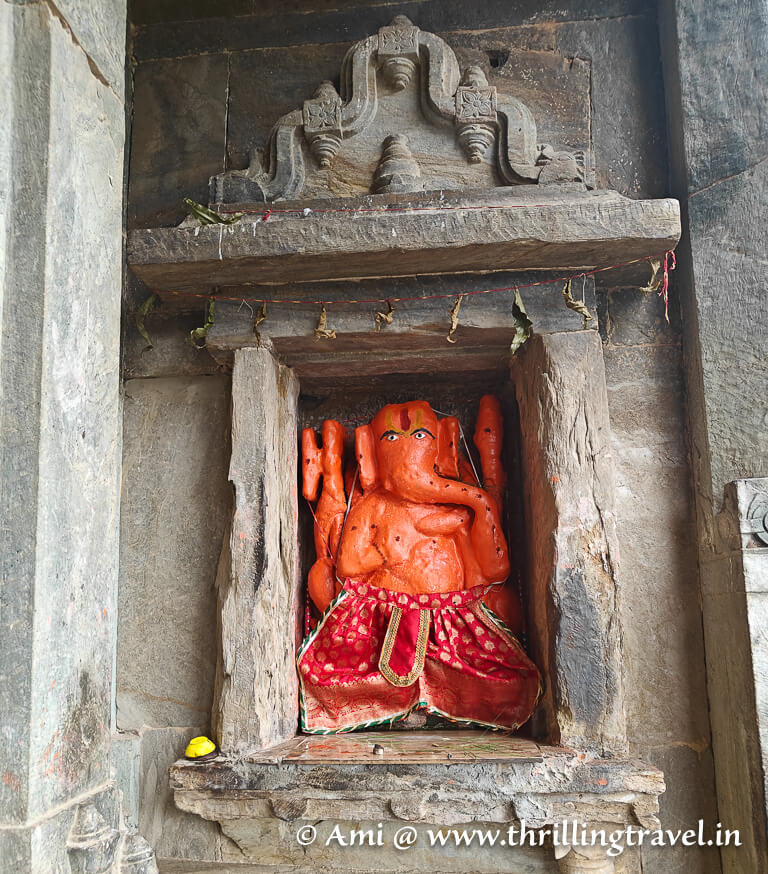
Whether it was never completed or it fell into ruins, is something I am not sure of. However, even in its half-completed state, the temple is quite photogenic. Its missing octagonal corbel roof adds that visual charm to your picture frame. The temple is no longer functional and there are not too many carvings around. The door frame of the main sanctum (usually closed) will give you an idea of what might have been if it were complete.

The elevation of the Laxmi Narayan Bihari ji temple plinth gives you a slightly higher angle over the Panna Meena baori — one that most photographers miss entirely because they never think to cross the lane and look back.
Ambikeshwar Mahadev temple – The Amer story that gave the town its name
When at the Bihariji ka mandir, you will see another temple with a huge shikhar (temple dome) that seems considerably lower than the usual ground level. That, my friends, is your next stop on this Amer town walking trail – a very significant one when it comes to the story of this town and its name.
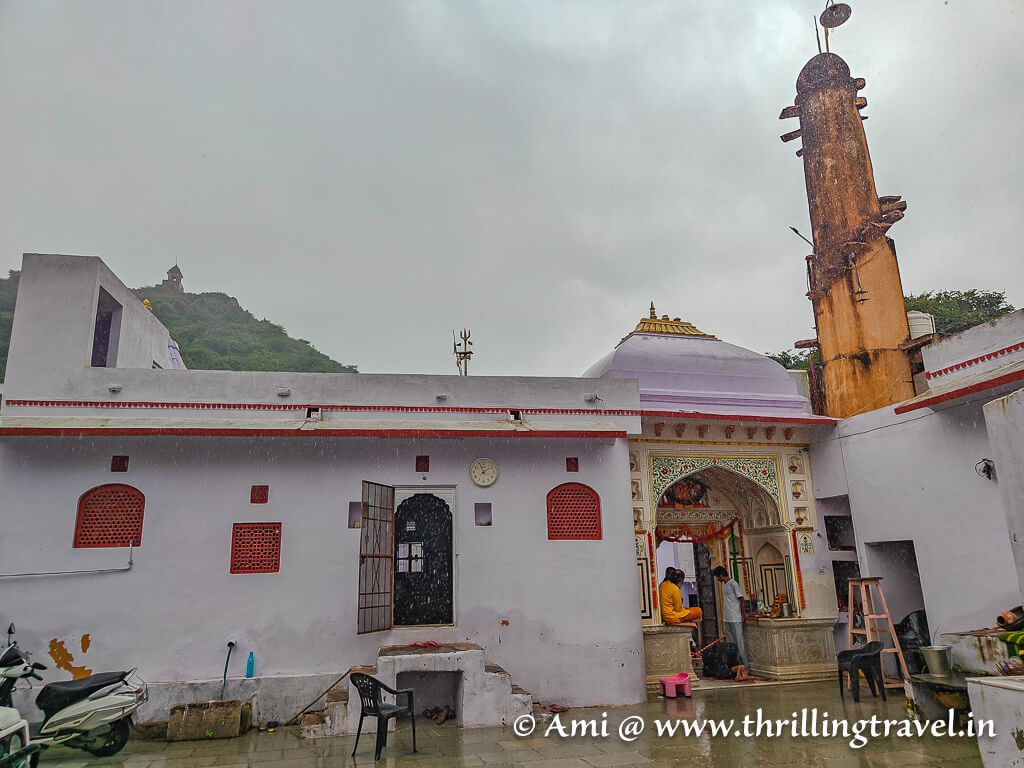
Past some old green windows and the old Amer step well, you will come to a temple entrance that belies its actual age. The outer facade is whitewashed and shiny as if the place was recently built. If the town elders are to be believed, the Ambikeshwar Mahadev temple is more than 5000 years old.
The age is questionable as there is no concrete evidence of it being this ancient. However, the stories associated with the temple – do put it way back in history – even before a town called Amer existed. Plus, there are some unusual features of this temple that will make your visit worthwhile.

Over two of my visits, I got lucky with a storyteller – the resident priest of Ambikeshwar Mahadev temple. The wise old gentleman took great pride in sharing the foundation story of the temple. He took us back to the time when the Meenas ruled this area. A cow belonging to then Meena king would wander to a particular spot in the forest every day and release her milk there — spontaneously, without being milked. Curious, the king ordered the spot to be dug up. That is when they found a Shivling – 22 feet below the ground. A temple was built around it and a town began to grow – a town that is believed to have got its name Amer – from the Ambikeshwar Mahadev temple.

“But, that is not where the tale really starts” – smiled our storyteller. “The Shiva linga was always here – and is in fact, mentioned in the Puranas as the place where Lord Krishna had his mundan”. He took us back to a chapter in the mythological tale of Lord Krishna’s childhood. As a kid, he fought a serpent to reclaim the lives of his friends. In exchange for those lives, he promised to give Kaliya the snake his hair. Turns out, he sacrificed his hair here at this Shivlinga – named as Ambikeshwar Mahadev.
True or not, these were intriguing tales that brought to life a temple whose sanctum sits nearly six feet below the road level. You do not climb up to the deity as you would in most temples. You descend down to the Shivlinga, which is still revered by the residents of Amer town and around.
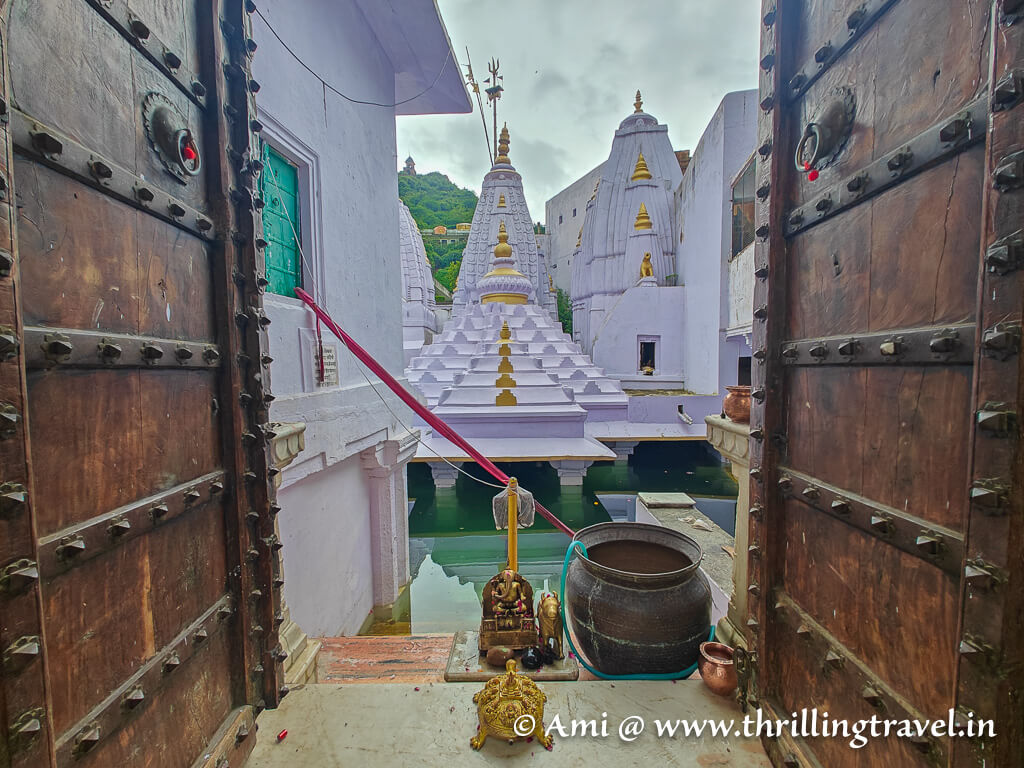
Owing to the subterranean feature, the temple shrine actually gets submerged during monsoons. This is the remarkable feature that I was talking about earlier. The overflow from Panna Meena Ka Kund — the stepwell you visited earlier — finds its way here and floods the lower sanctum. The rains, in effect, perform their own ritual anointing of the Shivling.
Interestingly, I first visited the Ambikeshwar Mahadev mandir during the monsoons and I could not even step into the shrine as it was nowhere to be seen. The only thing I could see of it was a reflection of a temple bell.
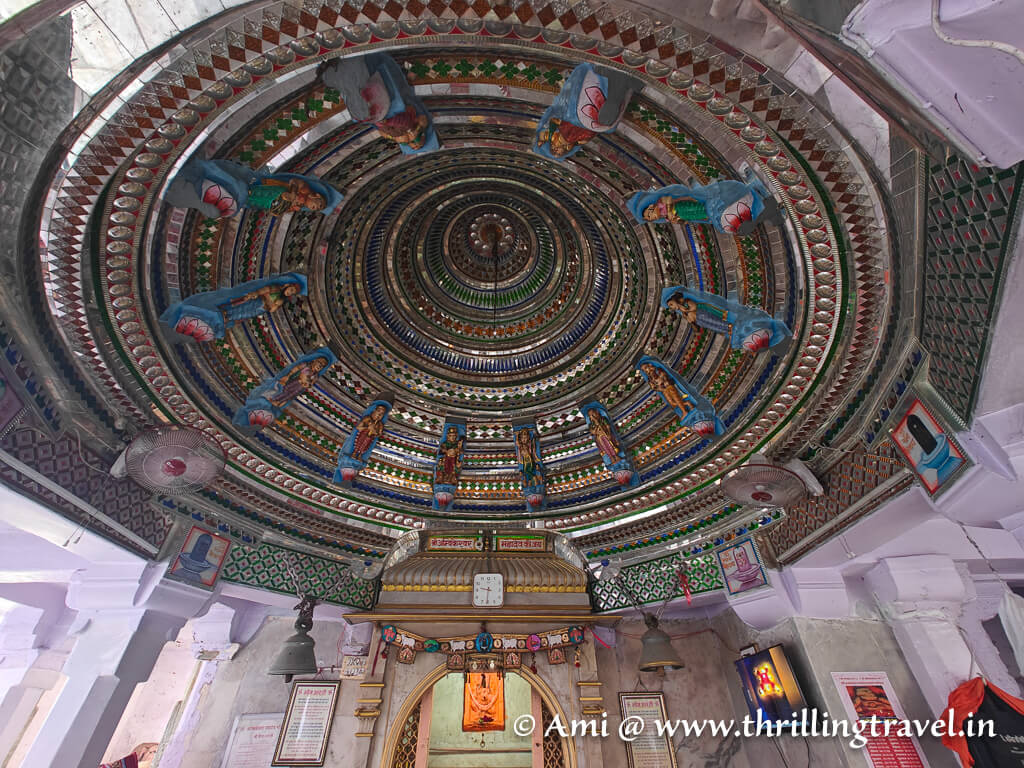
Fate and luck allowed me to return and see the temple again and this time I could pay my respects to the eternal Shiv linga inside. That is when I discovered the gorgeous mirror and glass ceiling in the Sabha mandapa (the hall just before the shrine).
Around the temple courtyard, you will find numerous other shrines – most with missing idols. The tall Dwaja Stambha — the ceremonial flagpole — is a part of this temple complex, towering over everything else in the vicinity. This is a marker of this temple’s seniority among all the shrines of Amer town. No other temple here has one.
Take a minute or two here – I have a feeling that like me, you will find a strange stillness that fills you with contentment and peace.
Ambikeshwar chowk
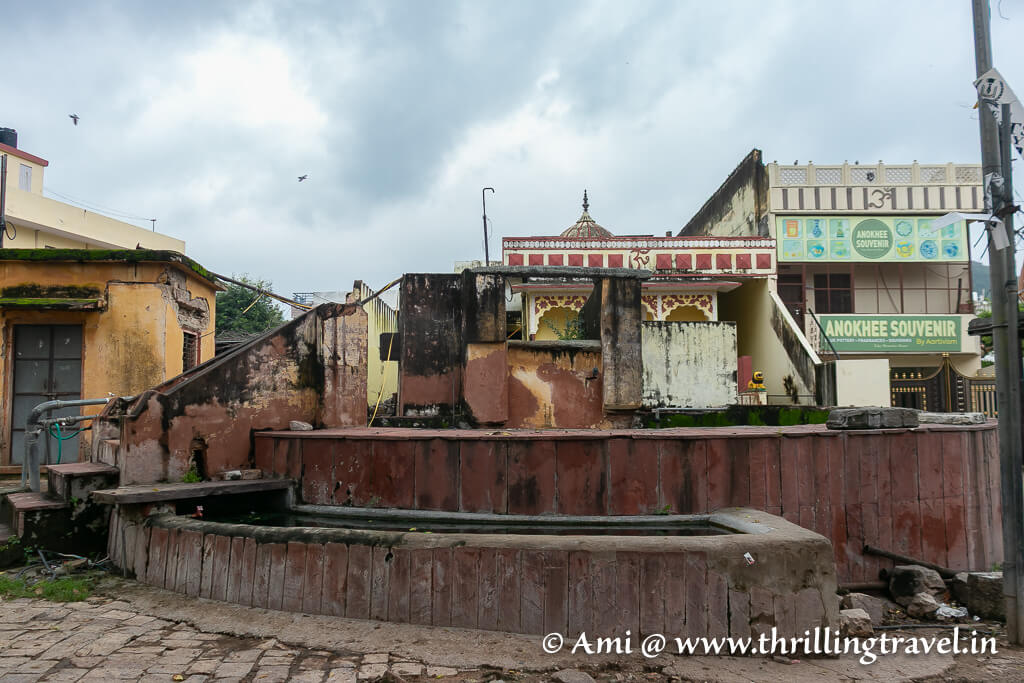
The temple is located in Ambikeshwar Chowk, a large open square that feels almost too spacious for the narrow lanes of Amer town. That scale is deliberate. This chowk was built for crowds — for processions, for festivals, for armies seeking blessings before riding out to battle.

The square also has another temple – Rameshwarji mandir and an old draw well with pulleys that could be handled using bullocks.
Jagat Shiromani temple – the only Meerabai temple in the world

From Ambikeshwar Chowk, you can either take the main road of Amer town or take a short detour through a narrow stairway to arrive at the most visually striking stop on this entire heritage walking route of Amer town. The Jagat Shiromani Temple is quite a sight — with an ornate marble archway flanked by trumpeting elephants, intricate carvings climbing every surface and a shikhara that rises above the roofline of everything around it.
To be honest, this Amer town attraction needs a complete post of its own – which I shall put together here. For now , let me share a quick history of Jagat Shiromani temple.

Built with sandstone and marble, the construction of this temple took nine long years between 1599 and 1608 AD by Queen Kankawati, wife of Raja Man Singh I. She built it in the loving memory of their son Jagat Singh, who died at a young age of 34. The Queen named it Jagat Shiromani — meaning jewel on the head of the universe.
But the story that actually made it popular belongs to Meera Bai. The black marble idol of Lord Krishna enshrined here is traditionally regarded as the same one venerated by the 16th-century bhakti saint Meera Bai during her time in Mewar. Meera Bai — poet, mystic and one of the most beloved figures in the entire Bhakti movement — considered Krishna her true husband, her devotion so total that she refused to recognise any earthly marriage.
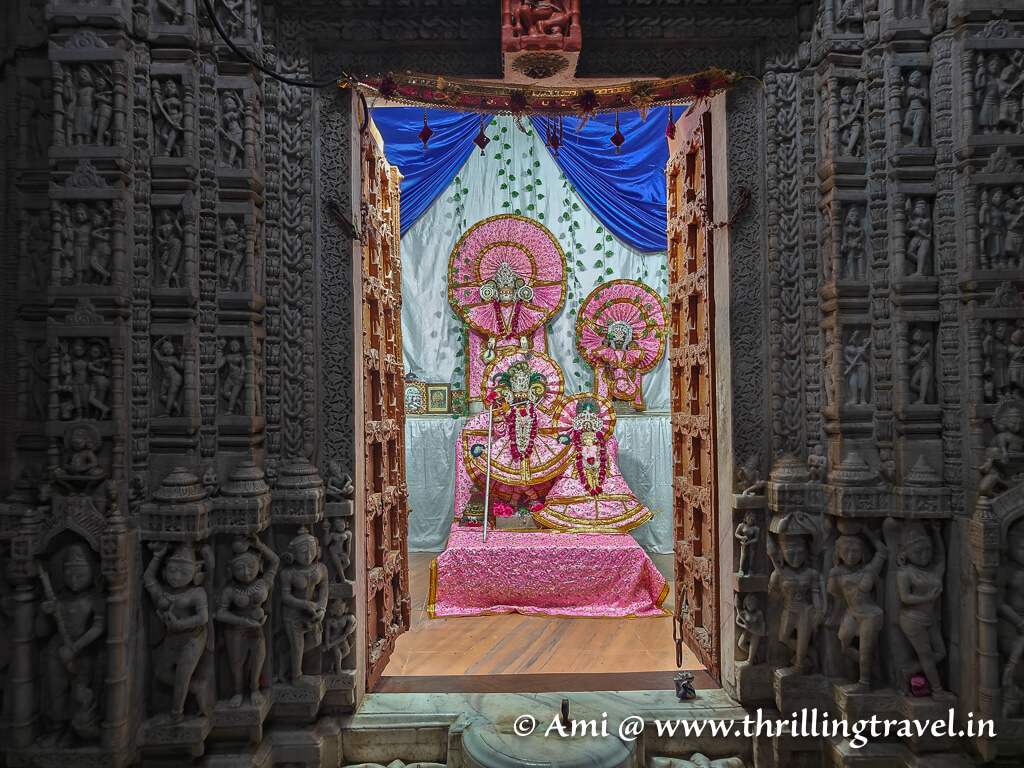
Raja Man Singh I transported the idol from Chittorgarh in Mewar to safeguard it amid escalating Mughal-Rajput conflicts. That is how it came to Amer. A statue of Meera Bai was installed alongside it. This is the only temple in the whole world in which idols of Lord Krishna and Meera Bai are worshipped together.
I am sure that it isn’t just the story that will pique your interest in the Jagat Shiromani mandir. The architecture pulls you to have a closer look at the various niches. Starting with the entrance archway — the toran which is a monolithic piece of work. The single piece of marble has tons of carvings along its surface – from floral fillers to Hindu Gods.
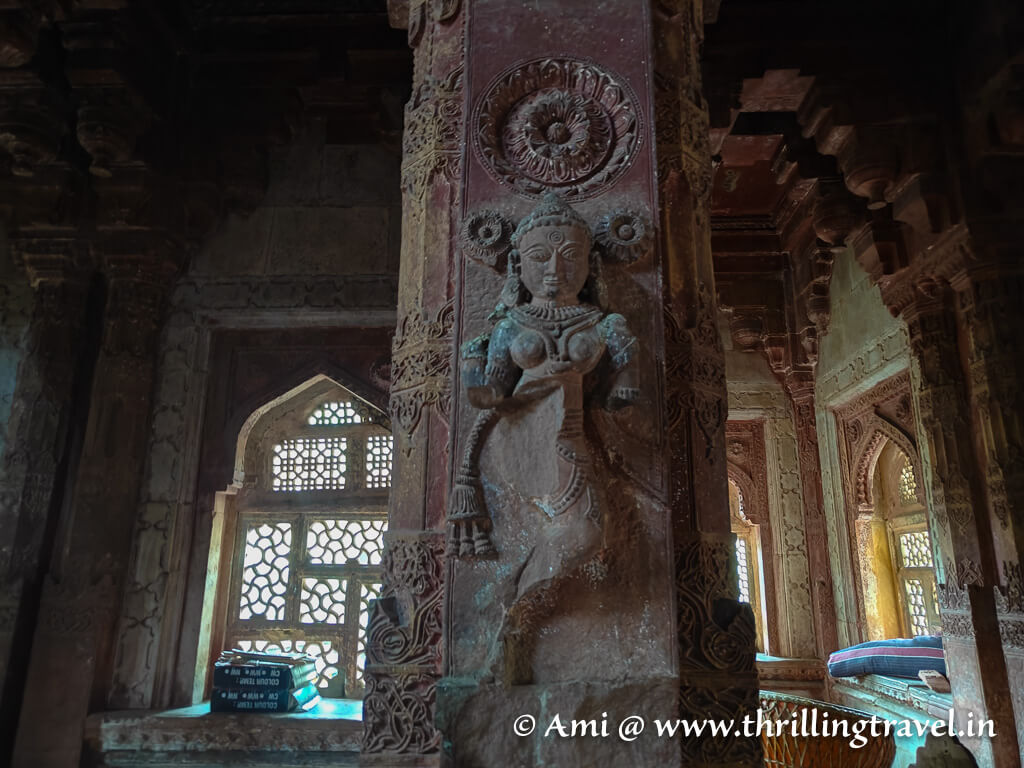
Inside, the ceiling and pillars of the assembly hall have 17th-century frescoes — faded now, but still visible — and the sanctum holds the black marble Krishna idol that Meera Bai – the latter placed a little lower than her Lord to show her respect.
Even the miniature shrine of Garuda outside is a sight to behold. I can go on and on about this gorgeous temple all of which I have covered in detail in this post.
Alternative routes for the heritage trail of Amer Town (Other places to see near Amer Fort, Jaipur)

The walking trail I have described above covers the heart of Amer town. But if you have more time — or if you want to return on another day — there are a few more places in and around Amer that deserve your attention.
As I mentioned earlier, you can either begin at Panna Meena ka Kund or Jagat Shiromani temple and follow the same route through the town. However, you have three options to extend this route and enjoy the things to see in Amer.
Trust me, there are so many other hidden gems here and of course, a few in plain sight. Here are your alternatives.
Alternative route one – Amer Fort walls, Kheri Gate and Anokhi Museum
This is the extension I would recommend to anyone with a love for hiking and around 2 – 3 hours to spare (preferably in the morning). Before you start the main trail from Panna Meena ka Kund, you can head to Kheri gate, finish a hike, come back and visit the Anokhi museum. Then you can continue following the original walk from Panna Meena ka Kund. Here is a short brief on the stops along the way –
Kheri Gate
Kheri Gate is one of the original fortified gateways of Amer town, still standing in the lane exactly where it has stood for centuries, with local residents walking past it without giving it a second look. It was one of the main gates to enter the Amer town – the first line of protection for its residents back in those days.
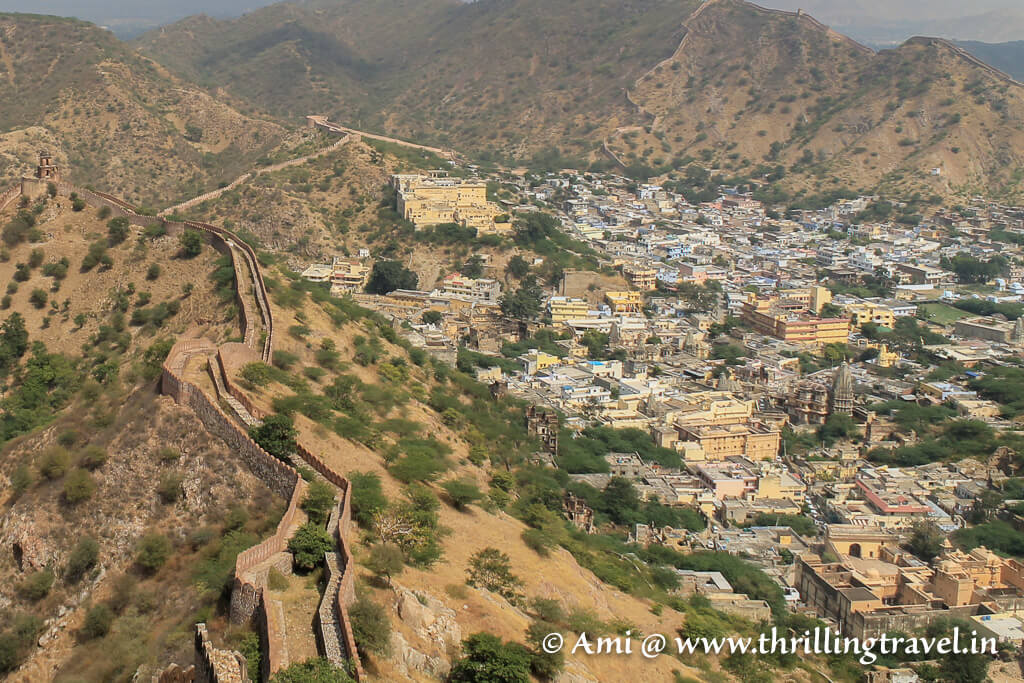
Today, it is your gateway to climb the 3rd-longest wall in the world – the Amer Fort wall.

Amer Fort wall and Sagar lake
From Kheri Gate, the Amer Wall trek begins. You can walk around 100 m uphill along the old stairs and then take a right that will take you to a lovely view of Sagar Lake. The lake is actually a reservoir built by Sawai Jai Singh II for rainwater harvesting. In the monsoon it overflows in a small waterfall that is a well-kept secret by the locals.
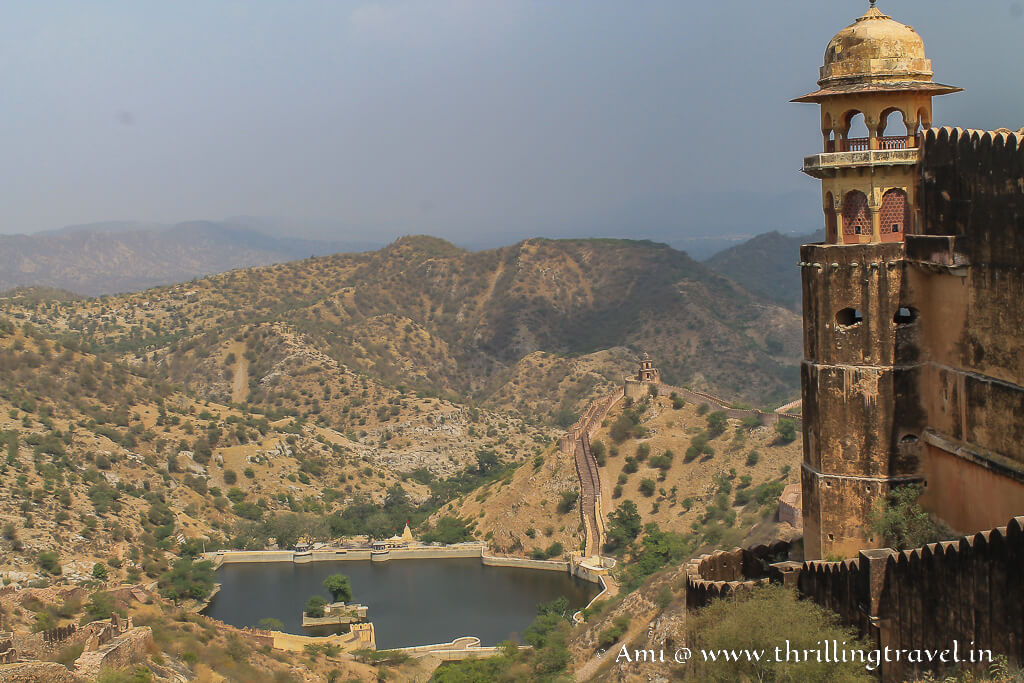
You can turn back from here and get back to the gate or continue on the stairs of the wall that has numerous watchtowers with stunning views of Amer Fort, Jaigarh Fort, Maota Lake and the hills beyond. A full loop will take you to a hidden Kuntalgarh Fort, but this will include a total distance of around 6 kms and almost 4 hours. So, if you do not have the time, I recommend getting back to Kheri gate.
If you just get to Sagar Lake and come back, you can finish up in an hour. Note that the trek is pretty much a do-it-yourself activity and you will not find anyone around. It is quite safe but do take a lot of water and wear appropriate shoes.
Anokhi Museum – former Chanwar Palkiwalon ki Haveli
Just beside the Kheri gate is a beautifully restored 16th-century mansion or haveli that used to be called Chanwar Palkiwalon ki Haveli. It is built along the perimeter walls of the town and was believed to have been owned by a distinguished family with a high military rank.

When Jaipur became the capital and people started leaving Amer for the new capital, this mansion too was abandoned. It fell into disrepair. A new owner bought it and restored it to its former glory in a manner that was recognized by UNESCO. Today it houses the Anokhi Museum of Hand Printing, which showcases the craft of block printing. Visit it for live demonstrations of this traditional art of Jaipur, its natural dye displays and a workshop where you can print your own textile.
Note that this has an entry fee of INR 80 and it is closed on Mondays.
Alternate route two – Narsingh ji ki Haveli, Old Amer palace, and Jaigarh Fort
This route takes you behind the main Amer Fort complex to a part of the town that very few visitors ever reach — and which contains some of the most layered history in this area.
Narsingh ji ki Haveii and Old Amer Palace

A little ahead of the Jagat Shiromani temple, you will find a seemingly large structure in ruins. A sign near its old gate marks it as Narsingh ji ki Haveli or Narsingh temple. When I visited last, there was a lot of restoration work happening here and I could not go in. However, from what I discovered, this was a temple dedicated to Lord Narsingh ji (Vishnu) built by the early Kachwaha kings. It is a part of the old Amer palace where they first resided.
The palace is popularly termed as Jodha Bai Palace where the famous princess, daughter of Man Singh I was born. She was the one who married the Mughal emperor Akbar. A lot of guides and historians mention this as the Kadimi palace.

The old palace of the Kachwahas was earlier accessible and included its own set of courtyards, Diwan-i-Aam, a hall where coronation used to take place, a Zenana Deorhi and many other apartments. Folklore has it that the first marriage of every king used to take place in the former Queen Balabai’s room (Saal).
There is an interesting tale that I heard attached to this room and ritual. Turns out that Queen Balabai’s husband, the King saw a group of ladies and addressed them as sisters. He did not realize his wife was a part of this troupe. The Queen took offense and renounced her marriage. She became a saint and lived her life in this room. She achieved a divinity that inspired newlyweds to visit the room to seek her blessings. Turns out even after her death, the room became a customary room for newlyweds to spend their first night in the hope of getting her blessings.
Narsinghji temple was built by the same queen and an idol gifted to her by a saint was kept here. Another story attached to this is that the saint had predicted that has long as this idol remained with the Kachwahas, they would rule Amer. Now whether it is coincidence or a divine truth, the idol was lost and the same year, the princely states of India were disbanded.
The place holds such a lure for me and I hope they restore it quickly so that I get to see this for myself. Maybe you might get lucky on your walk through Amer town and manage to see it before I do.
Jaigarh Fort – the protector fort
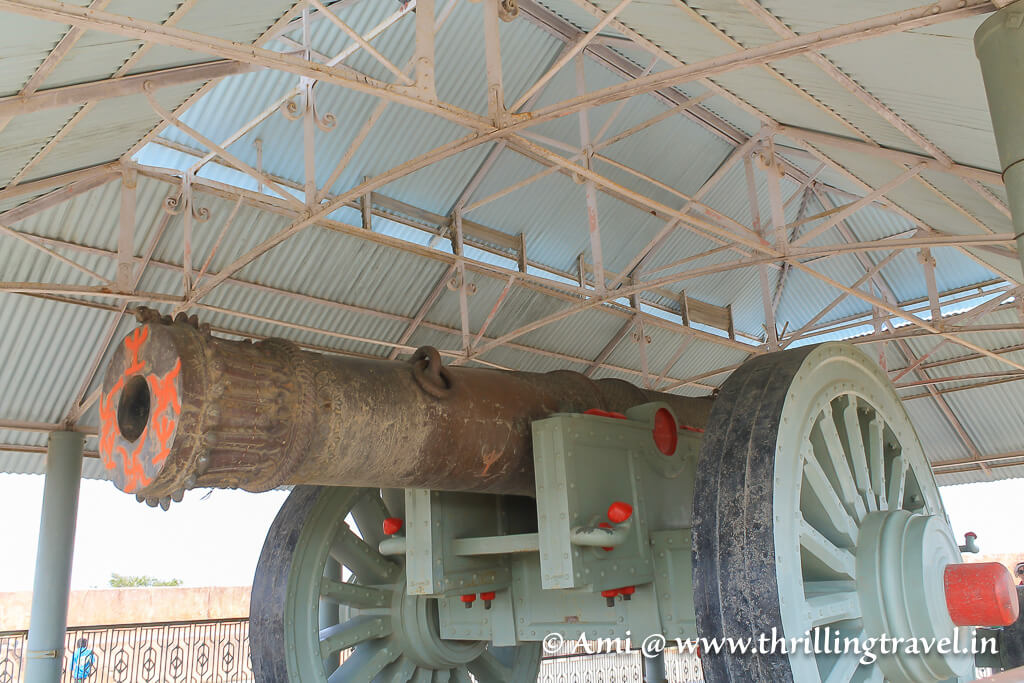
The hike to Jaigarh fort can take you anywhere between 30 – 45 minutes. The fort itself requires an hour to explore. I have put together this post dedicated to this fort with what to see inside and its various stories.
Jaigarh Fort was a military stronghold built to protect the Amer Palace below. It is connected to Amer Fort by an underground passage and houses the Jaivana Cannon — reportedly the largest wheeled cannon ever built. Just a fun fact for you to know – this was never used and was only test-fired exactly once in the 18th century. The cannonball allegedly landed several kilometres away near a village that was flooded by the impact. The views from Jaigarh’s ramparts over the entire Amer valley are the finest available anywhere in the area.
I highly recommend a visit here – even if you do not include it as a part of your Amer town walking itinerary.
Alternate route three – Old Amer Palace, Choor Singh ki Haveli, other havelis and Amer town center
I recommend this route for anyone who wants to understand not just the temples and monuments of Amer but the residential fabric of the town — the lives of the courtiers, merchants and nobles who built and occupied the havelis that line its lanes.
It is similar to the 2nd alternative route except that instead of continuing up to Jaigarh fort, you go around Amer fort and find the first spot – a long-forgotten seven-storey haveli.
Choor Singh ki Haveli (Shur Singh ki haveli)
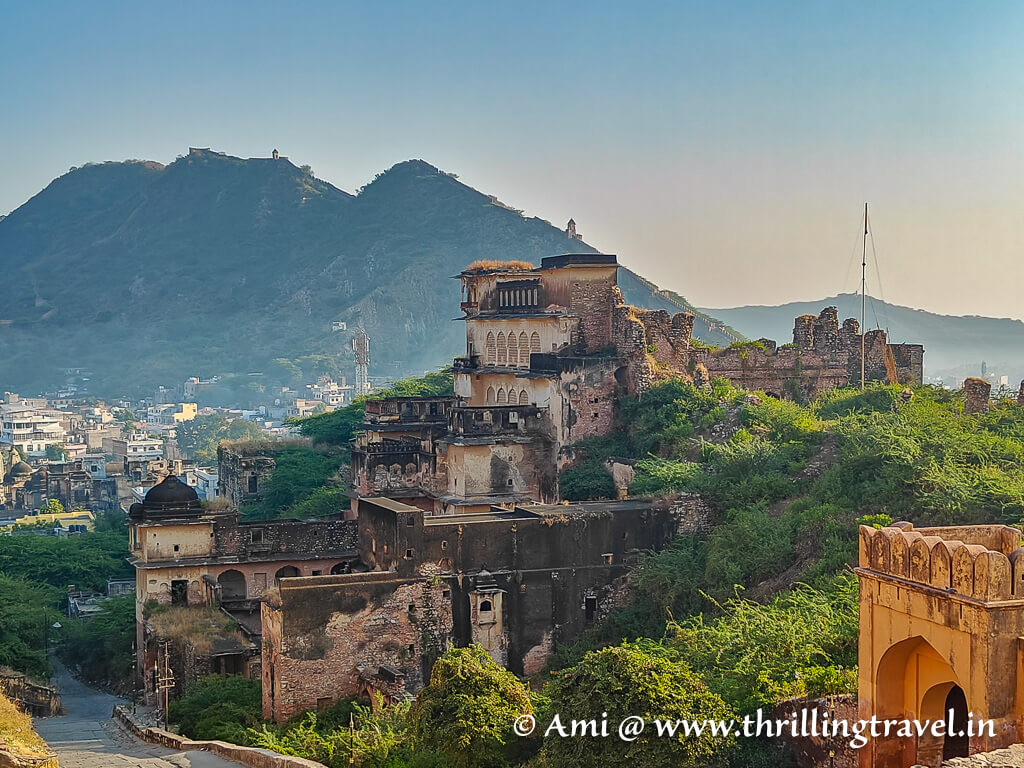
It is not just the fact that this has seven floors that will awe you but that it uses the Aravali hills as its support. Though in ruins, this is quite an impressive-looking mansion with jhali windows, courtyards and pillared corridors. Even in its faded state, it looks majestic and clearly indicates a family of importance. Add this to the fact that this is in such proximity to the fort of Amer. So who was the owner?
Most guides attribute the ownership to a Meena chief – Shoor Singh ji or Choor Singh ji. The Meenas, though overpowered by the Kachwahas were still inhabitants of Amer. More importantly, they became their allies and found important positions in the court and their army. Shur Singh was one of their chiefs and clearly important enough to have a mansion like this.

I am on a quest to find out more about him and this haveli but for now, this is all I know of it. The haveli is in a dilapidated state and one cannot venture inside. The place is under dispute, owing to which all the restoration work has been halted. That, honestly, is a sad state of affairs – given the wealth of this heritage haveli. I hope the authorities resolve it quickly enough to preserve this mysterious mansion.
Other miscellaneous havelis of Amer

From Chur Singh ki haveli, you just descend into the hustling town and, along the way, enjoy the various other mansions and temples. The town has dozens of living temples and is quite populated even today. You will see many frescoed havelis – with signs of life and lots of others that have been long abandoned. (Kind of reminded me of the havelis of Shekhawati)
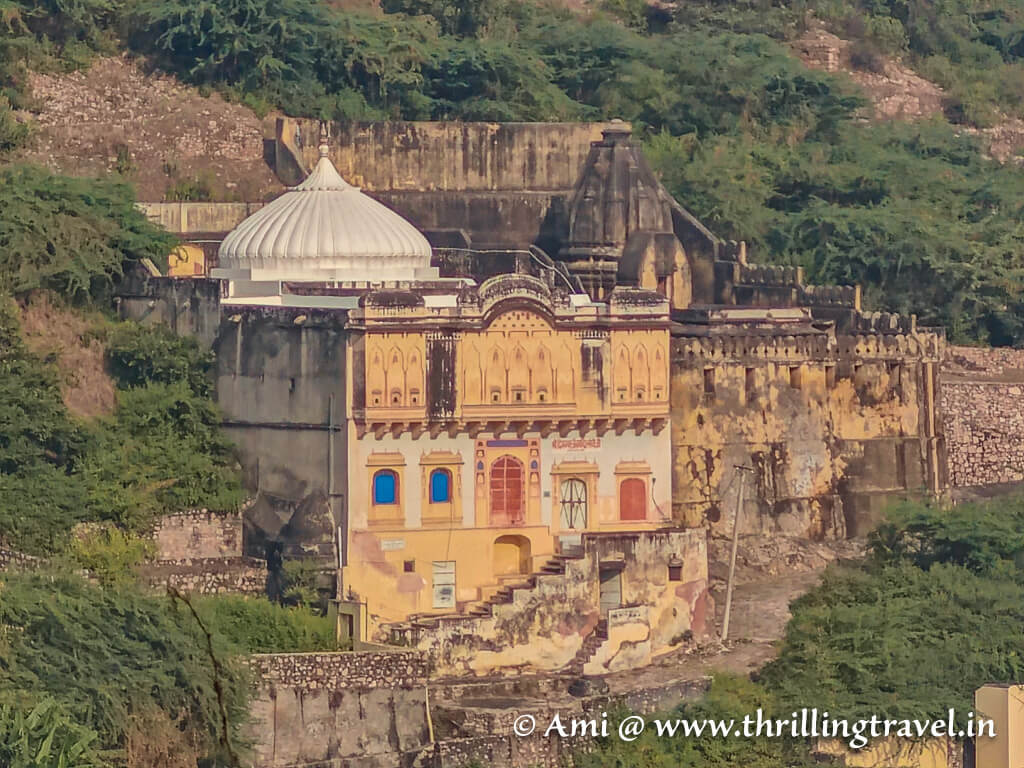
There are a few that have been converted into home-stays – which you can definitely opt for it you plan to explore this region in detail. With the Amer wall hikes, tons of temples near Amer fort, cultural sound and light shows – there are tons of things to do in Amer. A home-stay here would help you do justice to the town.
Amer specialty snacks and sweets at Ganesh Chowk

Eventually, you will find your way to the main road of Amer town (the one that you possibly came in from Jaipur). On this road, you will see tons of snack shops. Don’t just dismiss them. Enter one of them and feast a little on the kachoris that are a traditional breakfast or snack in this part of the world. There is a variety – pyaaz ki kachori (onion kachori), hing ki kachori, kachori in kadhi etc
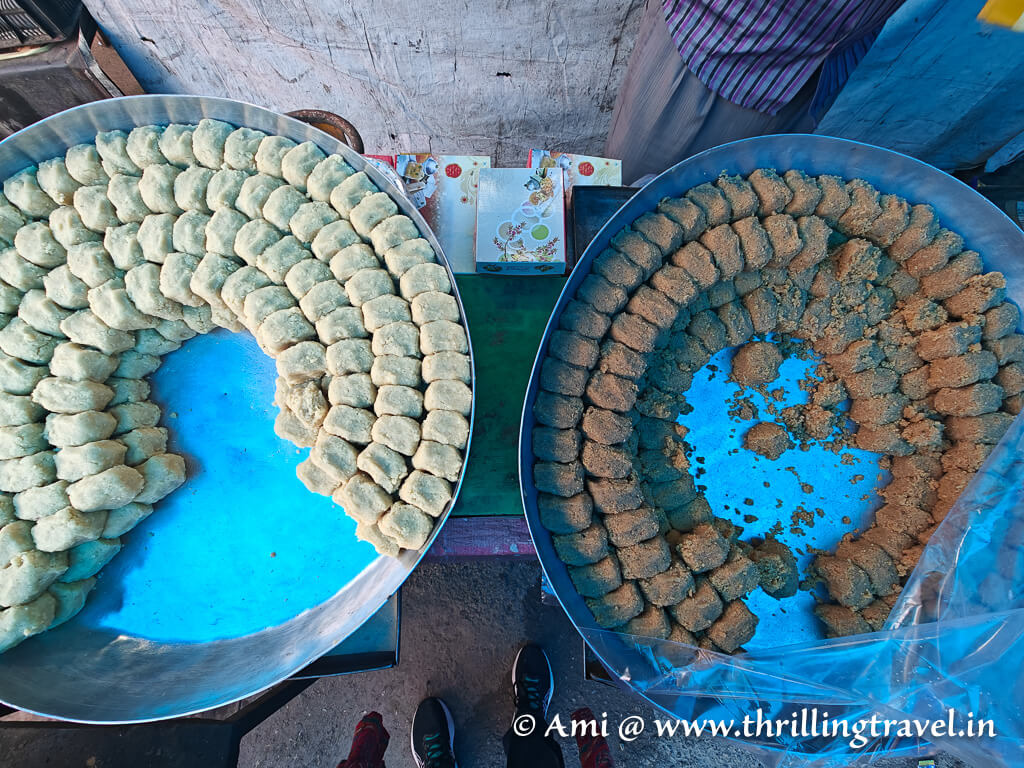
Don’t forget to try their gujiya – the fried snacks that look similar but actually have flavors. The most important and oft missed sweet is called “Gunji”. The local tale around this sweet is that for centuries, this was made in Amer and is the offering made to Sila Mata (the deity of Kachwaha clan) whose temple is in Amer Fort. This is especially during the Navaratri festival and even to date, this tradition continues.
Gunji is made only in Amer and you will not find it in Jaipur city. I would say it makes a perfect end to this amazing Amer heritage and cultural walking tour.
What is the best time to do the Amer Heritage Walk?
I would strongly recommend the October to March window for a walking trail of Amer town. The days are clear, the temperature is manageable for walking — rarely climbing above 25°C in the peak winter months — and the morning light on the sandstone temples and the stepwell is at its most beautiful. December and January are the coolest months, which makes the uphill sections of the Amer wall trek considerably more pleasant than they would be in April.
April and May are doable but demanding. Temperatures in the Jaipur region regularly cross 40°C by mid-April, and walking cobblestone lanes between 10 am and 4 pm in that heat is genuinely unpleasant. If you are visiting in summer, restrict your walk to early morning — start by 7 am, finish by 10 am, and return for the temples in the late afternoon.
The monsoon months — July to September — are a different kind of beautiful. The Aravallis turn green almost overnight, Sagar Lake fills and overflows, and Panna Meena Ka Kund rises to its most dramatic water level. The tradeoff is humidity, occasional flooding of the lower lanes, and the Ambikeshwar sanctum potentially being inaccessible due to water.

In terms of timing,.7 am is ideal for the main walking trail — the lanes are quiet, the light on the Kund is extraordinary, the temples are less crowded and the priests at the Jagat Shiromani are performing the morning aarti. By 10 am, tourist groups begin arriving and the atmosphere shifts noticeably.
If you are combining the town walk with the Amer wall trek, start even earlier — 6 am at Kheri Gate gives you the sunrise from the watchtowers before the heat builds.
For those who prefer evenings, the Jagat Shiromani Temple between 6 pm and 8 pm is a compelling reason to return — the evening aarti in the golden light, with the temple lit and the lanes cooling, is one of the nicest experiences Amer has to offer.
How to Get to Amer Town
Amer town sits just 12 kilometres north of Jaipur city centre on the Delhi Highway (NH 48) — an easy trip from anywhere in the city.
By bus:
The most budget-friendly option. Buses run from Ajmeri Gate and Badi Chaupar in Jaipur’s old city roughly every ten minutes, taking 40 minutes to an hour. The fare is ₹20–40 per person. Ask to be dropped at Amer town or the Jagat Shiromani Temple stop rather than the fort parking.
By cab or auto-rickshaw:
App-based cabs via Ola, Uber or Rapido run around ₹250–350 from the city centre; an auto runs ₹150–250. I would recommend booking a cab for the day rather than a one-way drop — Amer town can take longer than expected and finding return transport from outside the fort parking at the end of a long walk is more effort than it is worth.
By your own vehicle:
A straightforward drive via the Jal Mahal road. Parking near Maota Lake at the base of the fort is the easiest option. There is also informal parking closer to the Jagat Shiromani Temple for those starting the town walk — arrive early as it fills up by mid-morning.
Tips for Amer Old Town walk
Here are some of my tips to prepare for a good walk through Amer town.
- Carry enough water – especially if you are heading for the Amer wall hike.
- Wear comfortable shoes and sleeved clothes (since you are visiting temples)
- There are quite a few places to eat in Amer – from cafes to dhaba style food.
- There are restrooms at Panna Meena ka Kund and Anokhi museum, Amer
Common FAQs about the Amer cultural walk?
How long does the Amer town walking trail take?
The main trail — Panna Meena Ka Kund, Bihari Ji Temple, Ambikeshwar Mahadev and Jagat Shiromani — takes around two to two and a half hours at a comfortable pace. Add half a day if you are combining it with Amer Fort, and a full day if you are doing any of the alternative routes including the wall trek.
Is Amer town the same as Amer Fort?
No — and this is the most common source of confusion among first-time visitors. Amer Fort is the grand hilltop fortress that most people come to Amer to see. Amer town is the settlement at the base of the hill — the lanes, temples, stepwells and havelis where the people who built and served the fort actually lived. They are in the same location but are two very different experiences. This post is about the town. For the fort, I have a separate guide
Can I do the Amer town walk without a guide?
Yes, comfortably. The main trail is compact and easy to navigate. What you will miss without a guide is the stories — and in Amer town, the stories are half the experience. If you are doing the walk for the first time, I would recommend at least a half-day guided heritage walk so that you have the context. You can then return on your own for a second, slower wander. For the wall trek beyond Kheri Gate, a local guide is advisable on the first visit.
Can I combine the Amer town walk with a visit to Amer Fort in a single day?
Yes — and I would actually recommend doing the town walk first, before you go up to the fort. Walking the lanes, standing in the Jagat Shiromani temple and understanding the Kachwaha history at ground level makes the fort itself far more meaningful when you arrive at it. A half day for the town walk in the morning, followed by the fort in the afternoon, is a very satisfying full day in Amer.
Is Amer Town Safe?
Entirely. Amer is a settled residential town with an active community and regular tourist footfall near the fort. The lanes are busy with locals during the day and the main temple areas are well-frequented. The one practical caution I would add is for the wall trek — do not attempt the upper sections alone on a first visit, and inform your hotel or someone in Amer town of your route if you are going beyond Sagar Lake. The ridge trails are isolated and phone signal can be patchy in places.
Before you go, pin this




Popularly referred to as a Restless Ball of Energy. My Mom refuses to entertain my complaints about my equally restless daughter & assures my husband that I was born with a travel bug.
I am a Post-Graduate in Marketing by qualification and a travel blogger by passion. Besides travel, I enjoy photography and if you don’t find me at my desk, I would be out playing badminton or swimming or just running. I believe in planning for every long weekend through the year. And when I cannot travel physically, I travel virtually through this travel blog. My travel stories have also, got published on various websites and magazines including BBC Travel, Lonely Planet India and Jetwings. I have recently published my first book – When Places Come Alive – a collection of stories that are based on legends, landscapes, art and culture of a place which is available in both ebook and paperback format.
You might also like these posts –
- How to plan a perfect Amer fort tour in Jaipur (what to see, tickets, timings & insider tips for 2026)
- The Jagat Shiromani Temple story – The History, Architecture & legacy of Meera Bai mandir in Amer, Jaipur
- Jaipur City Palace Royal Tour: Experience the Grandeur of Royalty
- All the things that will make you go WOW at the City Palace Jaipur
- How to plan a trip from Delhi to Jaipur by road?
- Inside the Palace of Winds: A Guide to Hawa Mahal Jaipur
- Tour of the Jantar Mantar in Jaipur
- A guide to a must-do heritage walk in Jaipur (includes insider tips on what to see & how to plan a Jaipur old city walk)
- 10 travel tips for Rajasthan
- The intriguing Jal Mahal in Jaipur
- Sisodia Rani Bagh: A royal tryst with nature
- Secrets of the Jaigarh Fort in Jaipur
- Best areas to pick hotels in Jaipur
- Places to see in Jaipur over 3 days