
Encircled by the World’s 3rd longest wall
Perched on a hill, lies an old palace with its stunning halls.
Walk through the painted gates, past the mirror courts
And marvel at the architecture outside and inside the Amer fort.

Discover one of the must-visit destinations of Jaipur with this Amer fort guide. Learn about what to see inside Amer fort while getting insider tips on how to book the perfect Amer palace tour. From bookings to timings and the best way to enter - it is all covered in this mega guide.
You have not seen the Pink City properly if you have not visited the Amer Fort, Jaipur. Dating back much before the city of Jaipur, this UNESCO World Heritage site was the powerhouse of the rulers. What started as a small fort in the 10th century, Jaipur’s Amer is a fairly well-recognized landmark – a big thanks to movies like the famous Jodha Akbar. I cannot deny that my first visit to Amer Fort was highly colored by popular literature, and I also admit – I was NOT disappointed.

There is so much more to the Amber Fort or Amer Fort than what is portrayed in the trending travel articles and movies. The ancient walls have so many untold stories that one Amer Fort visit cannot uncover. Despite my umpteen visits (more than five now), I continue to piece together chapters that make up the Amer Fort story. One visit is not enough for a complete tour of Amer Fort. That said, with this definitive travel guide to Amer Fort of Jaipur, you are in luck. I have not just covered the popular attractions inside Amer Fort but the rare ones too.
This blog post aims to prepare you to visit Amer Fort and the palace in Jaipur. From what to see in Amer fort, its phenomenal architecture and history, how to book and when to visit, I have jotted it all down. I have also, included tips on the best route to explore Amber Fort. There are suggestions on the Amer fort light and sound shows as well as other places to visit near the fort.
So, without much ado – let’s get the virtual Amer fort tour started.
Quick links for a Jaipur Amer Fort visit
In case you are looking for some quick links to tours, places to stay and travel accessories for your Jaipur – specifically Amer Fort trip, you can consider using these online options.
- Booking.com has several good Jaipur stays listed on their site. These range from luxury hotels to mid-prices havelis, homestays and hostels. I have also got this post on the localities and areas where you can plan to stay for your Jaipur visit.
- GetYourGuide is a good resource with tons of Jaipur tours including heritage walks and cycling tours. You can check these five related that could work for you –
- Viator.com is another online resource for booking walking tours, transfers and guided tours in Jaipur. Here are five that you might want to consider for this visit.
- For any of your travel needs or general shopping, consider using Amazon through this link.
Disclaimer: This article includes affiliate links. This means that at no cost to you, I will receive a small commission if you purchase through my link. Thank you for supporting me with this.
The Amer fort story (History of Amer Fort, Jaipur)
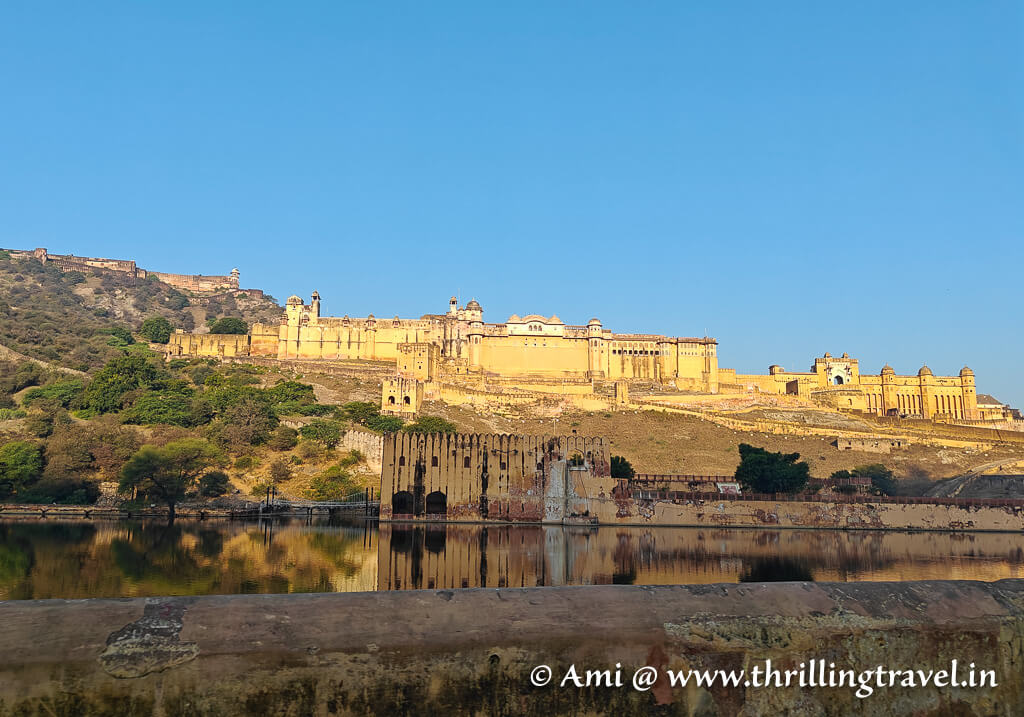
I guess, most of you may have heard of the Navratanas (9 gems) of Emperor Akbar – Birbal being one of the key ones? Well, belonging to the same Navratanas was Raja Man Singh I – the ruler of Amer. It is him who is credited for having built the current structure. However, this was not the first palace.
Long before Raja Man Singh and the Kachwahas dynasty, Amer existed as a small hill kingdom called Dhundhar under the Meenas clan. The Meena tribe built a smaller palace, that can still be seen behind the main Amer Fort. This is called the Kadimi Mahal.

In the 10th century, rhe Meenas were overthrown by the mighty Kachwaha dynasty who were originally rulers of Gwalior. The new rulers occupied the Kadimi Mahal. Its the Amer fort story goes, this palace is believed to be where the famous princess Jodha Bai (who married Akbar) was born and hence, now this palace is popularly referred to as the Jodha palace.
The present day Amer Fort history can be traced back to its foundation in the 967 AD, that was actually laid by Raja Alan Singh from the Meena clan. However, for a long time, nothing was built over it. In the late 1500s, Maharaja Man Singh built over this foundation and his successor – Maharaja Jai Singh I expanded this palace. The royal family lived here till their capital moved to the present day Jaipur. This is when their dwelling shifted to the Jaipur City Palace.
Renowned for its artistic splendor and defensive architecture, in 2013, Amer fort along with 5 other forts of Rajasthan was awarded a UNESCO World Heritage tag of “Hill forts of Rajasthan).
Is Amer fort and Amber fort the same?

Many of you might be wondering if I got the name right – Is it Amer Fort? Or is it Amber Fort?
Well, it is one and the same. There are various stories surrounding the original name – Amer and the anglicized version – Amber. The one that I have heard the most from various guides is that the capital town of Dhundhar kingdom was called Ambikeshwar after the Amba Mata temple that was built on top of the hill called Cheel ka Teela (Hill of the Eagles). The same was shortened to Amer.
Another version of this story is that it was named after the Ambikeshwar Mahadev temple – one of the oldest temples of the town. Either way, the name Amer was mispronounced by the British and it later became Amber.
What is the best way to get to Amer fort?
Jaipur is well connected to all Indian cities via flights, trains and roads. It is part of the famous Golden Triangle and if you are on one of those tours, then you are sure to visit Amer Fort.
The distance between Jaipur city and Amer fort is just 12 kilometer and if you are not a part of tour and want to visit, then here are the best options –
Visiting Amer fort by bus
There are several tourist buses, Government buses, and private taxis that take you from Jaipur to Amer Fort. You will find quite a few near Ajmeri gate and Badi Chaupar in Jaipur. The frequency is almost every 10 minutes. The total journey time might range from 40 minutes to 1 hour and the price per person is between INR 20 – 40, depending on the type of bus.

By car
If you have your own car, you can just drive to Amer fort. It is a pretty straightforward road from the city via Jal Mahal to the fort.
There is a designated parking space near Maota lake or you can climb up and try to find a parking at the back entrance. The latter is however, quite difficult as the parking is almost always full. I would recommend the parking space near Maota lake.
By taxi or tuk-tuk
This is possibly the most convenient where you do not have hassles of parking. You can book a cab using one of the many app-based services like Uber, Ola or Rapid. The average price would be around INR 300 for a drop to the fort. I found it easy to get a return cab too, from the app – which saved me a lot of waiting charges.
That said, some of you might not want to take a chance on your return journey. If that is the case, then just book a transfer using the booking resources I have shared or hire a cab for a day from one of the local vendors. Most hotels have a travel desk from where you can avail this service.
What is the best time to visit Amer Fort Jaipur?
Jaipur is extremely hot during summers – i.e – from April to June. Besides these months, the rest of the year is good for a visit. Winters between November to February would be the most pleasant.
Monsoons – that is between June to September can be dampening. It can be a little painful with the crowds sheltering at various points – and trust me, there is a lot of crowd.
The Jaipur Amer fort timings are from 7 am to 9 pm. This is the case on all days except for Holi (usually falls in March) when Amer fort is closed for public. Being a key tourist attraction in Jaipur, it is almost always crowded. Also, its scenic backdrop makes it popular with wedding photographers and you might find yourself almost always photobombing a few of them – unintentionally.
The best time to visit Amer fort and avoid excessive would be reach there by 7 am. The crowd usually starts pouring in after 9:30 am – which gives you a good one and half hour to explore Amer fort. Once you are done, you can even visit the places near Amer fort including Jaigarh fort.
Amer Fort has a beautiful light and sound show in the evening. The one in English starts at 7:30 pm while the one in Hindi is at 8 pm. If you wish to attend the same, I recommend reaching the fort by 4 pm and then attending the show. However, be prepared for the crowd.

Booking your Amer fort tour and tickets
Amer fort ticket prices
As of 2026, the Amer fort entrance fees for Indians are INR 200 while for foreign tourists, the price would be INR 1000. This is an increase from the earlier amount of INR 100 for Indians and INR 500 for foreigners – the first in the last 10 years and a much needed one to preserve the heritage fort from the heavy footfalls that it has been receiving.
There is a composite ticket that includes all state-controlled monuments, museums and art galleries attractions of Jaipur. It is valid for 10 days and if you are planning to visit these attractions, it might be worthwhile to get that ticket. The composite tickets cost INR 1300 for Indians and INR 5500 for foreigners.
The Amer Fort Light and Sound in English show costs INR 200. The Hindi one is priced at INR 100.

Where to book the Amer Fort tickets?
All the tickets are available at the Amer fort entrance. However, I would urge you to beat the crowd and book the tickets online through the official site. Note, though, that you can only book the Amber Fort tickets on this site.
Composite tickets are available only offline at the entrance of any one of the Jaipur attractions included. The light and sound show at Amer Fort can only be booked at the entrance of the fort or through one of the links mentioned in the quick links section of this blog post. The links also, include tours of Amer Fort with a guide and a few other attractions. It might be worthwhile to pick that and get one of these Amber Fort tours. Check them out for their traveler reviews and book one for yourself.
Should I hire a guide for Amer Fort? What would be the charges?
I always recommend hiring an Amer Fort guide for first timers. While this Jaipur fort is well-marked with signage, it is always good to have someone to pinpoint various treasures hidden inside Amer Fort.
There are fixed rates for the state guides and as of my last visit in January 2026, for a group of one to four people, it is INR 400.
You also have the option of hiring a guide online (check the Quick links section of this blog) or downloading an Amer Fort audio guide.
How to enter Amer Fort?
Located along the Aravalli hill range, there is a bit of climbing required to enter the fort. There are two Amer Fort entrances – Suraj Pol, which is widely recognized as the front entrance and rear gate called Chand Pol.
I recommend that you enter either one of these gates and use the other to exit. That way, you get the best of both worlds.
Entering through Suraj Pol at Amer Fort
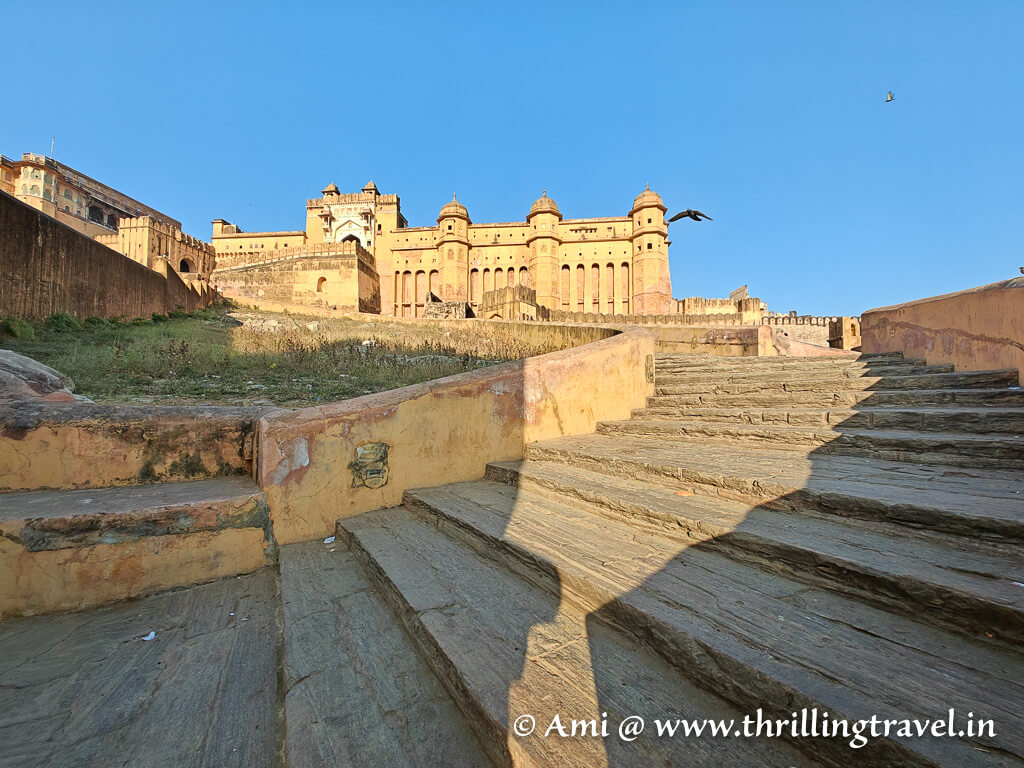
Use the 500-step staircase. Sounds daunting, but trust me, it is not. Climbing up the Amer Fort stairs is fairly easy, with enough viewpoints to take in the gorgeous views of Maota Lake, Kesar Kyaari, Amer town, and the mighty wall along the hills. Of course, there are a few hidden gems that you will cross as you ascend.
With breaks, it will not take you more than 15 minutes to climb up and enter Amer Fort through Suraj Pol.
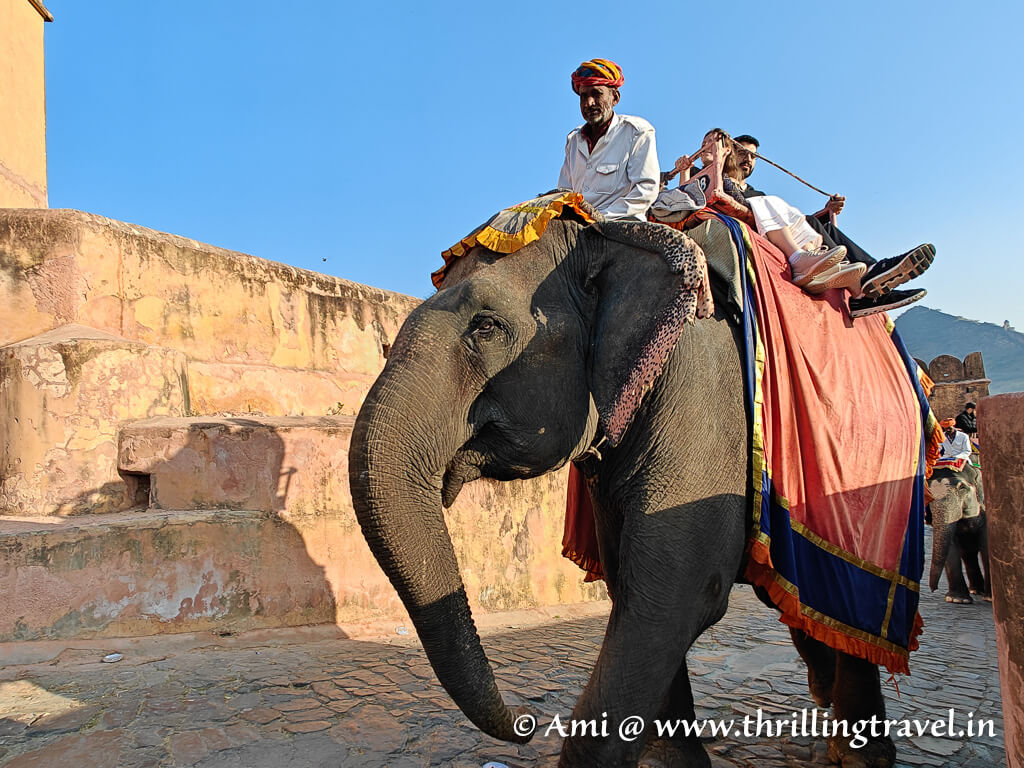
There is one more way you can scale up to the Suraj Pol – which I do not recommend owing to ethical concerns. This is the Amer Fort elephant ride, which costs INR 2500 for a couple. There are plenty of red flags on these, which you can check on the internet before deciding to opt for them.
If you are unable to climb up, then you can opt for the option that takes you to Chand Pol.
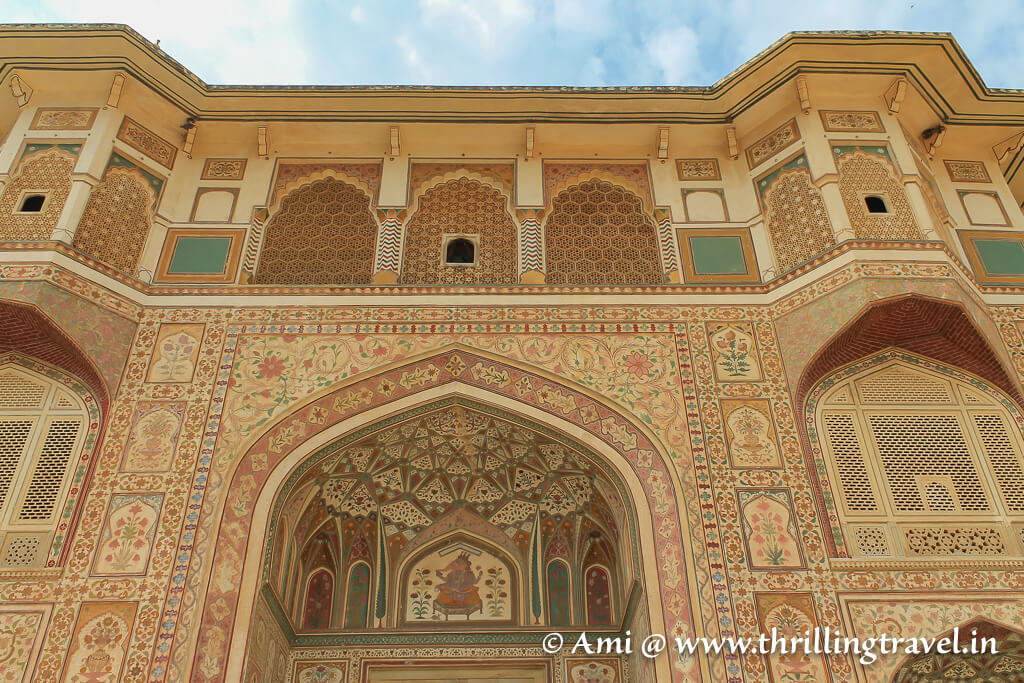
Entering through Chand Pol of Amer Fort
There are several jeeps that you will find at the base of Amer Fort, near the parking. These take you from the base directly to the rear entrance, eliminating the staircase hike. The drive is pretty quick and it takes you through a few lanes of Amer town, giving you a glimpse of the old capital.
An Amer Fort jeep ride price ranges between INR 500 – 800 for a round trip.
Alternatively, you can try an Amer town walk and climb up via the Jagat Shiromani temple. The climb is not very steep. It will save you a few pennies while at the same time, you get a good look at the temples and havelis along the way.
The layout and architecture of Amer Fort
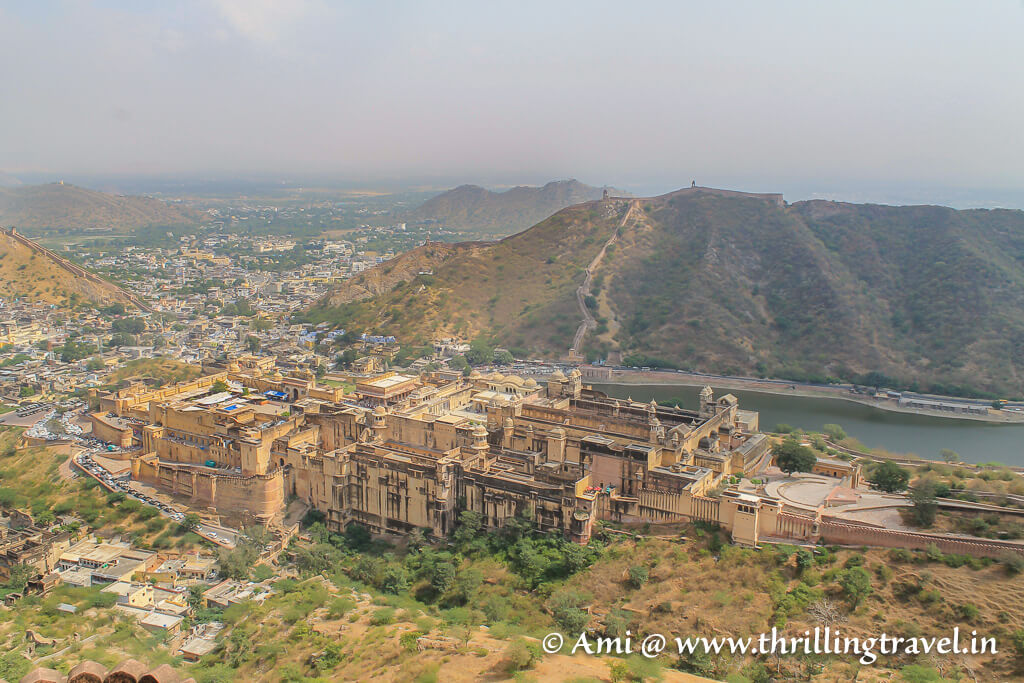
Amer Fort is an intriguing amalgamation of engineering and aesthetics, where on one hand, you will be amazed with their climatic adaptations and effective defense mechanisms. And on the other hand, you will be floored with its glamorous interiors and vibrant facades. A mix of red sandstone and marble, the architecture of Amer Fort can be best explained as a fusion of Rajputana style and Mughal architecture. I shall point out these nuances as we do a virtual walkthrough inside Amer Fort.
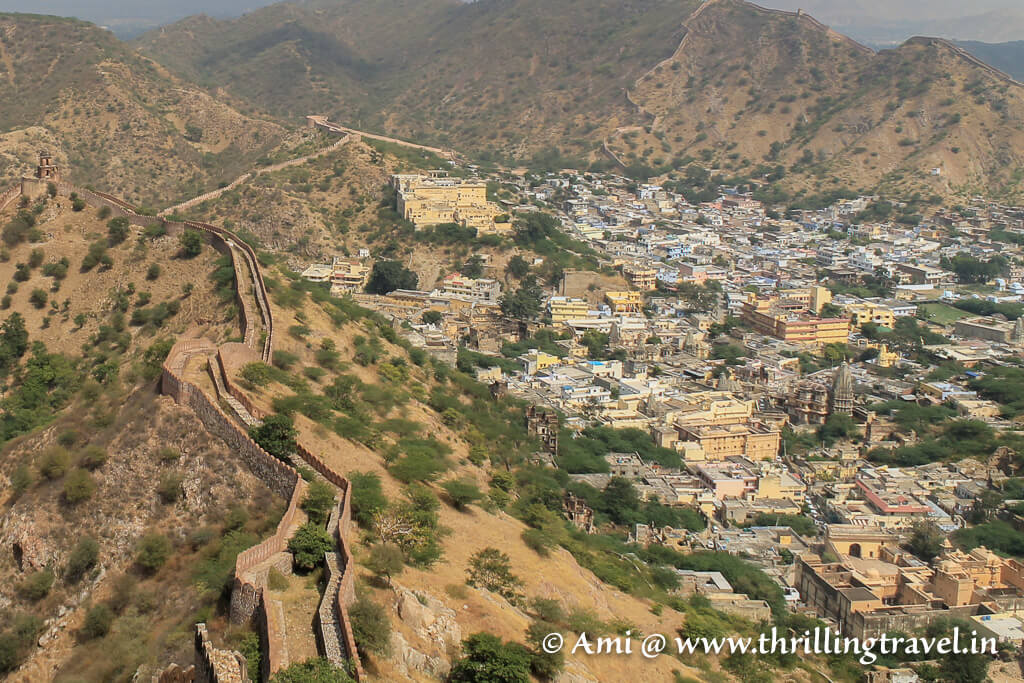
In terms of the layout, the basic structure of this fort includes 2 major entrance gates and 4 different courtyards. The courtyards are interconnected, and each serves a specific purpose. Surrounding the fort is a long Amer fort wall with various look-out points. In fact, it extends to over 15 kms and is deemed the 3rd longest wall of the world (after the Kumbhalgarh fort wall, which is the 2nd longest). This is one of the awe-striking facts about Amer Fort.
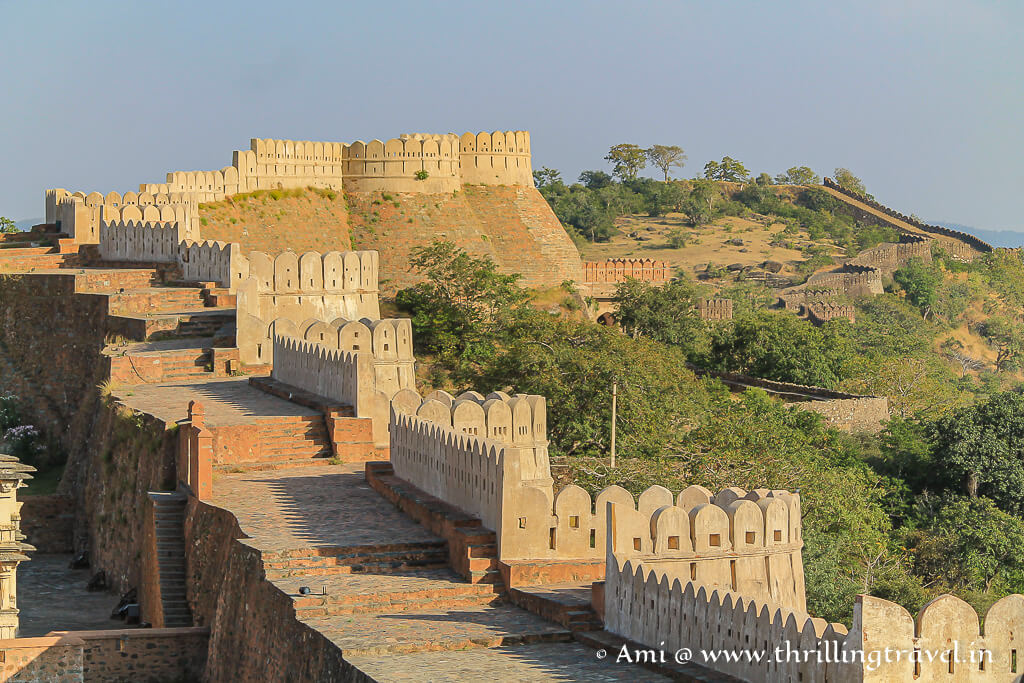
It might be India’s longest wall but the one at Kumbhalgarh Fort in Rajasthan is the World’s 2nd longest one after the Great wall of China. What is more, it is a part of the UNESCO World Heritage Site.
Surrounding the fort is Maota Lake in the front while there is Sagar Lake behind the fort. Both these lakes not only served as a water source for the Amer Fort palace but also, doubled up as a defensive barricade.
Secret passages, hidden corridors, and brilliant use of science for light and water are some of the key features of Amer Fort. In fact, the stories lurking around them will leave you in awe of the place. So, without much ado, let’s proceed with our tour of Amer Fort.
What to see inside Amer Fort, Jaipur?
Irrespective of how you get to Amer from Jaipur, you will cross the hillocks of Aravalli, and that is where you get a glimpse of Amer fort. The fort stands majestically against the hills with a shimmering Maota lake at its base. I have always heard a “Ooh” and “Ah” from my fellow travelers – especially those who are first-timers on this tour of Amer.
Once you have parked or gotten off your ride in front of the lake, you can take either of the two options to get to the main entrance. For this Amer fort guide, I am taking you along the stairs past Maota Lake to Suraj Pol.
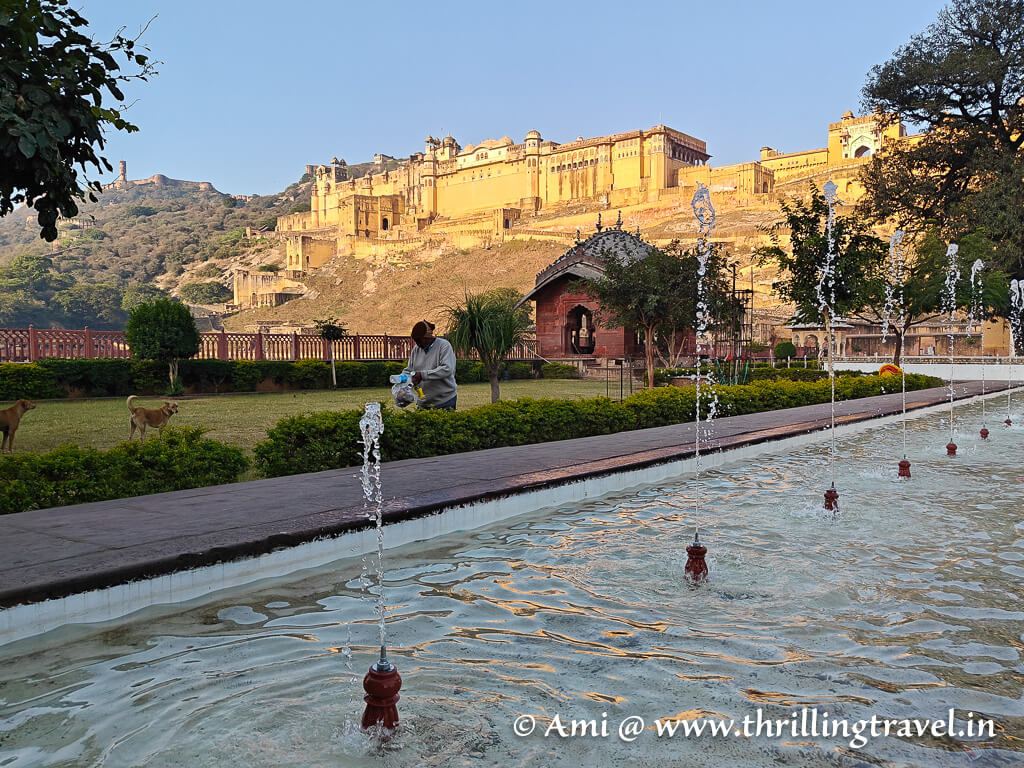
Dil-e-Aram Bagh – at the base of Amber Fort
You will enter a pleasant garden with a fountain-lined pathway that leads to a small building. Some Amer Fort experts peg this as a reception for guests, while others term it an office. A couple of Chattris or domed pavilions offer you a photo point to capture the lovely Maota Lake.
Before you proceed, let me share a couple of offbeat Amer fort attractions which most people tend to overlook in a quest to get to the top. Right by the entrance building – which incidentally is the Archaeological museum of Amer, there are a pair of red pillars with inscriptions. These were not originally part of the Amer but were discovered in a village called Barnala Yuup pillars. The sacrificial pillars date back to the 3rd century and include documentation of the sacrifices and offerings given to Lord Vishnu.
If you are passing through the Dil-e-Aram bagh around mid-morning and evening, you will find a lot of hawkers selling curios and artifacts here.
Kesar Kyaari Bagh – the saffron garden of Amer Qila

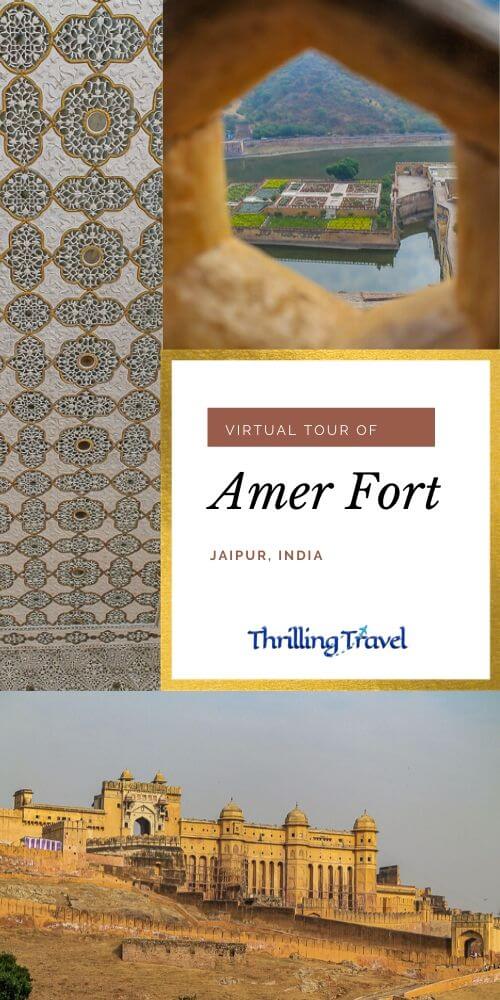
As you start ascending, you will get a clear view of what was the saffron garden of Amer fort. The gorgeous Kesar Kyaari Bagh set in the This unique Saffron Garden is set middle of Maota lake was like a landscape oasis for the royalty. The picturesque hexagonal park was a 16th century addition to Amer fort and one can still visit it during the light and sound show.
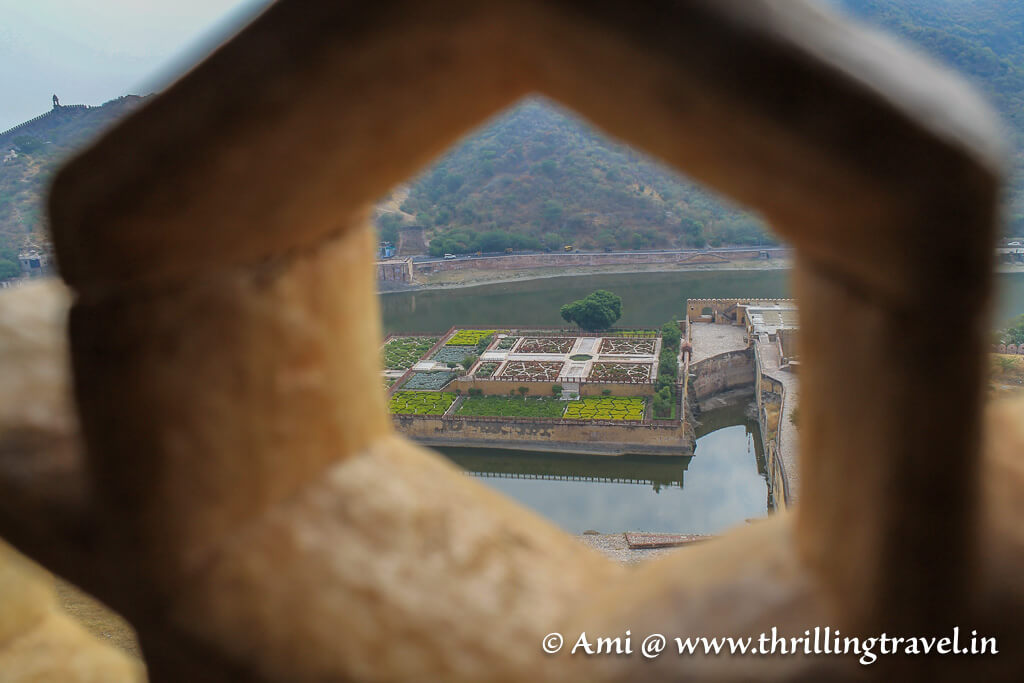
Personally, though, I think I got the best view of Amer’s Kesar Kyari garden through the lattice windows of Jas mandir and the royal washrooms (giggle!).
Fortifications, mandir, and the forgotten story of Choor Singh ki Haveli
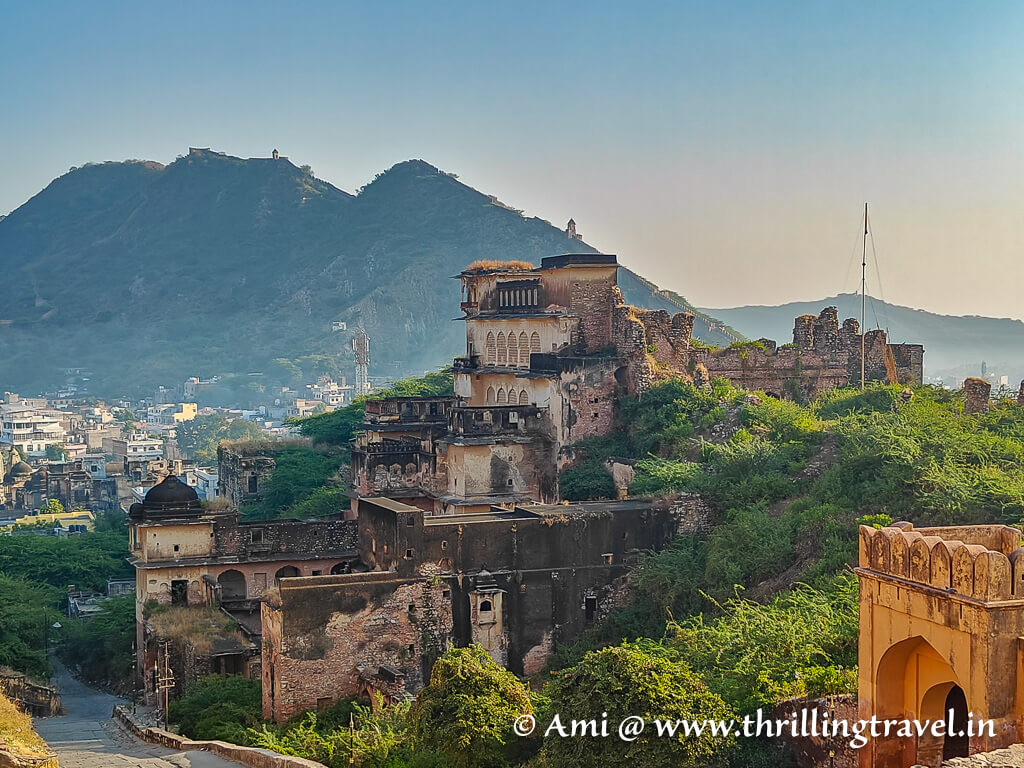
Over my last few visits, I have been climbing up to Suraj Pol and not once have I felt exhausted. The reason is the various forgotten attractions along the way. There is always a new fortification or barrack that I have spotted. And I am almost always fascinated by the forgotten mansion of a courtier (some guides say Meena chieftain) – Shoor Singh or Choor Singh.
His haveli lies abandoned but even in its crumbling state, it is very obvious that this was a grand one. Not much is known about it and almost every Amer guide has their own interpretation of the place. However, one thing that they all concur on is the ingenious manner in which it was constructed – using the support of the Aravalli hills as its back.
In one of my walks through Amer town, I passed it and I could see more than one courtyard and at least seven-floors of this Choor Singh ki haveli. You can learn more about this place in my Amer town walking tour post.
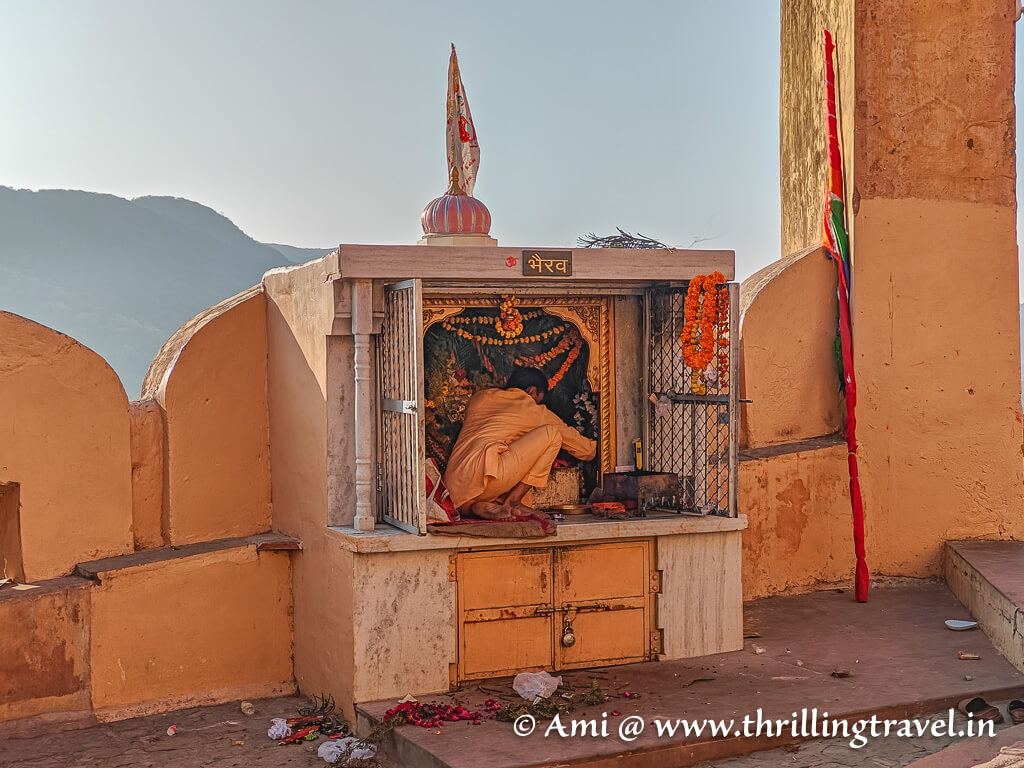
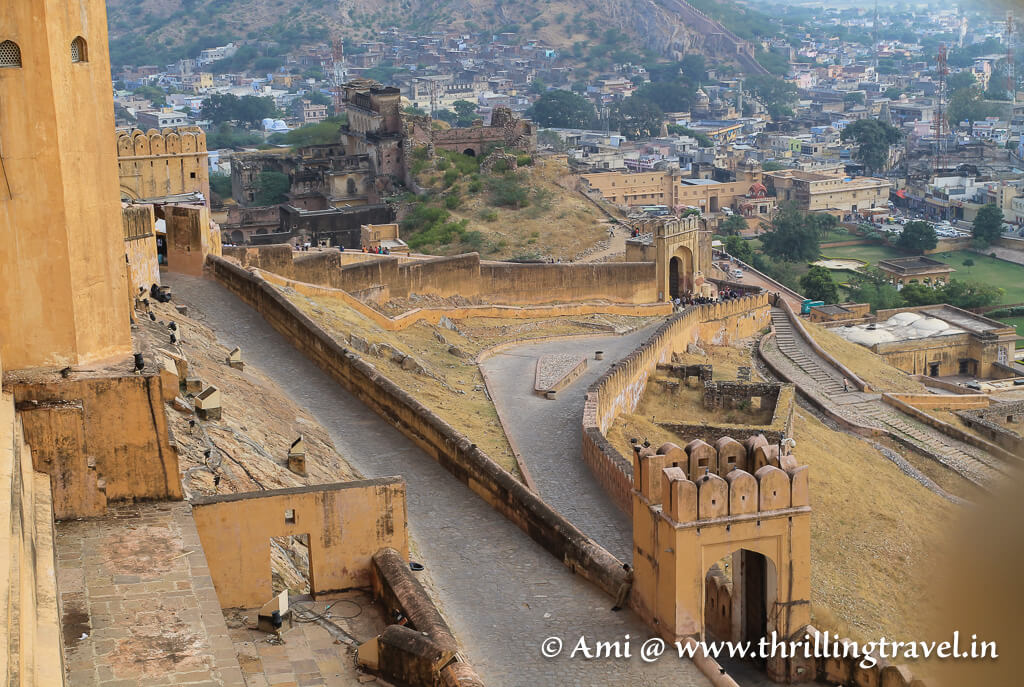
Notice the zig-zag pathway that makes it difficult for the enemy to attack. Almost at the top, you pass one arched doorway. Right next to it is a small shrine dedicated to Lord Bhairav (Lord Shiva). It is an active shrine and you will find a tiny temple shop from where you can buy offerings – if you wish.
Carry on further and bend around to finally see Suraj Pol – the main entrance to Amer Fort.
Suraj Pol – the main gate of Jaipur Amer fort
Facing the rising sun is the Sun Gate or Suraj Pol. Currently, the only way to enter this gate is by foot or on an elephant. While this might seem like a good experience, I would personally like to discourage you from this Amer Fort Elephant Ride for the reasons I shared earlier.
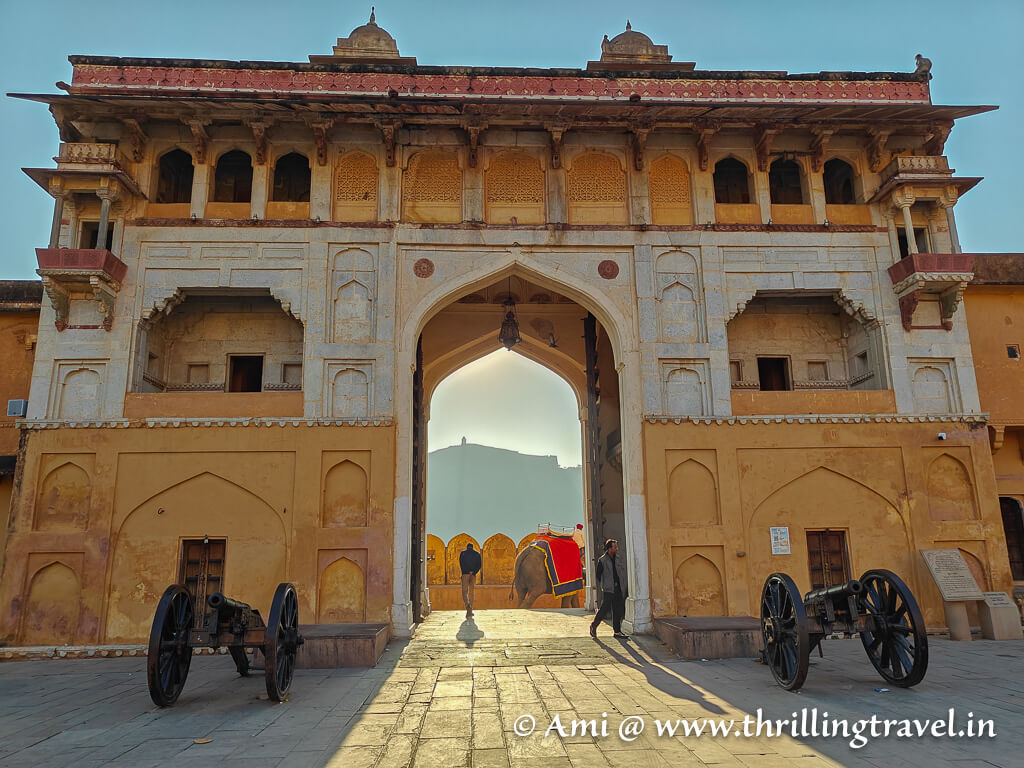
Sure, the elephants were used by the Kings in the bygone era to enter this very palace after their victory in various battles. Suraj Pol was used by the King and his army for a victory march. The lattice windows of the palace allowed the women to watch the procession while staying hidden from public view.
The gate has a few defensive features like spikes on the doors and above that, openings for boulders, weapons and even hot oil. You can see two old cannons kept on either side of it. The alcove near the door (which shields you from the marching elephants even today) was used by the doorman and also, as a Naqar khana where musicians would sit and play a victory tune for the victorious army that would march straight into the first courtyard- The Jaleb Chowk.
Jaleb Chowk in Amer Kila
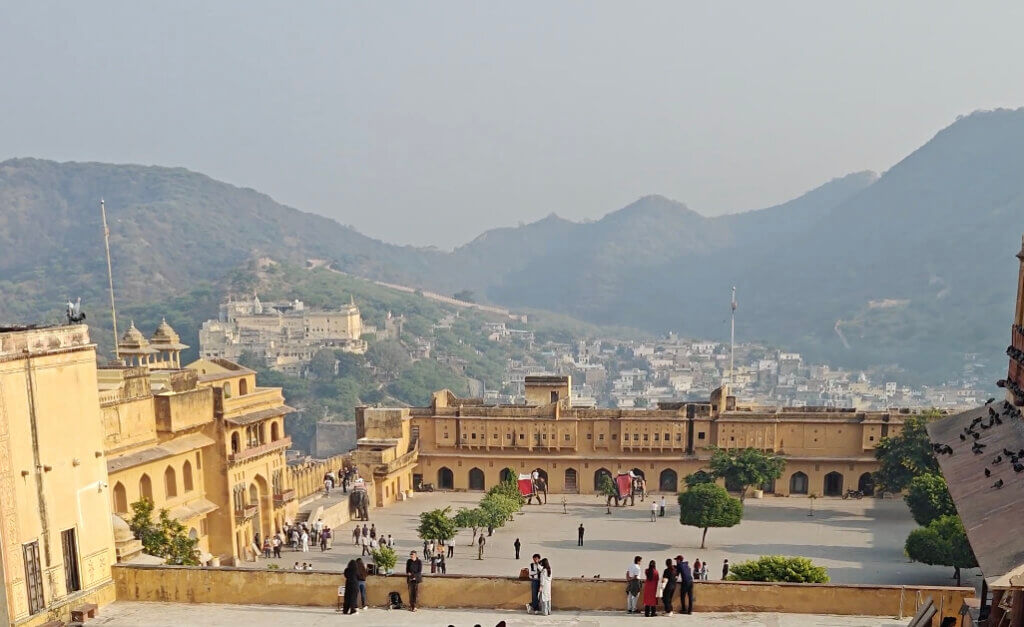
This is the first major courtyard of Amer Kila. The word Jaleb Chowk is derived from Arabic and means a place of assembly for the soldiers. This is where you will be if you enter from either of the two entrances. The courtyard was largely used for army parades.
Surrounding the courtyard are elephant stables and barracks as well as watch points. You will also, see a lot of guides here and if you have not hired one, then you can opt for them here, near the ticket counter.
Chand Pol – the 2nd important gate of Amber fort, Jaipur
Right across the Jaleb Chowk, opposite the Sun gate, is the Moon gate or the Chand Pol. This is where you would be entering Amer Fort if you have opted for a jeep or a vehicle drop. In terms of structure and defensive mechanics, it is similar to the Suraj Pol and opens to another zigzag pathway – albeit a shorter one and with a ramp.

Sila Devi temple – another interesting Amer fort story.
Now you have two options – one is directly take the stairs to another gate or take a narrow ramp between the wall and the giant staircase. I recommend that you take the narrow ramp to discover the temple of Sila Devi. The Goddess is believed to be the kuldevi or clan Goddess of the Kacchawas. There is an interesting tale related to the temple inside this temple.
It is said that the temple Idol was found by Raja Man Singh, following his dream and hence, is special. During one of the battles against the Raja of Jessore (Bengal), the King dreamt of finding this statue in a water bed. The Goddess in his dream asked him to find the statue and take it with him. True enough, the idol was found and since then, has been the centerpiece of this temple.
The Shila Devi temple is also, attached to the practice of animal sacrifice during the nine days of the Navratri festival. The same was done in the presence of the whole town, till it became a private tradition of the royal family and later was stopped altogether.
Also, in the same shrine, is an idol of Hindalaj Mata, the clan Goddess of the Meenas who ruled before the Kachchawas and later worked with them in Amer. Cameras are not allowed here.
A short flight of stairs takes you towards the 2nd courtyard of Amer Fort, Jaipur.
Singh Pol or the Lion Gate
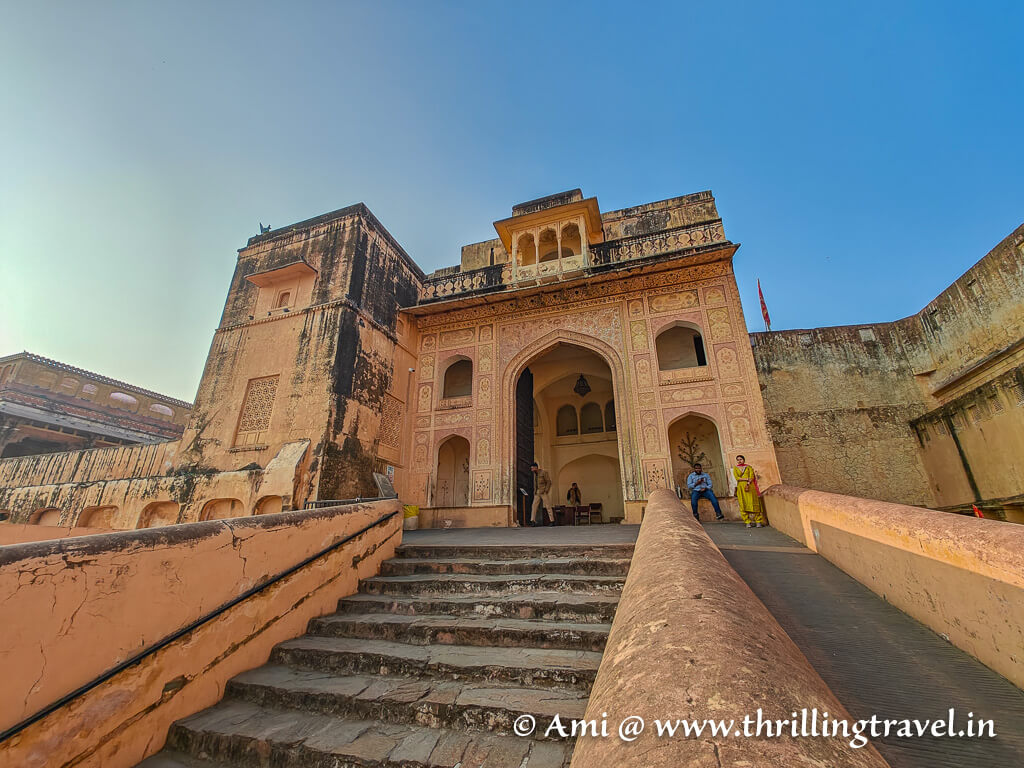
The ramp and the staircase both lead to another gate called the Singh Pol. This translates to “Lion Gate” and was a screen for the public visiting the Amer Fort Palace in those days. Even today, you will be screened here for your tickets and to ensure you are not carrying any major equipment or food inside Amer Fort.
The Singh gate was built by Maharaja Jai Singh in the latter part of the 17th century. Not only was it protective, but this was also, designed to impress. You can still see the faded frescoes covering the gate, which in its heyday would have reflected its royal aura to the visitors.
Diwan E Aam – Hall of Common Audience in Amer ka Kila

Walk through the Singh Pol and you will see a pillared stage has galleries on the top. The Diwan-e-Aam or the Hall of common audience in the 2nd courtyard of Amer ka Kila. This is where the King heard appeals from his subjects in Amer. He is believed to have sat in the center of the red sandstone-pillared hall while the ministers would line up on either side. The other people would stand outside the gallery and in Jaleb Chowk.
The galleries on the top would be covered by curtains to allow women to bear witness to the proceedings below.
Satais Kacheri (27 offices)
I know, I know. There is something gorgeous distracting you. I promise I will get to that, but until then, let’s talk about offices with a view. Connecting the Diwan-i-Aam to the stunning Ganesh Pol side is an open pillared passage that once held 27 offices. Thus, it was called Satais Kacheri (Satais = 27).
I would honestly, have loved my office here with an undeterred view of the Aravallis, Maota lake and the lovely Kesar Kyari. In those days, the offices were demarcated with curtains and possibly did not have those large desks that we have now. The open to both sides would have ensured proper ventilation and in fact, cool breeze.
I could not get a proper capture here as there were too many wedding photographers occupying the space. With that, you can guess how picturesque it must be.

Ganesh Pol – the most gorgeous places to see in Amer Fort of Jaipur
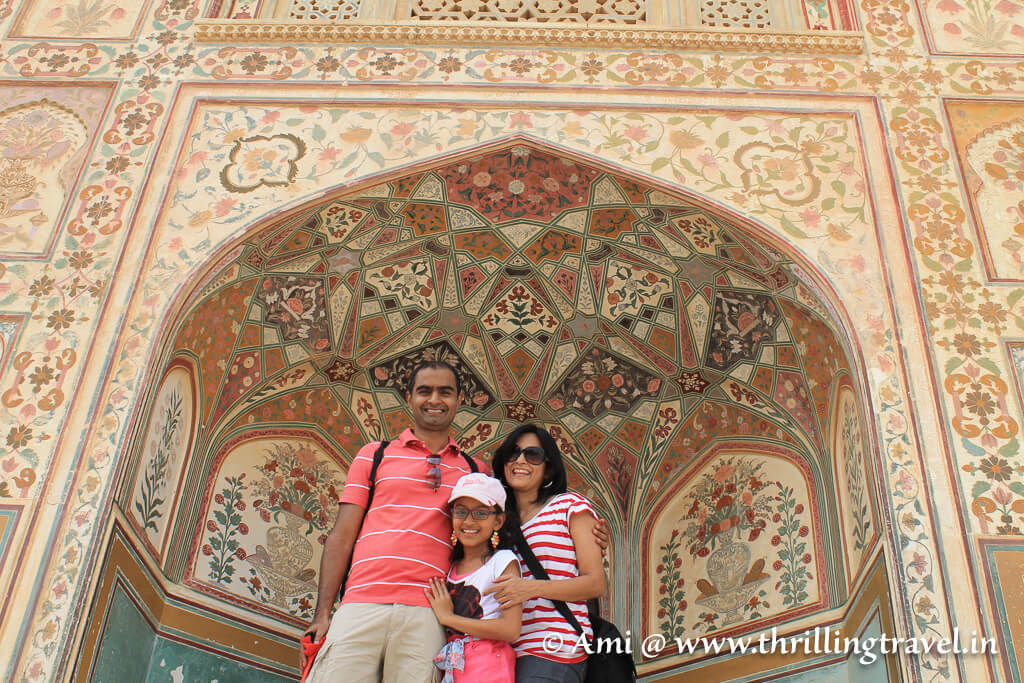
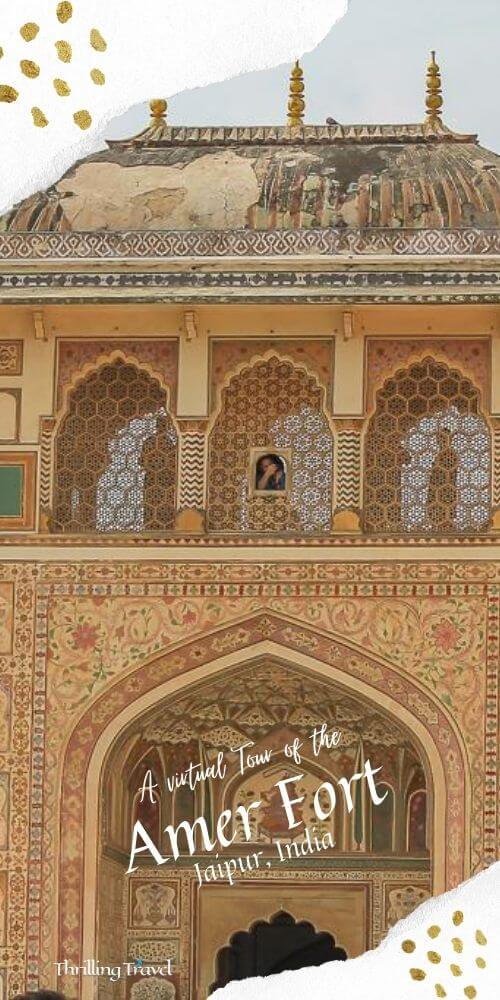
I am sure that from the time you walked into the 2nd courtyard, this majestic gate caught your eye. The Ganesh Pol has been the subject of many Instagrammers and photographers. Covered with frescoes using vegetable colors, the gate leads to the inner courtyards of the Amer Palace. Lord Ganesh is known to remove obstacles and is a symbol of new beginnings. I suppose you can now work out why this gate was so named.
We were told that during rains, this place looks even more stunning. Rains or not, the gate made a stunning backdrop for some photo memories as you can see. It is almost always crowded but I got really lucky with one of my early morning trips to get a complete crowd-free picture.
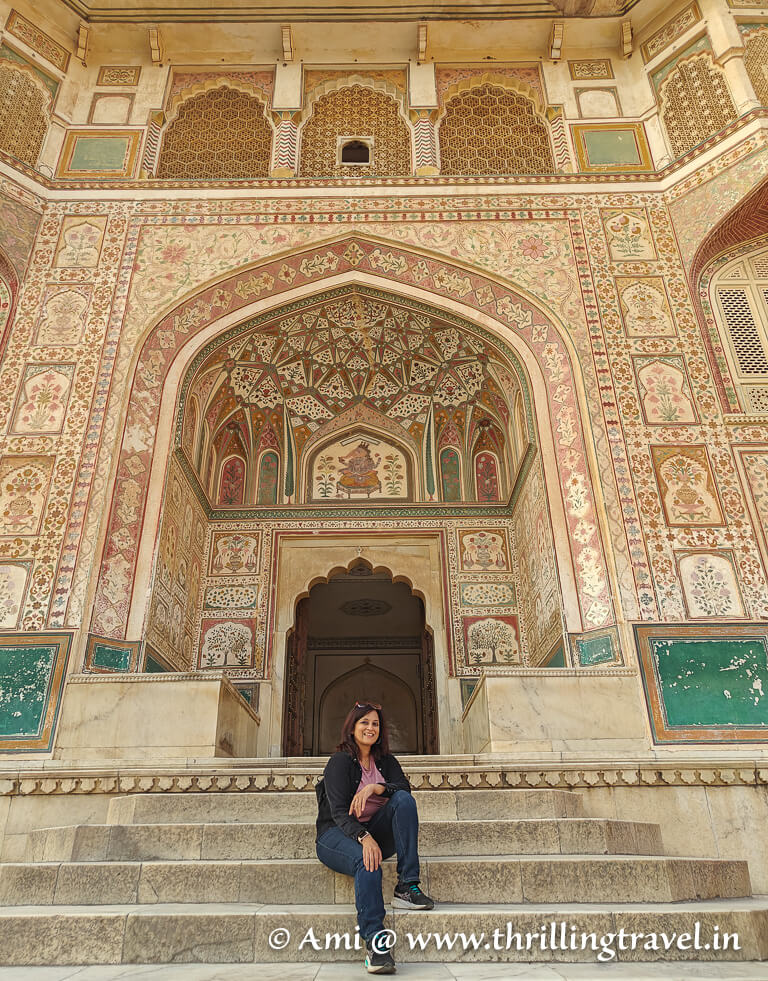
It is believed that the royalty was welcomed here with a full fanfare, especially as they returned victorious from a battle. I had myself imagining a scene from Jodha Akbar movie wherein Akbar was greeted with a Tilak by the royal Queen when he first visited Jodhabai. Of course, that did not really happen here. 🙂 But you get the picture.
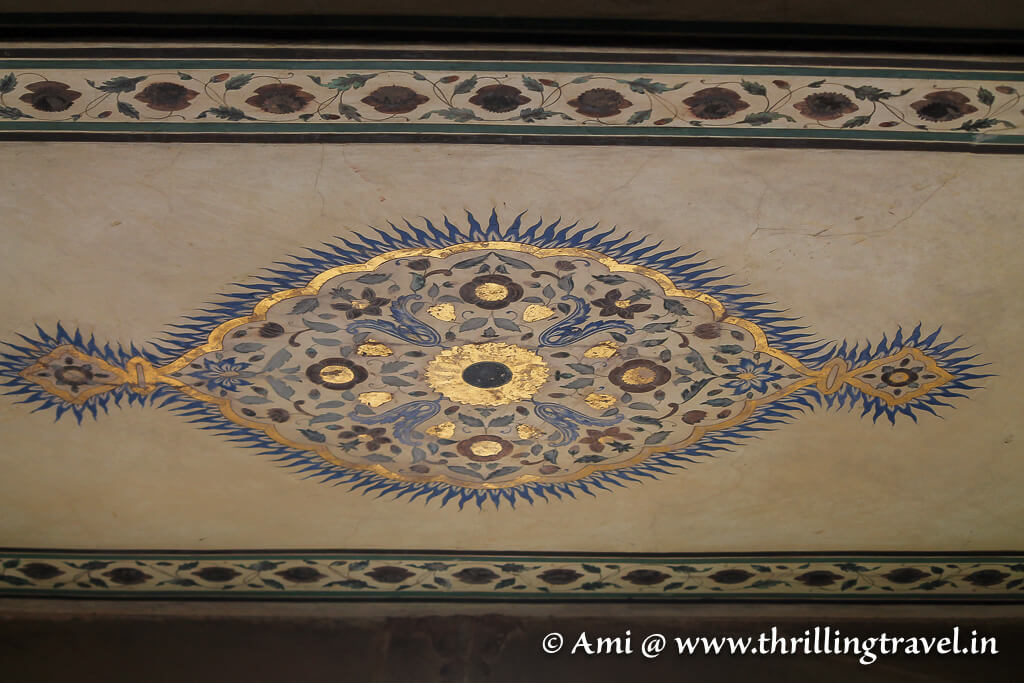
P.S: Don’t miss the gold color on the frescoes that you will see on the ceilings when you step through the Ganesh Pol. The same was done using solid Gold paint.
Suhag Mandir – a section for the royal women
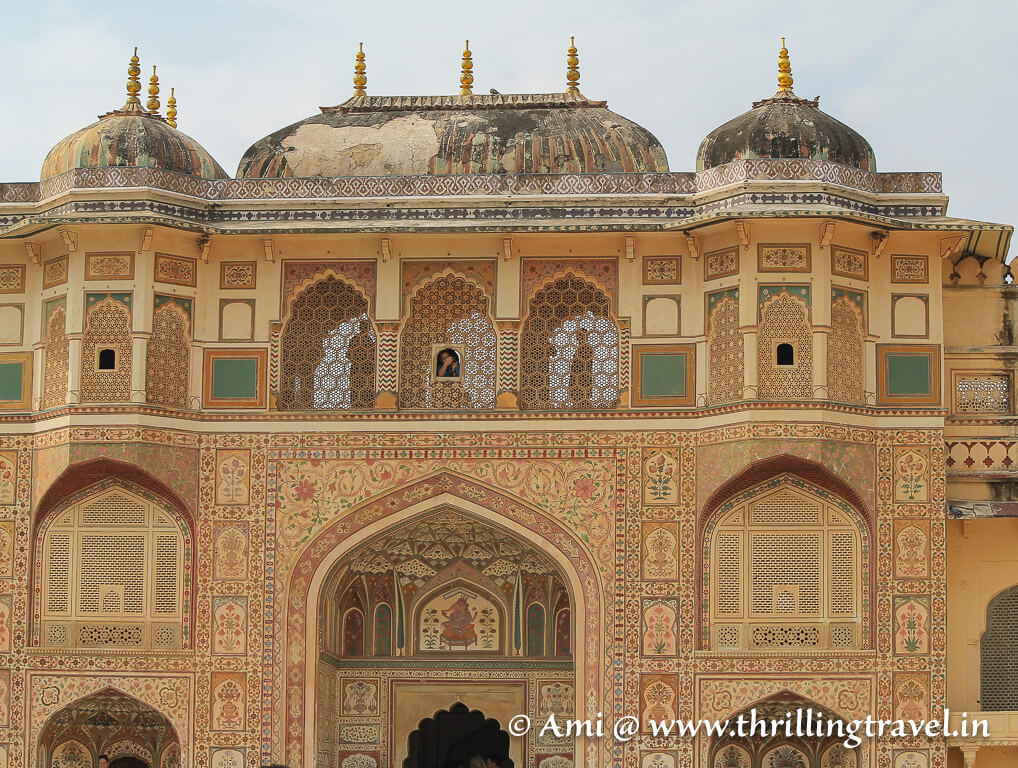
The Ganesh Pol is a gate attached to a three-level structure. The top-most with jhalis (lattice windows) is called the Suhag Mandir. This was where the Royal ladies could witness the happenings in the various courtyards, as they were not allowed to appear in public.

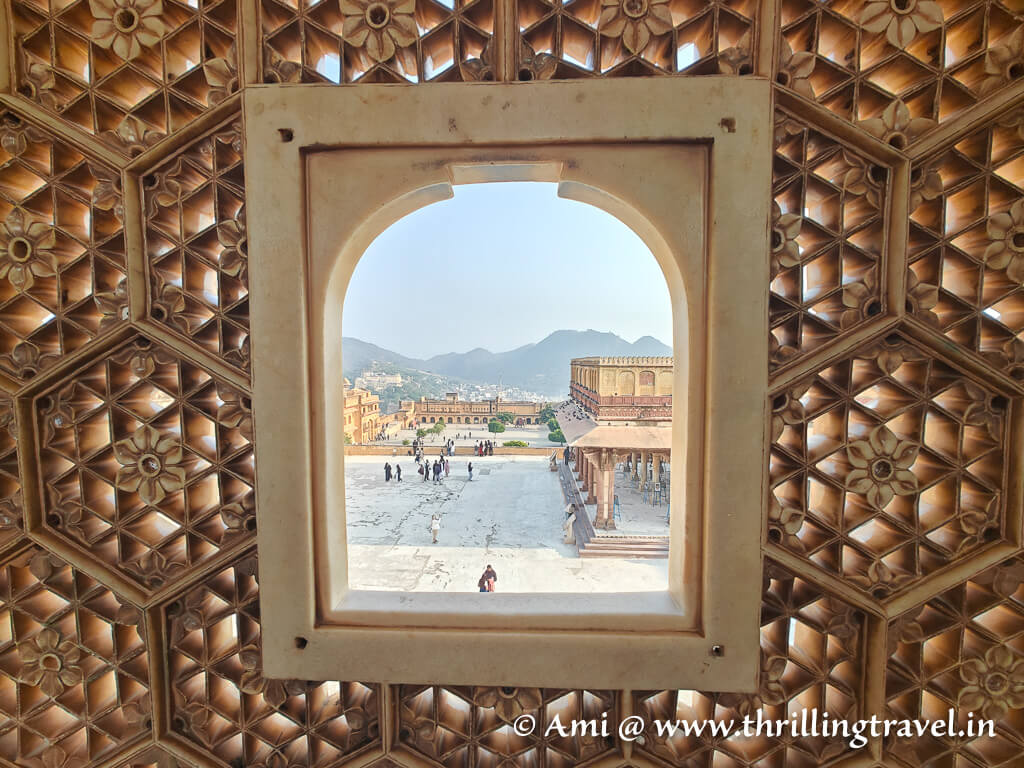
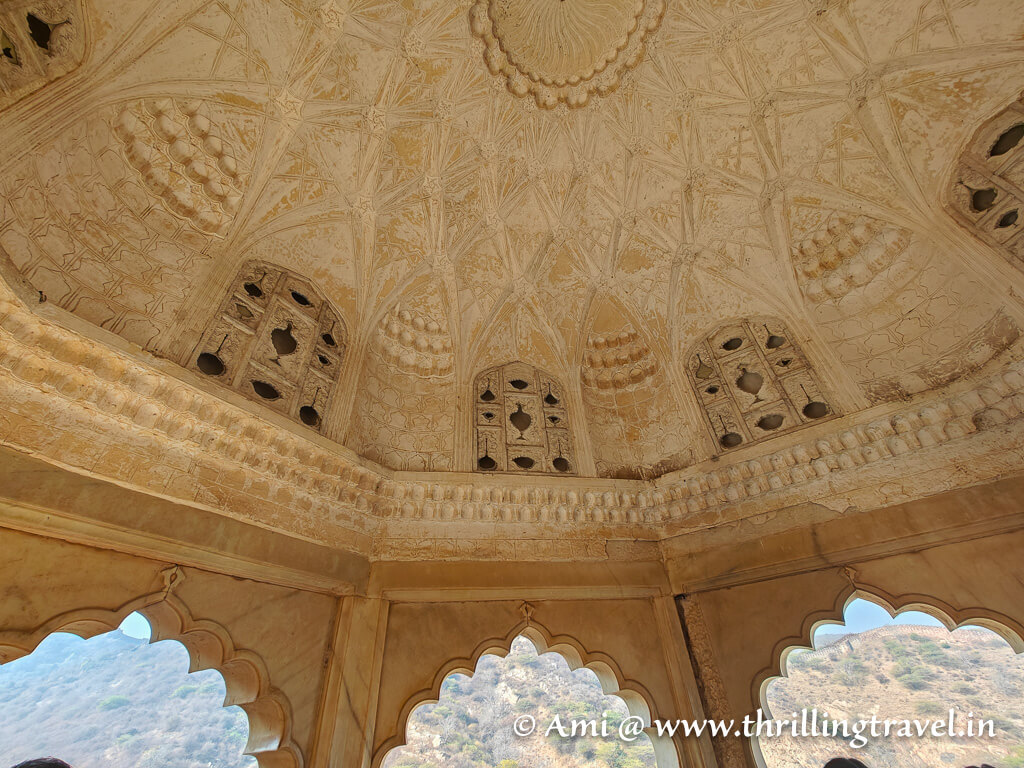
You can climb up to the same via a narrow staircase or ramp and witness the view for yourself. While you are up there, follow the path to the west and you will come across a chattri. Along with the views of Jaigarh fort and Amer town, you also, get to enjoy a good breeze under a carved ceiling. No points for guessing why this was a lookout point.
The Royal dining hall

This was one of the hidden attractions that I had missed in my first Amer fort tour. To find this, take the staircase down from the lookout point at Suhag Mandir. You have to peek through a window and there you will see a frescoed room. This used to be the Royal Rasoi (kitchen) and dining room.
Turkish Hamam – an oft-missed attraction of Amer fort
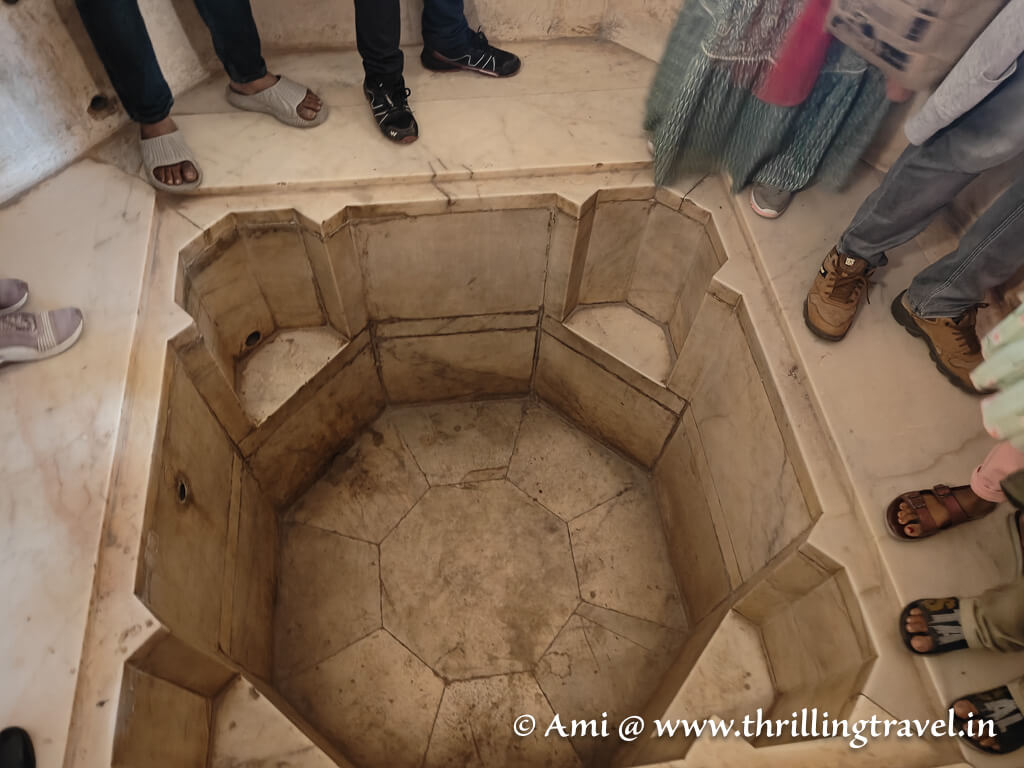
On the other side of the Suhag mandir is a hammam or the Turkish bath. It is another offbeat part of the fort that a lot of guides at Amber Fort tend to leave out. However, I would recommend a visit here to see how ingenious they were with the same. It is like a mini spa with sections for changing, massage and a steam too.
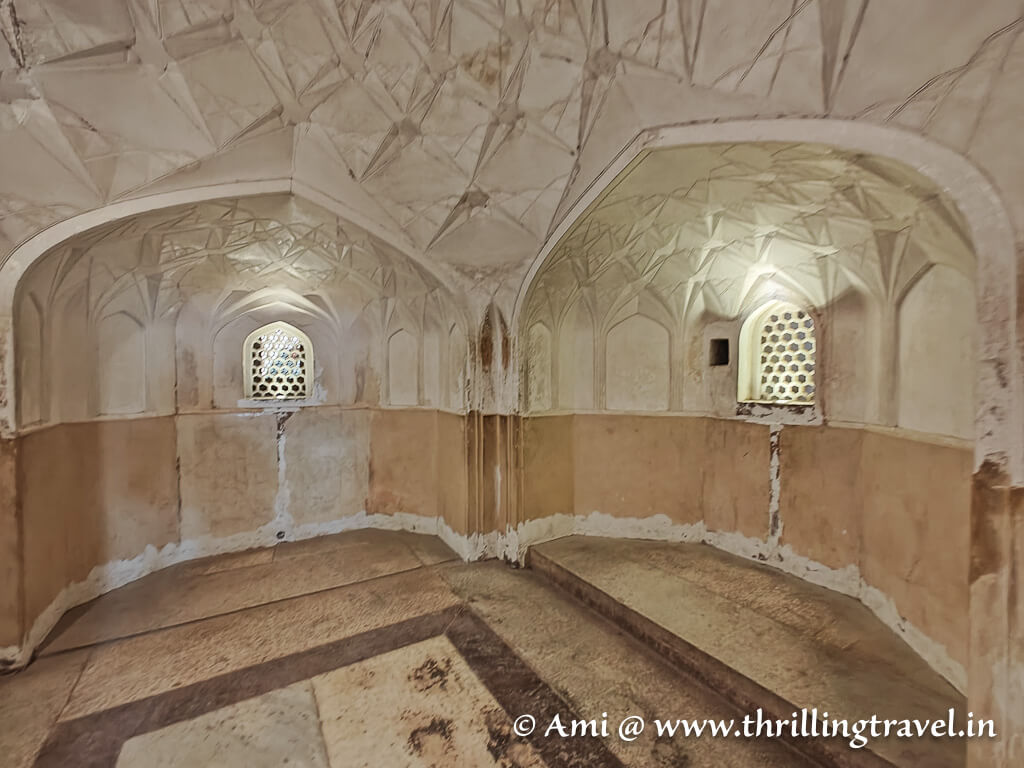
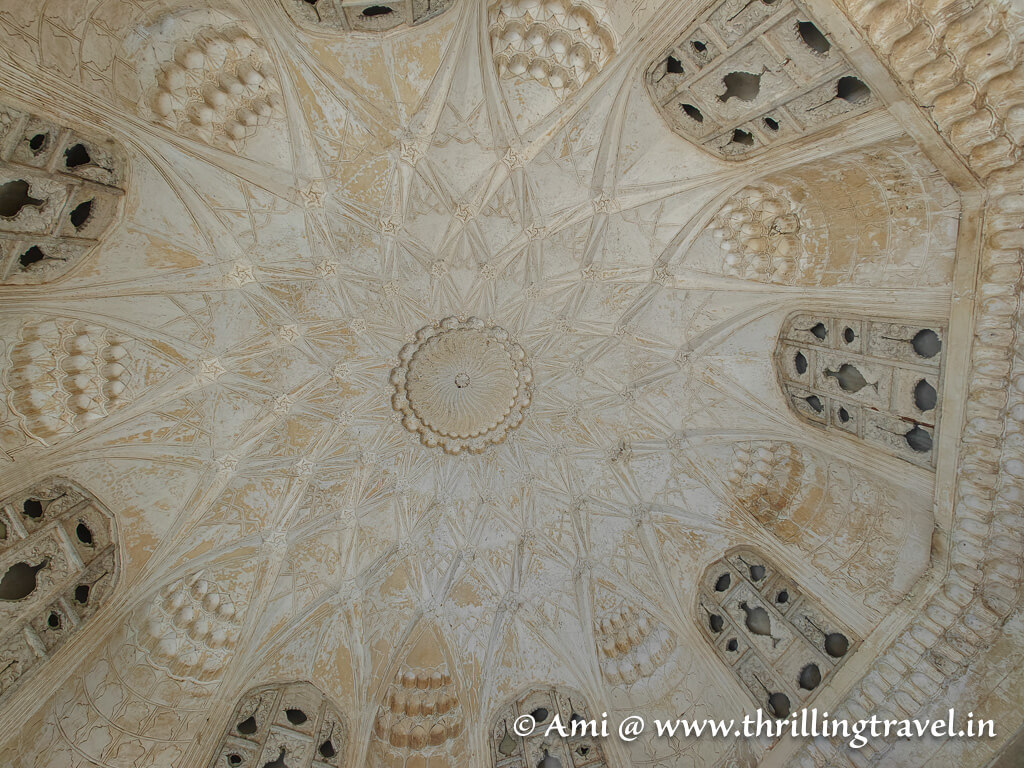
The marble bath house has angled prismatic ceilings to keep the interior warm, which also, adds an aesthetic touch to the room. Wandering through it got me back to my recent visit to the Alhambra and its Nasrid palaces in Spain.
Diwan-e-Khas – the Hall of private audience or the Sheesh Mahal of Amer Fort
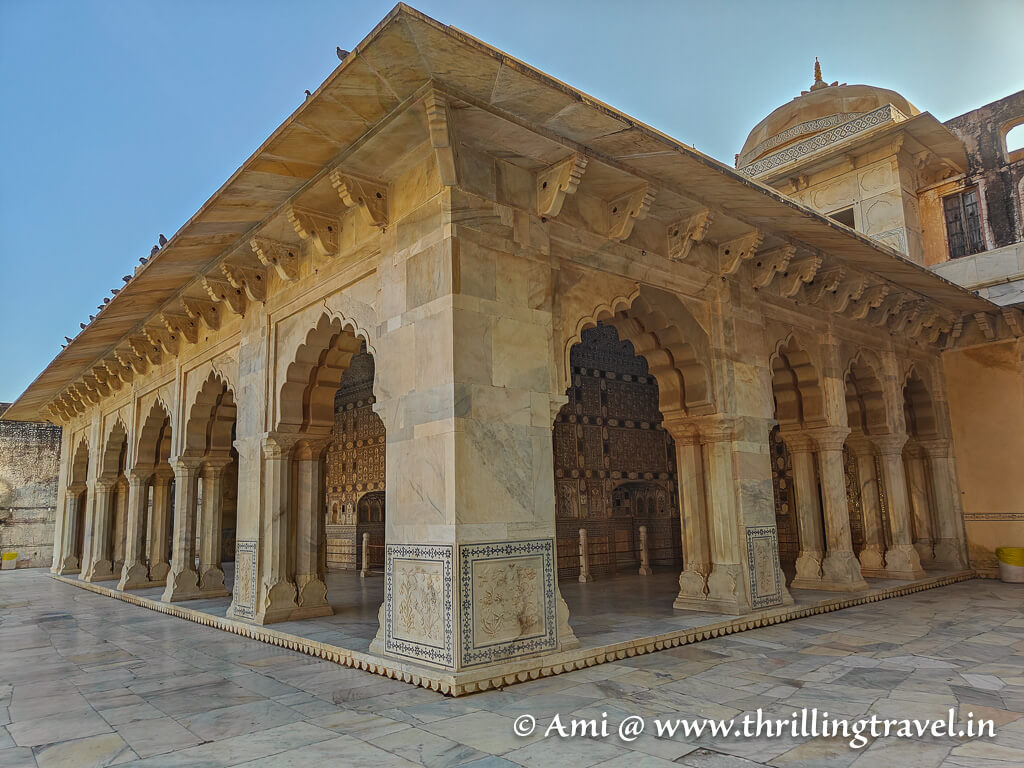
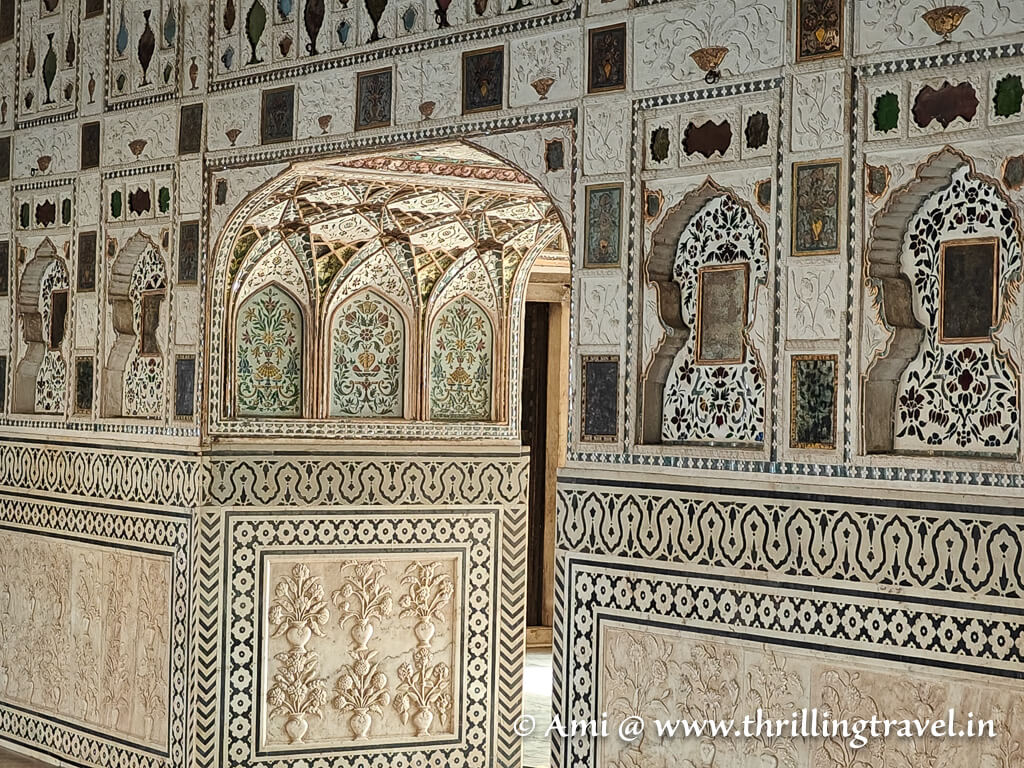
The moment you cross Ganesh Pol, your gaze would automatically be drawn towards the glistening building with glass and mirror work. This is the Hall of Private Audience – Diwan-e-Khaas, where highly secretive meetings with important people took place.
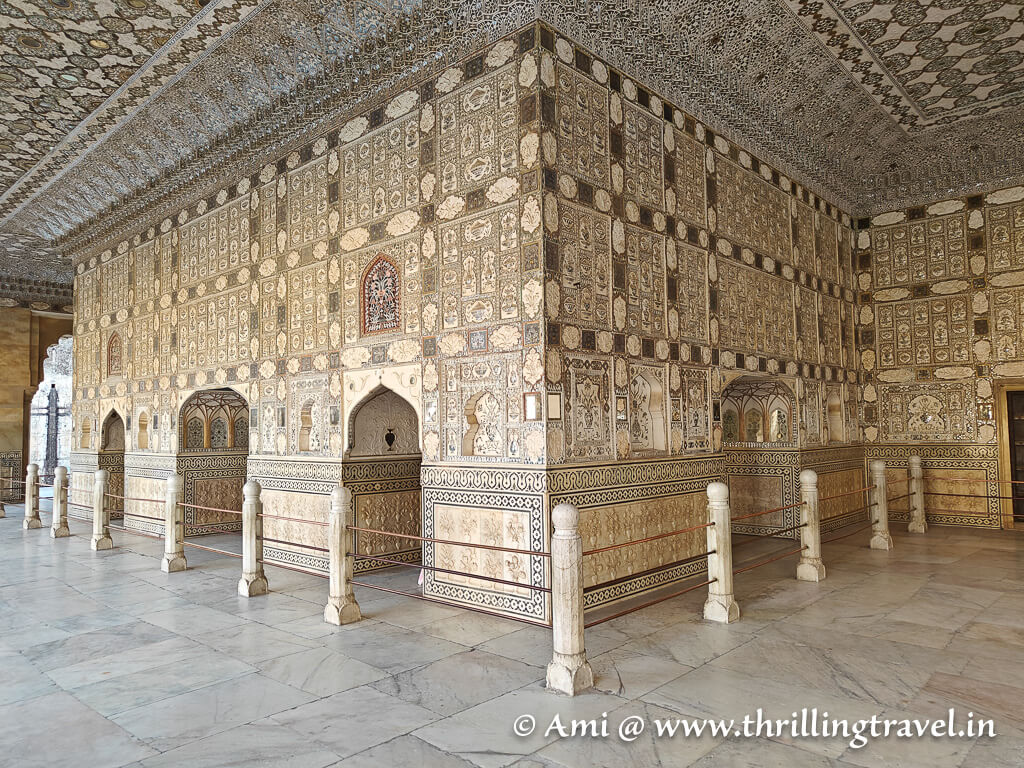
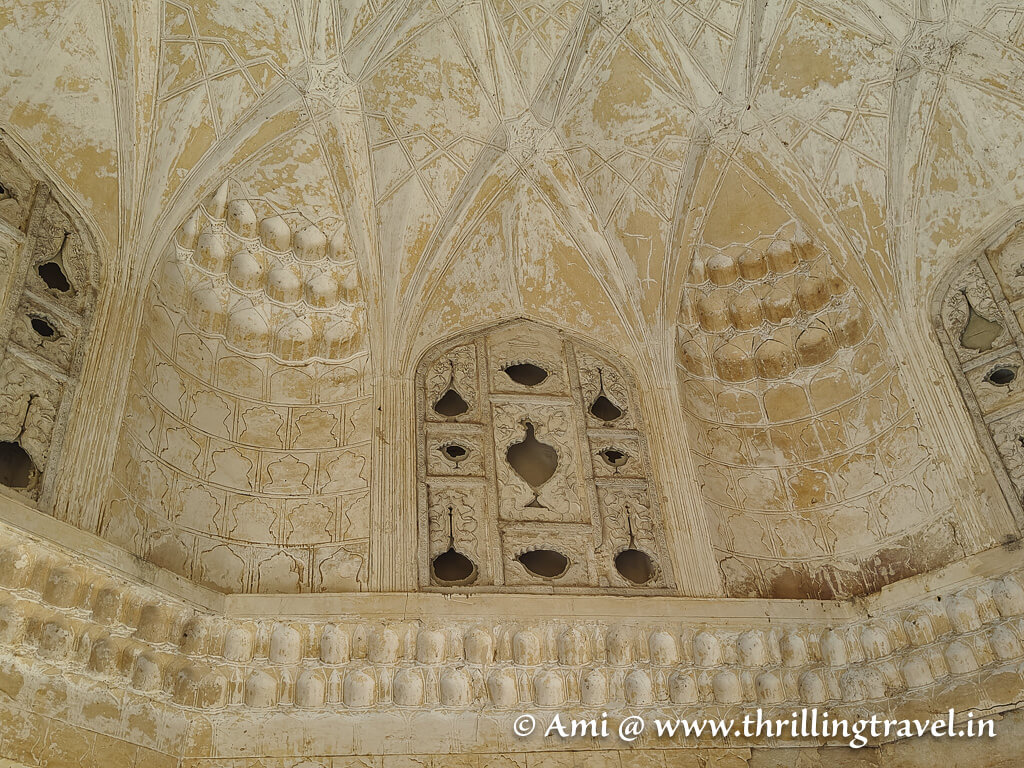
The main chamber in front of you was decorated to impress – with intricate floral designs interspersed with mirror work and glass. One candle that was lit in the night reflected throughout the palace, making the ceiling look like the night sky filled with twinkling stars. And that was not all that fascinated me. The glasswork is in no random pattern but is worked into beautiful floral designs. The inspiration for this Palace of Mirrors comes from the Mughal architecture (Check out the Sheesh Mahal of the Agra Fort).

The structure was built by Maharaja Jai Singh and hence it is also, referred to as Jai Mandir. Even after he moved out of Amer fort, he built a similar section in his new home – the City Palace of Jaipur – which you can see as a part of the royal tour of City Palace.
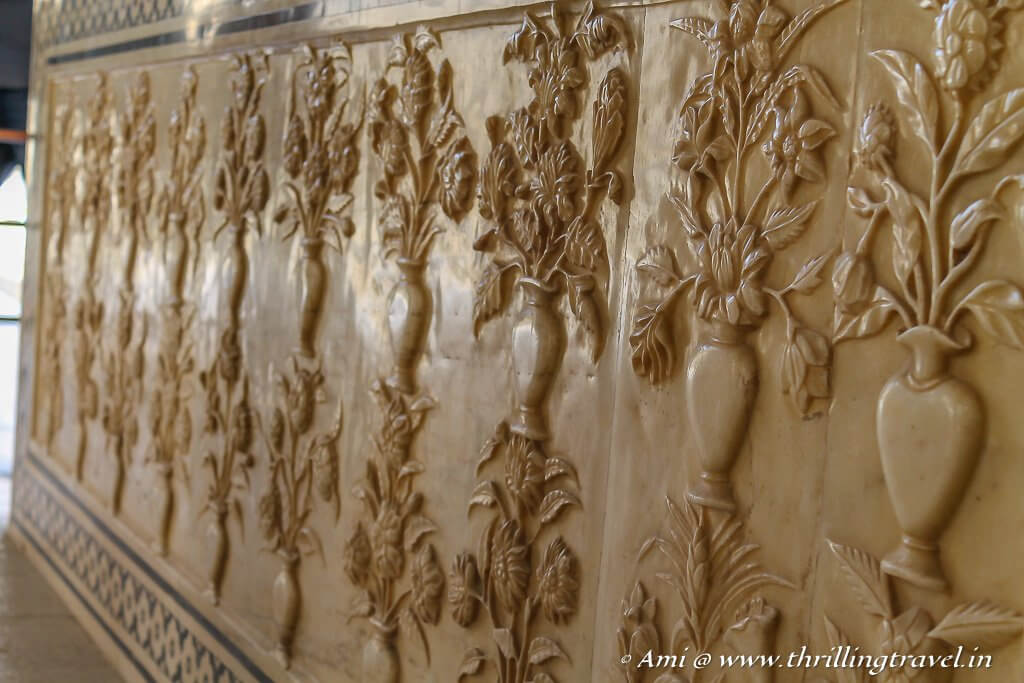
While here, do not miss the must-see attraction of Amer Fort that lies along the marble pillars and walls of the Diwan-i-Khas. These are popularly referred to as Magic Flowers. The Magic Flower of Amber Fort is carved such that you can spot 7 different pictures by covering various parts of the flower. These include the following and whether you take an audio tour or hire a guide, they will all take pleasure in showcasing this Magic Flower.
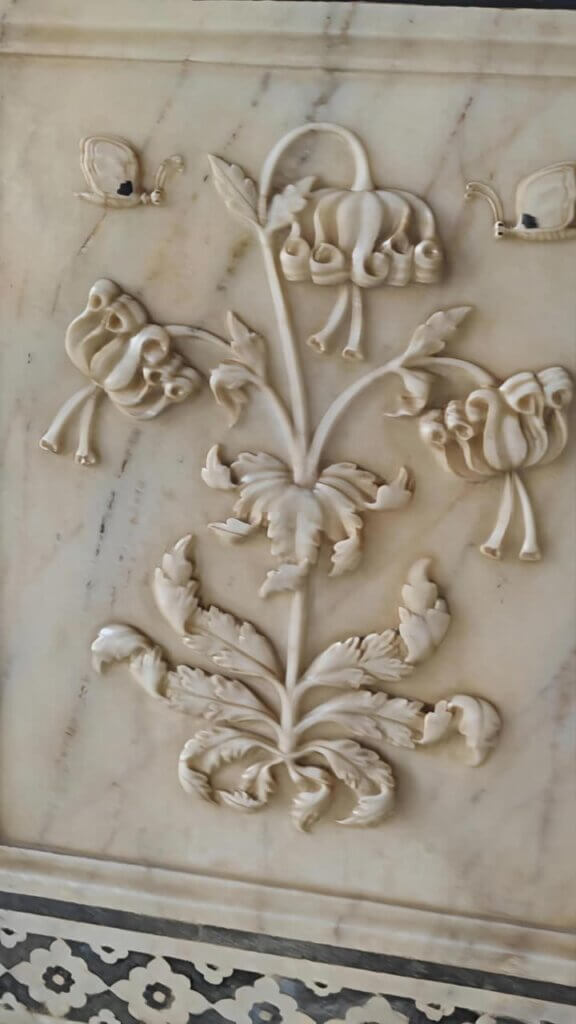
- A scorpion
- Lotus
- Hood of a Snake
- Fishtail
- An elephant’s trunk
- The tail of a lion
- A corn
Whether created by design or not, is a debatable topic. I, however, do believe the story that Sawai Jai Singh, who built this, was fond of riddles and often took pleasure in using the Magic flower as one.


There is this one place where our guide insisted that he take our picture. He pointed the camera at one mirror while we posed at another. Here is the lovely framed picture that we got.
Jas Mandir
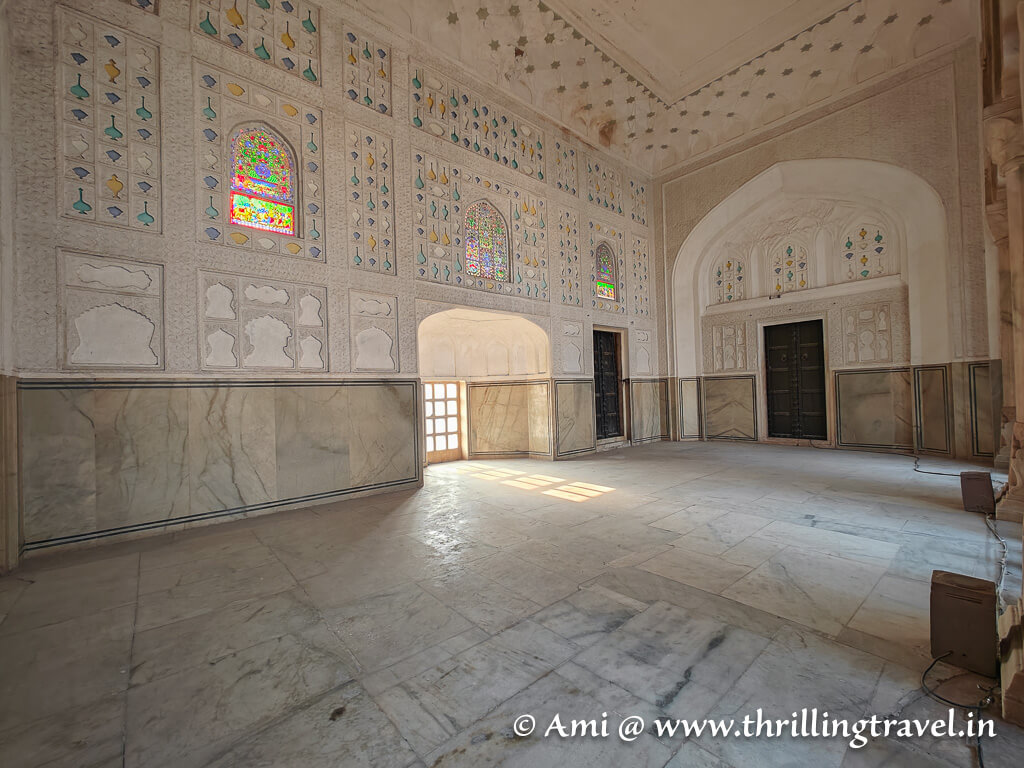
The section above Jai Mandir is called the Jas Mandir and this is out of bounds. The Jas Mandir was used for relaxing. It is believed to have beautiful floral walls and stained-glass interiors. You can get a glimpse of these in the passage that is next to the Sheesh Mahal of Amer fort. Peek through the windows and you will see pictorial stories created in stained glasswork.

Khus curtains were suspended from the Jas Mandir and the roof over the Diwan-e-Khas in summers. These were sprayed with water to get naturally cooled air. You can spot the curtain hoops on the roof.
Chahar Bagh – the gardens inside the Amer Fort courtyard

The dazzling Sheesh Mahal of Amber Fort, Jaipur, does take up a lot of your time. Those details are so mesmerizing!
Let me share a little note on the landscaped gardens that you will encounter in this courtyard. This is yet another aspect of Amer Fort architecture that is influenced by the Mughals. The gardens separating the Jai Mandir from the other section, called Sukh Niwas are called Chahar Bagh. The central star-shaped fountain is connected across the courtyards with narrow pipes. These channels helped cool both Jas Mandir and the Sukh Niwas.
Sukh Niwas of Jaipur Amber Fort
The Sukh Niwas, Amer Fort, was the resting quarters of the King. Right opposite his office. Besides his personal chambers, there were rooms for his main Queen or the Patrani and the second one in line. The size of the rooms and their decor distinguished them and also, implied their importance.
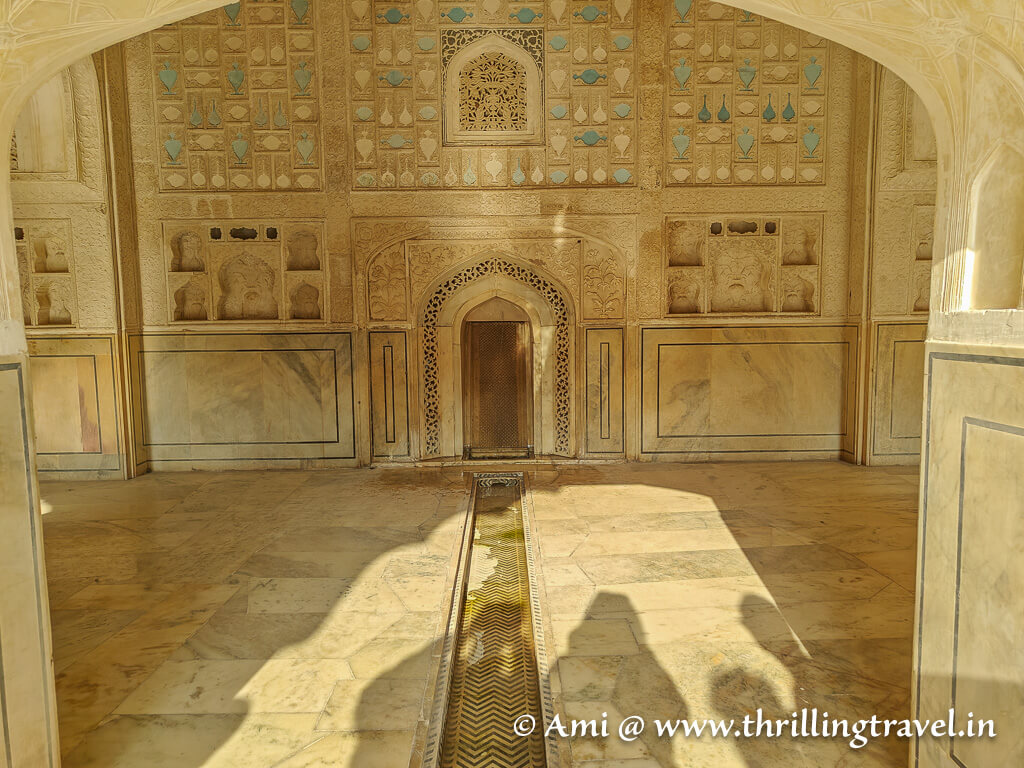
The ornate designs on the wall – the vases in pastel – were also, Mughal-inspired. Besides this wall decor, the main feature of this section is the small channels of water from the Chahar Bagh. These channels flow into small marble niches called Chini Khana. Above these small pedestals, you will see hooks from where swings were dropped. The Queens apparently used these as a place to cool of their feet and maybe, do a pedicure, while enjoying some cool breeze as they swung along.

At the far end, towards the wall, you will see another ingenious part of the Amer fort architecture. You will see water cascade over a marble niche that has holes around it. Breeze passed over the water, cooling the rooms – giving the occupants a much-needed respite during summers. See what I mean – aesthetic yet functional Amer fort interiors.
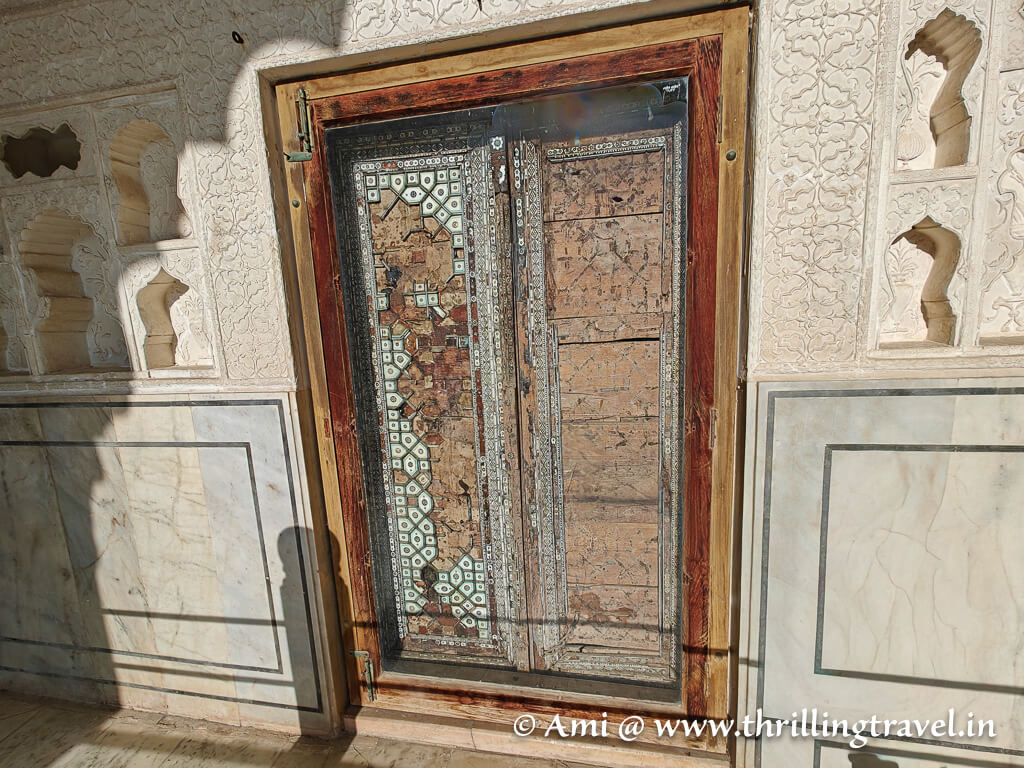
In the corridor, you will also find two displays – one of the wooden doors the designs of which were inspired by Chahar bagh and which were once used in the Sukh Niwas. The second is a palanquin that was used by the queens to move around the palace. You see, they used to wear such heavy clothes and jewelry that they could not really walk. So they were wheeled around. This also, explains the various ramps in the palace – example, the one leading to Suhag Mandir.

Raja Man Singh’s palace and the Baradari – the last courtyard of Amer fort.
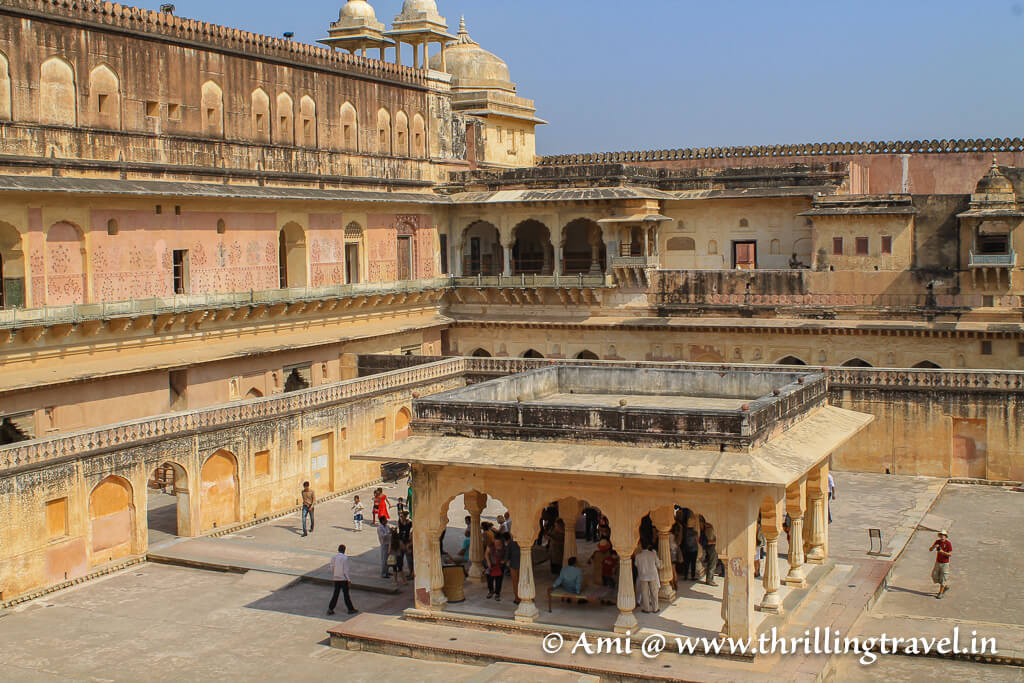
Exit through the doorways on the other end into the last courtyard of the fort. What you enter is Mansingh’s palace. It has his bed chambers and tons of secret passages (ooh!). Where these passages went, that is the quirky part I will reveal in the next section.
You will also find his personal bathing tub in a smaller courtyard outside his palace. Exit that and you will find the central pavilion or the Bardari Mandir, which was used by the Royal ladies and the King to just sit around.
Zenana Deorhi of Amber Kila of Jaipur
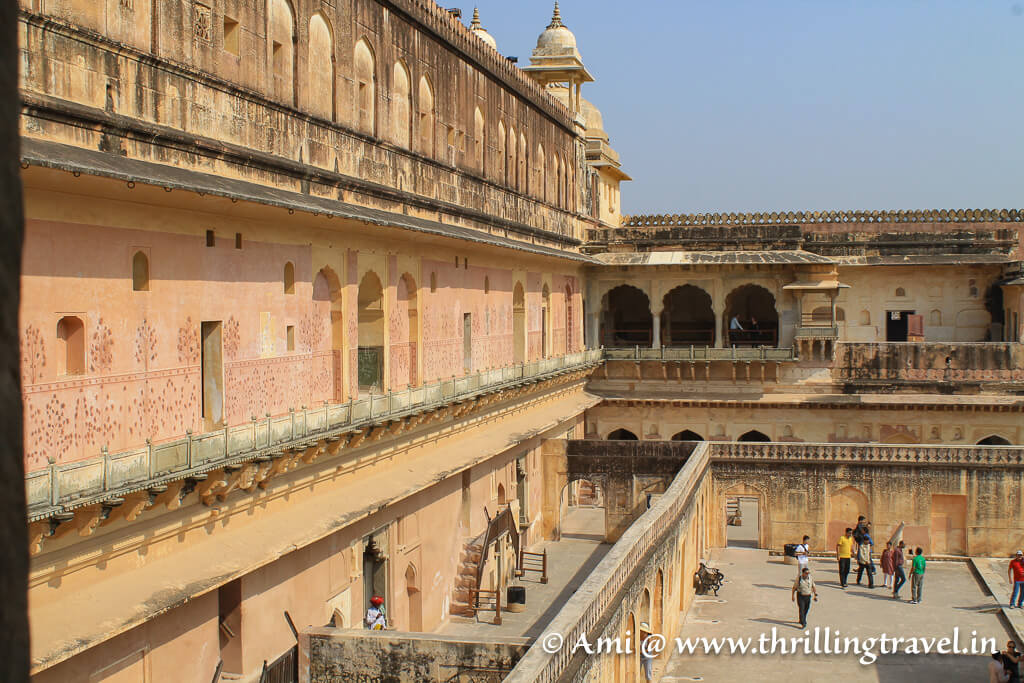
Around the baradari, you will see some rooms that belong to various Queens. Each room had its own sit-out and kitchen areas. It was like the concept of Royal row houses. The guide told us that there were 12 such rooms around the Bardari – one for each Queen. Now here comes the interesting part –
- The Raja was so superstitious that he is said to have one Queen from each Zodiac sign. Fact or not, don’t know. But an interesting story nonetheless. 😀
- Each room was connected through one of the many secret passages with the King’s room. The passage was a private passage that only the King would use. It was done so that when the Raja visited one Queen, the others would not know who he was visiting. Privacy and Jealousy avoided
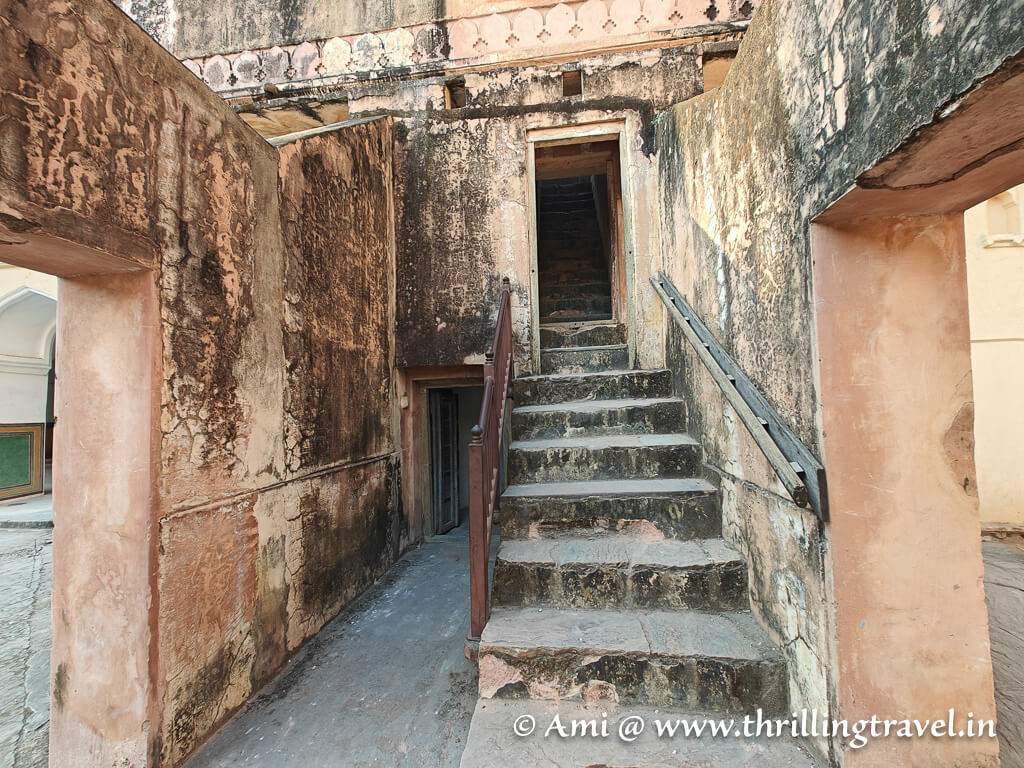
The last one is a fact as I ventured up one of the Queen’s apartments to see what was in it. Owing to a lot of damage, venturing here is not encouraged but it is not prohibited either. The curious me could not resist and went treasure hunting to follow one particular passage that ended up at the King’s chamber.
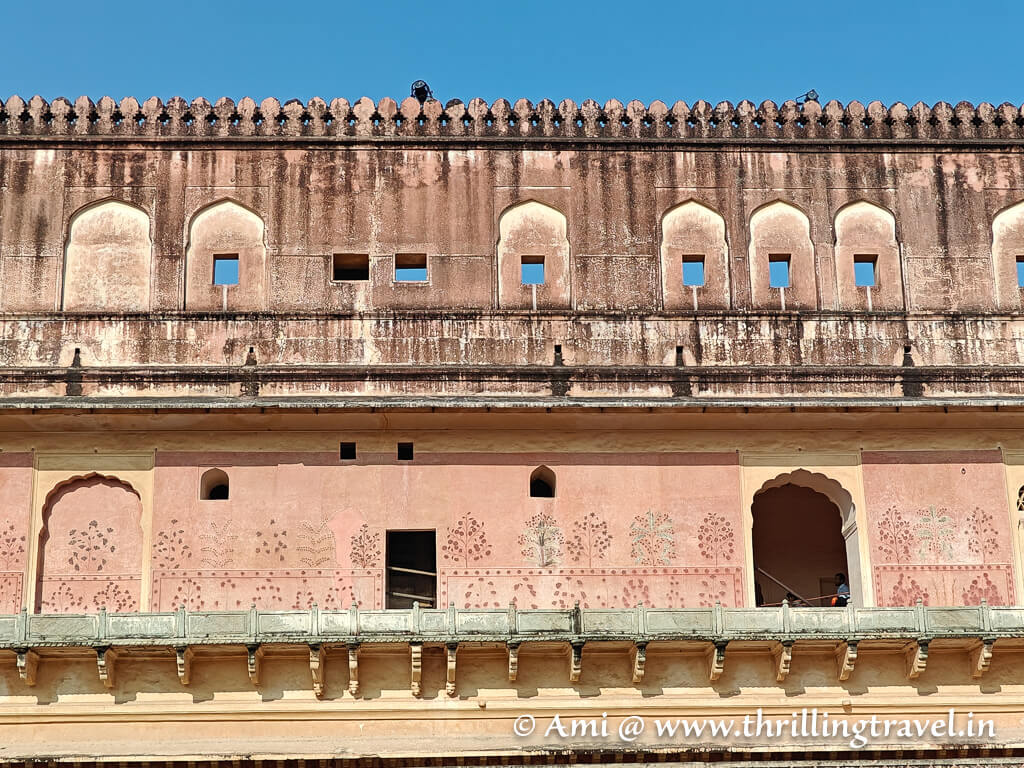
Tripolia gate

After Zenana, you will have to follow the exit signs that take you back towards Jaleb Chowk. You will pass through the Tripolia gate, which was a private gate connecting Jaleb Chowk, Raja Mansingh’s palace and the Zenana Deohri. When walking through this, you will come across this giant vessel.
This was not a part of the original Amer fort but was made for the Blockbuster film – Jodha Akbar. This huge vessel that was used by Aishwarya Rai in the film to cook for Hrithik Roshan :D. It was left behind after a shoot.

However, next to it, in a niche, is this vessel that is an earthen pot that was used to store dairy products. Kind of like a refrigerator and very much a part of the Amer history.
Secret tunnel from Amer Fort to Jaigarh Fort
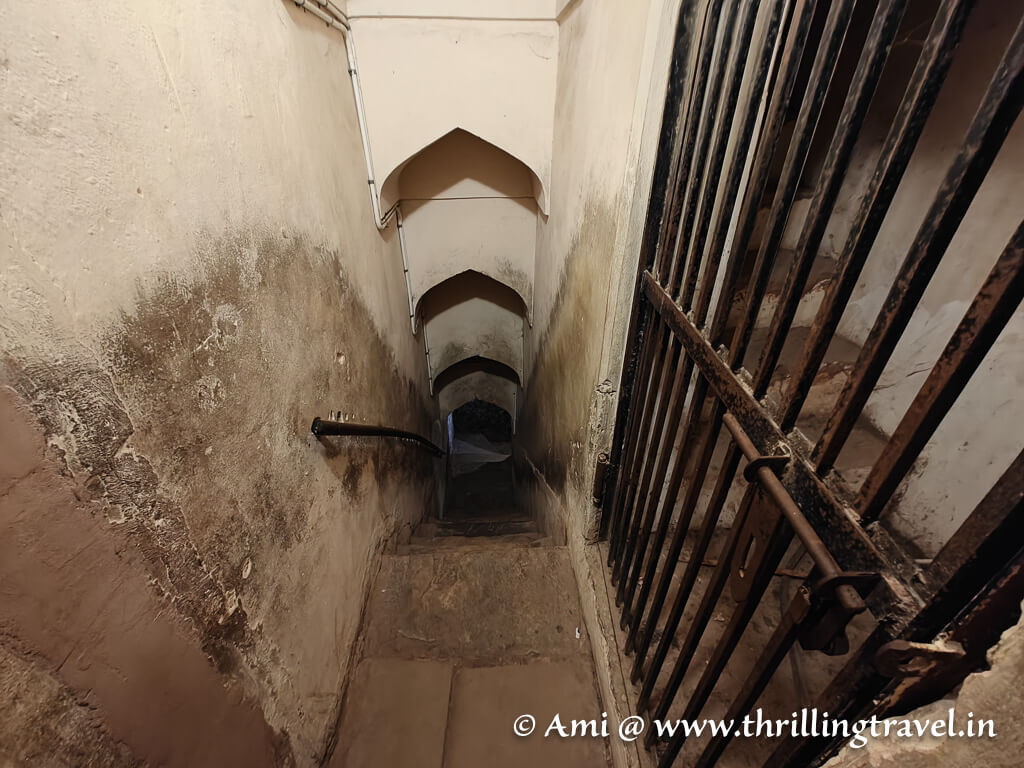
Right opposite the vessel is a small sign that indicates a secret tunnel to Jaigarh fort. This was a passage to the protective fort, allowing the women and children to escape to the safety of Jaigarh in case of an attack. The passage is partially underground and then it opens up. It has been cleared and you can book a separate tour to experience this.
Sadly, I still have not been able to and for that someday, I shall go back. For now, that is it in terms of places to see in Amer Fort.
Places to visit near Amer Fort, Jaipur
The Amer Fort tour takes over 2 hours to see all that I have shared. However, there is more outside the fort that you might want to explore. While I have a separate post dedicated to it, for now, let me list down the other places to visit near Amer fort Jaipur.
- Jaigarh Fort – This one I managed to go and trust me when I say, don’t miss it! Check out the tour of Jaigarh Fort here.
- Jagat Shiromani Temple – The beautifully carved temple is said to be a Meera Bai Temple. The marble carvings of the Toran (ornamental hangings) and the walls are quite exquisite. I have another post exclusively on this here.
- Ambikeshwar Mahadev Temple – This was the temple that gave Amer its name. I gets submerged in monsoons
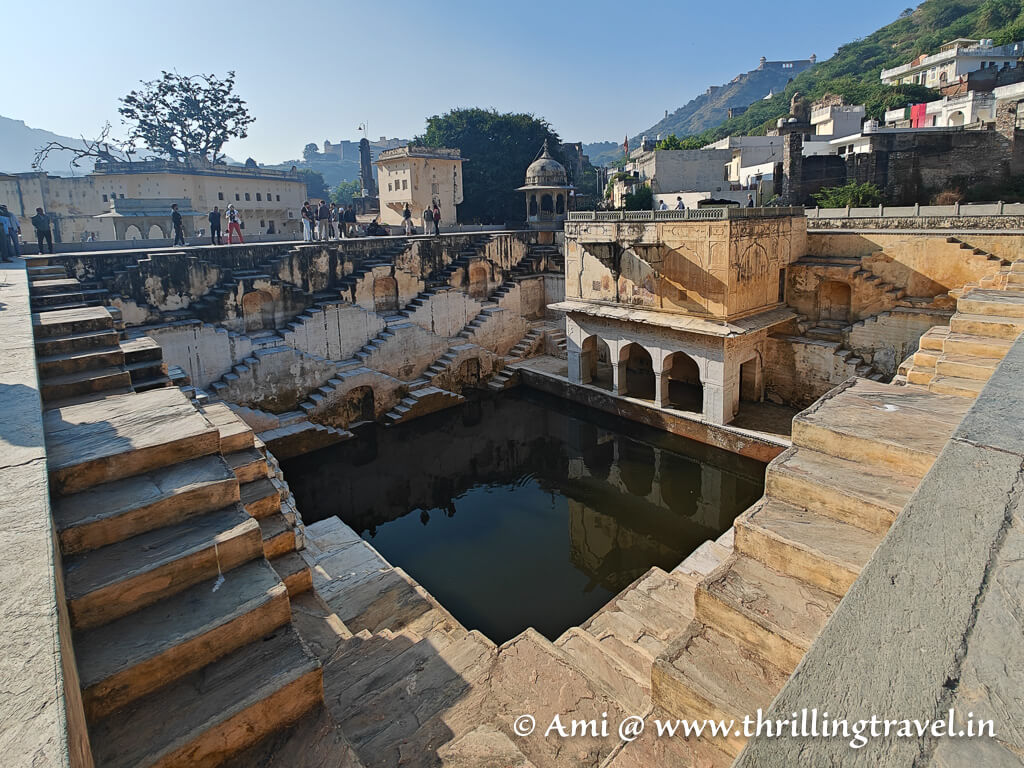
- Panna Meera Kund – The carved stepwell of Amer dates much earlier than the fort.
- Jodha Bai Palace – This is right behind the main palace. While you cannot enter it, you can get a good look from the outside.
With that, I conclude this guide to Amer Fort Jaipur. And I am sure, you are now well prepared to visit this place with all the information that I have shared on what to see in Amer Fort as well as my insider tips to make your tour easier. Just remember to bookmark this now so that you can pull out this virtual tour of Amer Fort, Jaipur, whenever you need it.
Common FAQs about an Amer fort visit
How much time is required to visit Amer Fort?
Keep aside at least three hours for a comfortable visit to Amer fort. 2 hours can be a rush.
Can you visit Amer Fort at night?
As of 2026, the Amer Fort closing time has been extended to 9 pm. Hence, it is possible to visit Amer Fort at night. You can also attend the Amer Fort light and sound show in the evening.
Before you go, pin this

Popularly referred to as a Restless Ball of Energy. My Mom refuses to entertain my complaints about my equally restless daughter & assures my husband that I was born with a travel bug.
I am a Post-Graduate in Marketing by qualification and a travel blogger by passion. Besides travel, I enjoy photography and if you don’t find me at my desk, I would be out playing badminton or swimming or just running. I believe in planning for every long weekend through the year. And when I cannot travel physically, I travel virtually through this travel blog. My travel stories have also, got published on various websites and magazines including BBC Travel, Lonely Planet India and Jetwings. I have recently published my first book – When Places Come Alive – a collection of stories that are based on legends, landscapes, art and culture of a place which is available in both ebook and paperback format.
You might also like these posts –
- A walking tour of Amer town, Jaipur (with a map & itinerary)
- The Jagat Shiromani Temple story – The History, Architecture & legacy of Meera Bai mandir in Amer, Jaipur
- Jaipur City Palace Royal Tour: Experience the Grandeur of Royalty
- All the things that will make you go WOW at the City Palace Jaipur
- How to plan a trip from Delhi to Jaipur by road?
- Inside the Palace of Winds: A Guide to Hawa Mahal Jaipur
- Tour of the Jantar Mantar in Jaipur
- A guide to a must-do heritage walk in Jaipur (includes insider tips on what to see & how to plan a Jaipur old city walk)
- 10 travel tips for Rajasthan
- The intriguing Jal Mahal in Jaipur
- Sisodia Rani Bagh: A royal tryst with nature
- Secrets of the Jaigarh Fort in Jaipur
- Best areas to pick hotels in Jaipur
- Places to see in Jaipur over 3 days