
A queen built it in tears, for a son she lost too soon
A saint poured her soul here, her Krishna her only boon.
The world rushed past to the Amer fort on the hill,
While Jagat Shiromani temple Jaipur kept its secrets still.

Discover one of the hidden temples in Jaipur. Learn about the Jagat Shiromani temple story that not only includes its history but the legend of Meera Bai. Get ready for a visit with my insider tips on how to get to Jagat Shiromani mandir, its timings and more.
Have you ever walked past something extraordinary without even realizing it?
I did — and I did it at Amer, of all places. Like most visitors, my eyes were fixed on the Amer fort crowning the hill, and everything else on that road just blurred into the background. It was only when I slowed down and did an Amer walking tour that a carved stone façade stopped me in my tracks. I stood there staring, genuinely stunned, asking myself one question — how on earth did I miss this?

That was my first encounter with the Jagat Shiromani Temple, Amer — and it was far from my last. I have returned to it more than once since, and each visit has peeled back another layer. The architecture reveals new details every time you look. The stories behind the Meera Bai temple, Jaipur (its popular name) grow richer the more you dig.
This post brings all of it together. From the Jagat Shiromani Temple history to the architectural brilliance that makes scholars stop and stare, and the secret that links this quiet Amer temple to one of the most beloved saints in Indian history — consider this your complete Jagat Shiromani temple guide. And if you are planning a visit to Amer, I will tell you exactly how to fit this into your day, along with details on the Jagat Shiromani temple timings, how to get there, and more.
Quick links for the Amer and the Jagat Shiromani mandir Jaipur tour
- Booking.com has several good Jaipur stays listed on their site. These range from luxury hotels to mid-prices havelis, homestays and hostels. I have also got this post on the localities and areas where you can plan to stay for your Jaipur visit.
- GetYourGuide is a good resource with tons of Jaipur tours including heritage walks and cycling tours. You can check these five related that could work for you –
- Viator.com is another online resource for booking walking tours, transfers and guided tours in Jaipur. They seem to have more options for the Heritage walking tour of Amer town. Here are five that you might want to consider for this visit.
- For any of your travel needs or general shopping, consider using Amazon through this link.
Disclaimer: This article includes affiliate links. This means that at no cost to you, I will receive a small commission if you purchase through my link. Thank you for supporting me with this.
The Jagat Shiromani temple history
Conquest, devotion or celebration? Usually these are one of the key reasons behind great temples. However, the Jagat Shiromani temple was built as a memorial and is symbolic of a mother’s grief.
The history of the Jagat Shiromani temple goes back to the 17th century and the reign of one of the most powerful Kachwaha king of Amer – Raja Man Singh I. It was his wife – Queen Kanakwati who got this temple constructed in memory of her son – Jagat Singh. Jagat Singh was in his early thirties when he passed away.
The construction of Amer’s Jagat Shiromani temple began in 1599 and completed by 1608. Dedicated to Lord Vishnu, the Queen named it Jagat Shiromani — meaning crown jewel of the world – after her son. Later, after a few years, the temple got famous as the Meera bai mandir of Amer. What made it so, is a fascinating tale that I will share in my next section.
The temple was and is still highly revered by the people of Amer as well as the royal family. Even after the royalty shifted out of Amer to Jaipur, the temple continued to be functional. Today, it has been designated as an Archaeological Survey of India (ASI) protected monument — an acknowledgment of its historical and architectural significance. That said, it receives lesser attention than its neighboring UNESCO heritage site of Amber fort. Which you will discover, is honestly a pity.
The architecture of Jagat Shiromani temple

Built in the Nagara style, the Jagat Shiromani temple architecture is predominantly the Rajputana style. It does have a few shades of Mughal architecture too – which is expected given the influence of the Mughal courts where Man Singh I served as a commander in chief. It is a seamless blend of the mythological and floral carvings with the lattice windows and pointed arches.

One look at the temple and you will be able to identify the primary building materials used in Jagat Shiromani temple, Amer are sandstone and marble. The layout is simple but the magic lies in hidden design principle used to make this temple – something that I discovered – thanks to Archit, my guide from the Jaipur heritage walk. Let me share that interesting secret about this temple’s architecture.
The Jagat Shiromani temple story & the Meera Bai connection
If the story of Queen Kanakvati gives Jagat Shiromani temple its emotional foundation, it is the Meera Bai story of this temple that gives it its soul. This is the tale that separates this temple from every other Krishna temple in Rajasthan — and the reason why, once you know it, you cannot walk through its doors without feeling the weight of something much larger than architecture.
Who Was Meera Bai?
For those unfamiliar with Meera Bai, here is a little introduction. She was a 16th century Rajput princess, who was married into the royal family of Chittorgarh, but her heart, her poetry, and her entire existence belonged to one being — Lord Krishna, whom she called her true husband, her lord, her everything.
Her devotion was radical for its time. She refused the conventions of royal life, sang in public, danced before Krishna’s idol, and wrote poetry of spiritual intimacy. Her bhajans — devotional songs — are still heard in temples. She is one of the most celebrated poet-saints in the Bhakti movement era.
From Mewar to Amer’s Jagat Shiromani temple
You might think that Mirabai came here in Amer and that is possibly the whole tale of how Jagat Shiromani temple came to be Meera mandir. Nope! That is not what happened!
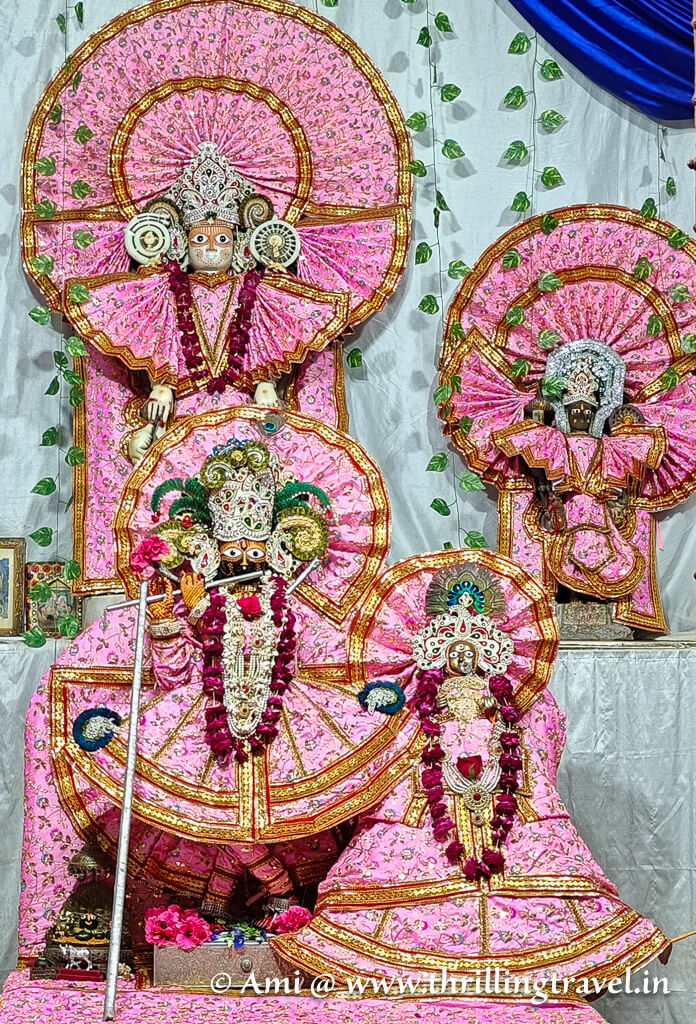
At the heart of the Jagat Shiromani Temple is an idol of Madan Mohan (Lord Krishna). But this is no ordinary temple idol. This particular Madan Mohan idol is believed to be the very same one that Meera Bai worshipped.
The story goes that when idol was in Chittorgarh even after she had left and during the Mughal siege was retrieved by Raja Man Singh I and brought to safety in Amer. It eventually found its new home here in the Jagat Shiromani Mandir. This Jagat Shiromani murti (idol) naturally fit in here as Lord Krishna is an incarnation of Lord Vishnu for whom the temple was originally built.
The Jagat Shiromani temple idol of Sri Krishna is only half the story. What makes Jagat Shiromani truly remarkable is that the temple complex also houses an idol of Mira Bai herself.
This is rare. Genuinely rare. Meera Bai was a devotee, not a deity — and yet here she is, enshrined and worshipped alongside her Krishna.
This fact itself makes the Jagat Shiromani temple special and possibly the only temple in the world where Meerabai shares a shrine with Lord Krishna. And now, you know why the Jagat Shiromani temple is popularly termed as the Meera mandir or Meera Bai temple. This Jagat Shiromani temple legend is also, possibly the best reason for you to visit this rare Krishna temple of Jaipur.
The layout of Meera mandir & its connection to the human chakras

Archit from Heritage Tracks shared some interesting knowledge about Jagat Shiromani — and Hindu temple architecture in general — something that I honestly, did not know about. This new tidbit made me see the temple with a new dimension. Let me share what I remember of it –
The layout of a Hindu temple is governed by an ancient principle called Vastu Purusha Mandala — in which the temple is designed as a physical representation of the human body and its chakra system. The journey from the entrance to the innermost sanctum called Garba Griha is a choreographed movement through the body’s energy centres, designed to quiet the mind and prepare you with the final encounter with the deity.
Picture a human body with the feet as the entrance of the Meera Krishna temple in Jaipur and then, find the corresponding chakras as you walk through the temple –
- The entrance is the Muldhara or the root chakra — you arrive here as you are, carrying the outside world with you. This is the root chakra in physical space.
- The circumambulation path around the temple are the Svadhisthana and Manipura (Sacral and Solar Plexus Chakra). The pradakshina is aimed at slowing you down and centering you.
- The mandapa or the hall way is where the shift happens. This is the Anahata (Heart Chakra) of the building — the bridge between the outer world and the sacred inner space.
- The antarala which is the narrow vestibule between the mandapa and the sanctum almost like the throat of your body. Vishuddha (Throat Chakra) is where the outside world starts fading away.
- The garbhagriha — the innermost sanctum, literally meaning womb chamber — is the smallest, darkest, most intimate space in the temple. By the time you arrive here, the architecture has done its work. The noise in your head has quieted. The deity is directly before you, in lamplight, in near silence. This represents the Ajna and Sahasrara (Third Eye and Crown Chakras)
- The last chakra – Sahasara or the crown chakra is represented by the shikhara or the towering roof of the temple that rises above the sanctum and rthe energy that transcends even the crown — reaching skyward, dissolving into the universal.
Fascinating, right? Suddenly, I was revisiting every temple I had seen. And more importantly, I had a new-found appreciation for the Jagat Shiromani temple layout. That said, every element of this layout has interesting features to offer. Let’s get on with the tour of Jagat Shiromani temple and find out the key things to see while you are here.
What to see inside Jagat Shiromani temple, Amer? (A tour of the Meera Bai temple)
There is a tendency to almost always by-pass this temple on your way to Amer Fort. From outside, you only see the tall shikhara. Though I drove past it on my first visit to Amer Fort, I felt a pull towards it. The shikhara was enough to indicate the presence of something beautiful inside. And sure enough, when I entered , I just stood at the bottom of the stairs for a long time, admiring the hidden toran gateway that I had missed in my rush, The first sight of the Jagat Shiromani temple is quite impressive.
In this section, I will walk you through all the features of the Meerabai temple, Jaipur. Let’s begin with the Toran gate.
The Toran gate of Jagat Shiromani mandir

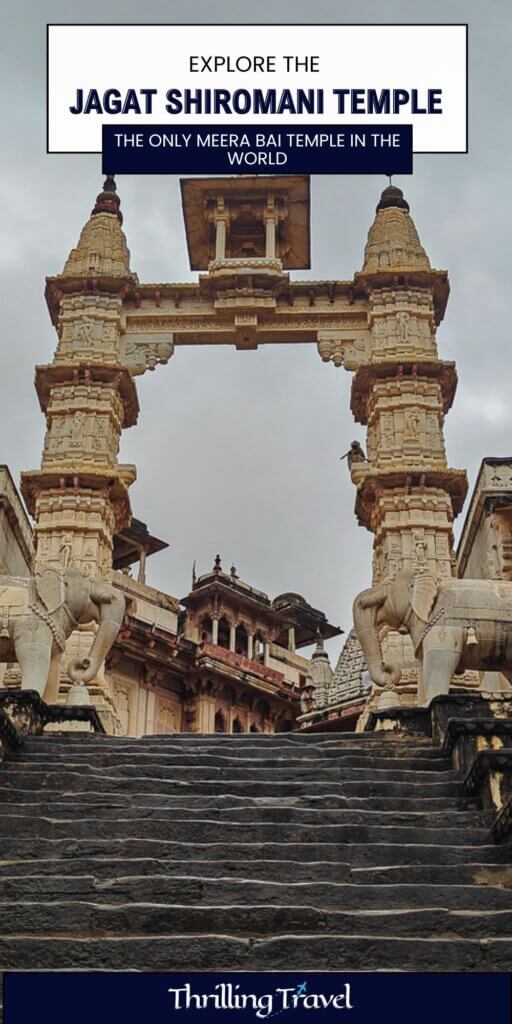
The stairs to the Meera temple lead to an ornate monolithic marble arch flanked by life-sized elephants. The sight literally stops you on your feet. As a photographer, you are really spoilt with angles. Should I take the angled staircase leading to the elephants? Or go closer and absorb the details along the Toran gate? Or pose in front of the elephant as I have in the cover picture of this post.
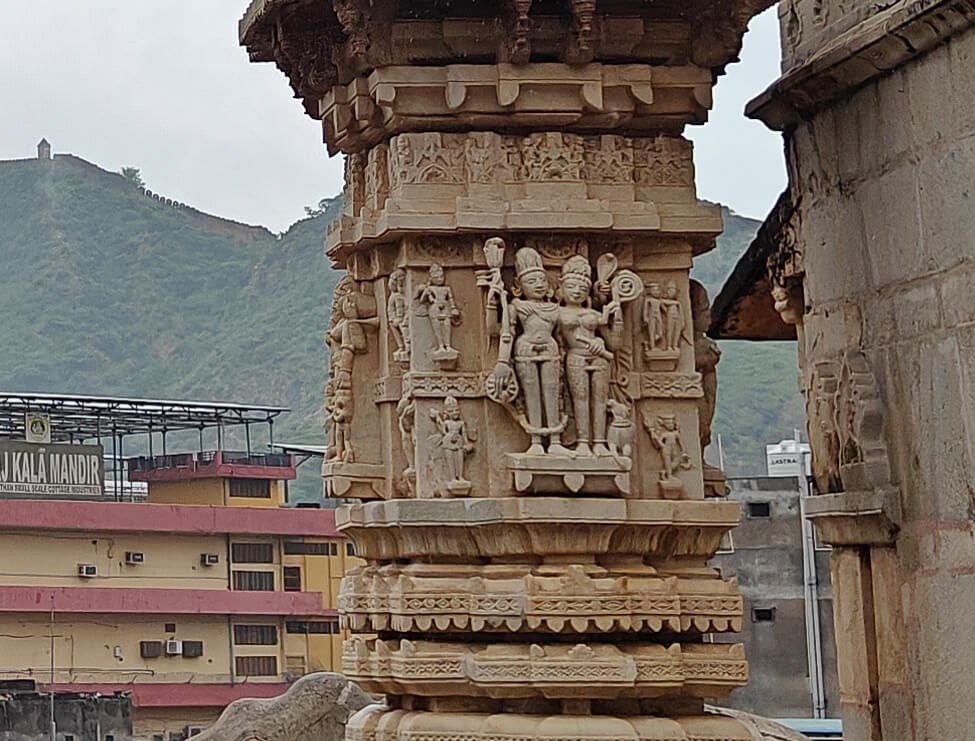
So, don’t be surprised when you almost always find the frame full with visitors. Everyone wants to take their picture here. Once you have had your fill of the frames, turn your attention to the intricate carvings – figures, motifs, and decorative bands with details that must have taken craftsmen years to produce.
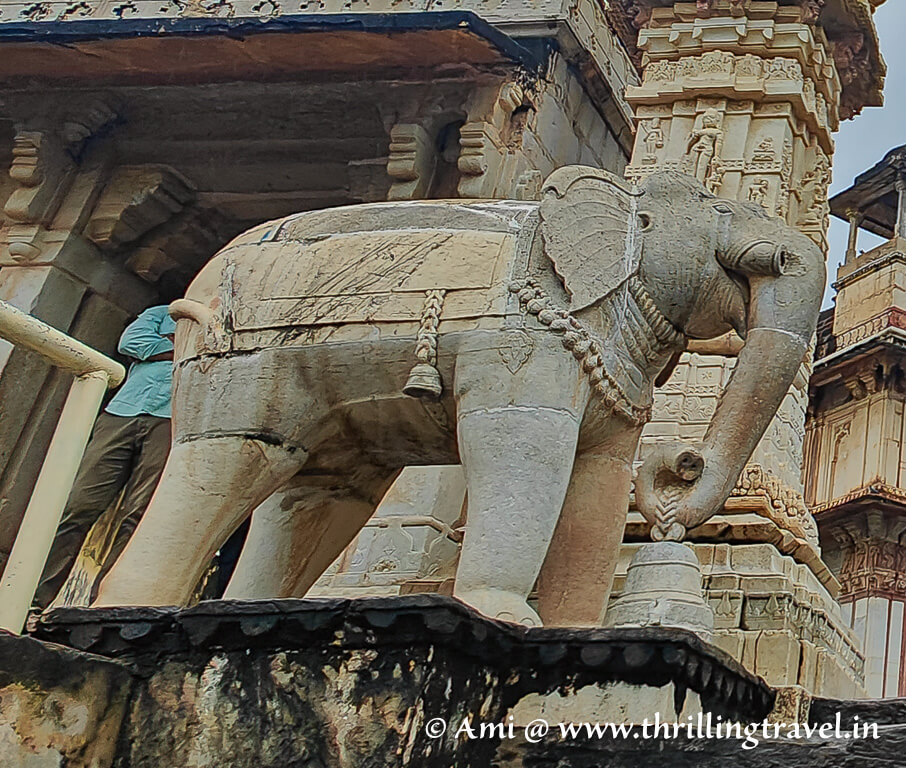
Remember though that the Toran gate is just the first impression. And a great start to what lies further inside the Meera mandir of Amer.
The 2nd entrance gate from Amer Fort to Jagat Shiromani temple
Step through the Toran gate into the courtyard. On your right hand side, you will see a smaller entrance to the same courtyard. Interestingly, this entrance connects directly to Amer Fort.
This was the royal entrance – which is quite simple compared to the toran gate. The family of Man Singh I did not need to come down to the main road to reach their temple — they had direct, private access from the fort itself.. For all its public grandeur, Jagat Shiromani was deeply personal to the royal family. Queen Kankavati built it from grief, and the fort-side entrance ensured that the royals could come here whenever they needed to — privately, directly, without ceremony.
If you are planning to visit this temple – either before or after the fort, then you can also, use this doorway. When you do, you will find yourself using a narrow stairway. Let me share an interesting bit about how the Queen used these narrow, uneven stairs. She never really walked down but would use a palanquin with two short men carrying it from behind and the taller ones in front -when descending. Naturally, they would reverse when ascending, ensuring that the Queen or the occupant was always level.
The facade of the Meera Bai temple, Jaipur
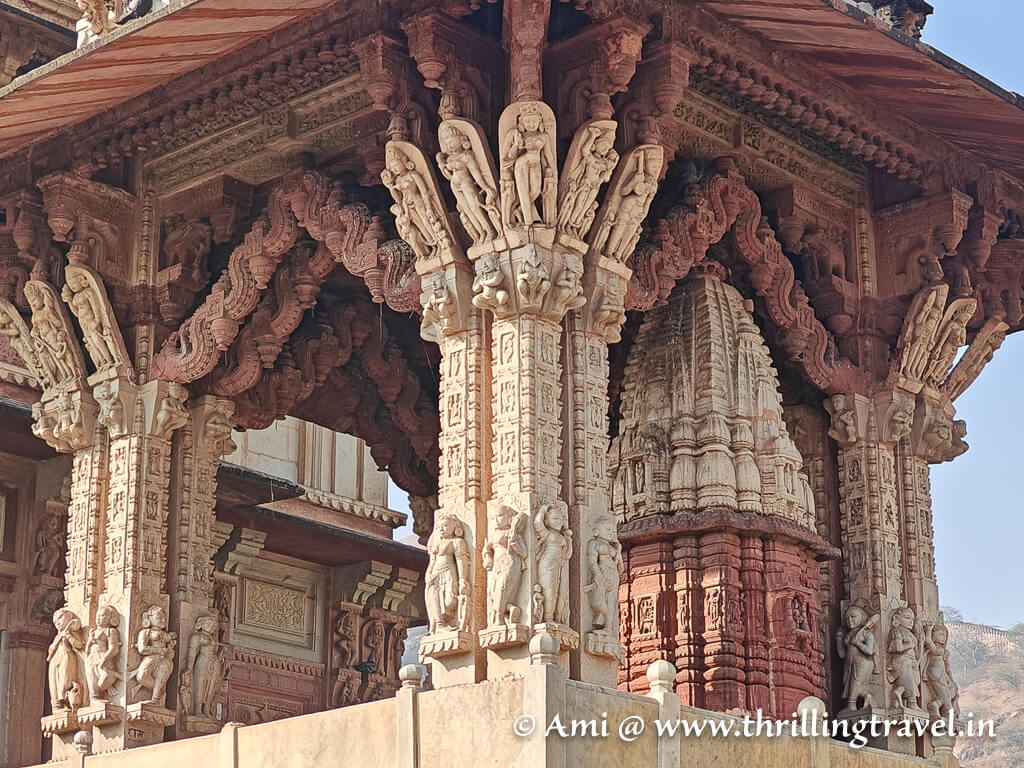
The temple is covered in carvings arranged in horizontal bands —elephants, horses, floral patterns and geometric motifs borrowed from the Mughal decorative tradition. There are apsaras and other celestial beings making their appearance along the pillars that hold up ornamental arches and ultimately merge into the exquisite shikharas. The entire facade is made of sandstone.
The temple doorway itself is the finest detail — carved with multiple bands of ornamentation, each layer different from the last. Run your eyes slowly across it before stepping through. It is easy to miss just how much is there.
This is where you can start visualizing the chakras of the human body – the first one being the entrance.
The Garuda mandapa
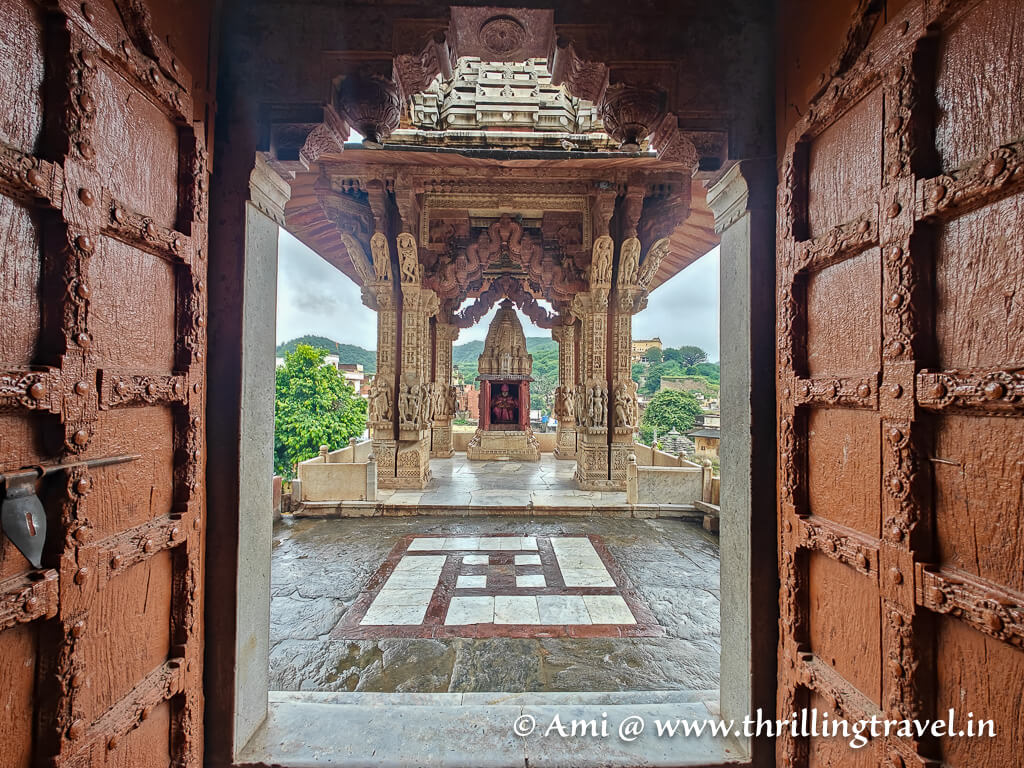
Before I take you to the main shrine, let me share a little about the smaller shrine that is opposite the main temple door. This is the shrine of Garuda — the divine eagle and vahana (vehicle) of Lord Vishnu. Its presence here is a direct reminder of the temple’s origins — Jagat Shiromani was originally built as a Vishnu temple, and a Garuda sanctum facing the main deity is a classical feature of Vaishnava temple architecture.
The mini shrine has its own set of intricate designs on its pillars and arches. It is quite a setting.
The Mandapa — The Pillared Hall
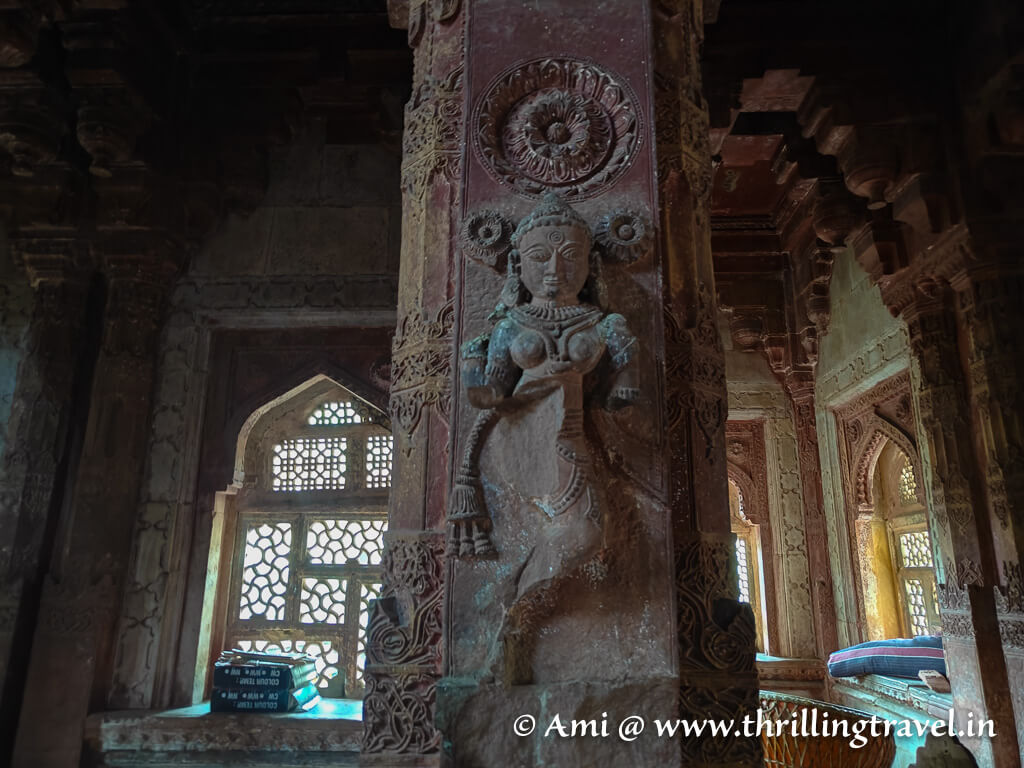
Step through the temple door and you enter the mandapa — the pillared hall that precedes the sanctum. The columns here have finely worked bracket capitals, and carvings of the nymphs in various poses. the ceiling above is worth looking up at.
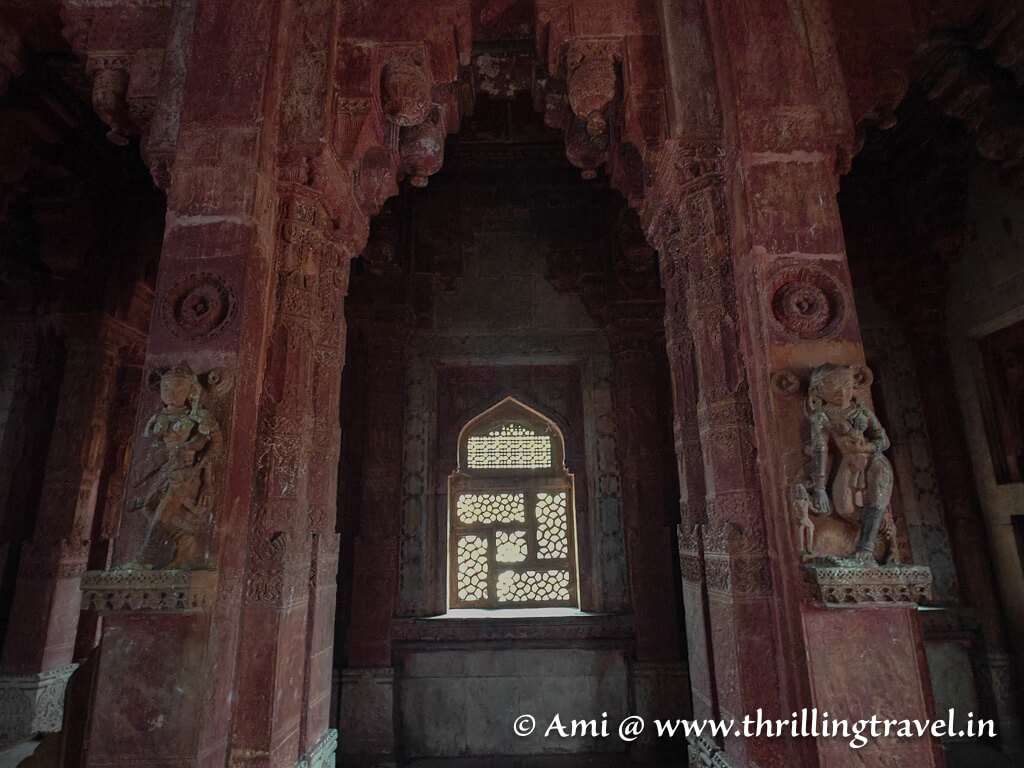
The light inside the mandapa is softer than outside — contained, quieter. You will notice the shift in atmosphere almost immediately. The busy road outside already feels far away.
The Garbhagriha — The inner Sanctum
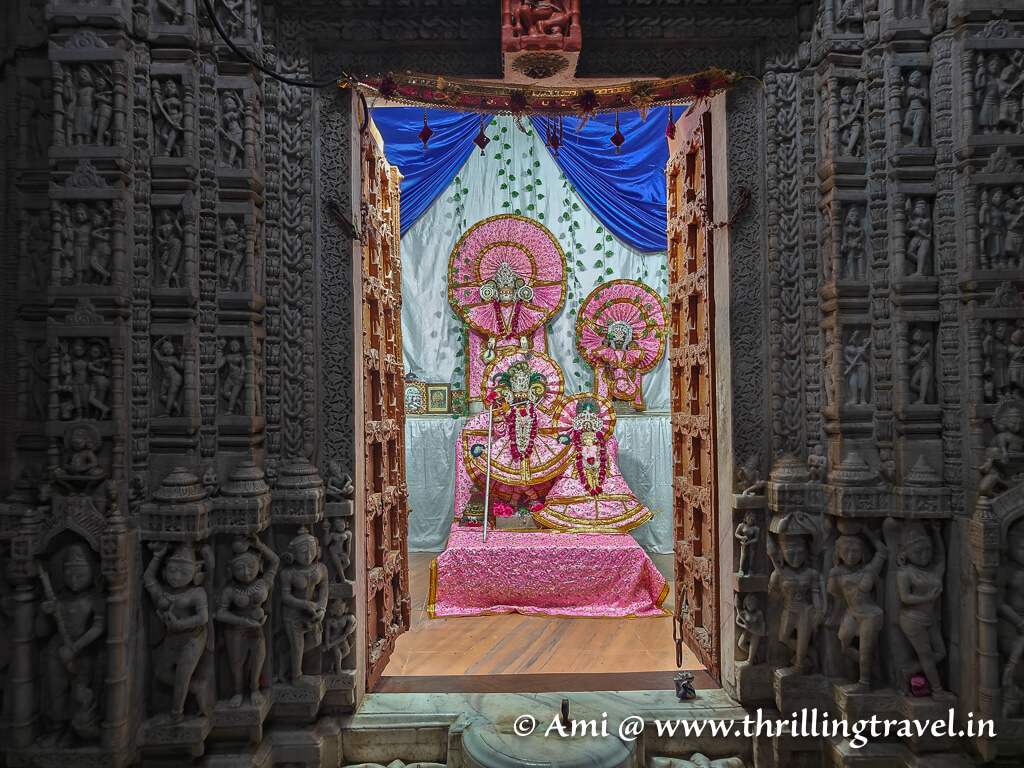
The innermost sanctum has a gorgeous carved door frame that perfectly outlines the scene behind. Here, the famed Jagat Shiromani temple murti of Lord Krishna that Meera Bai is believed to have worshipped — is adorned with flowers and illuminated by the warm glow of lamps. Just a pedestal below has the statue of Meera Bai herself— a devotee worshipped alongside her deity – possibly the only temple where this is done.
Above both of them is the statue of Lord Vishnu – for whom the temple was originally built. Together, they cast a divine aura that is not just seen but felt.
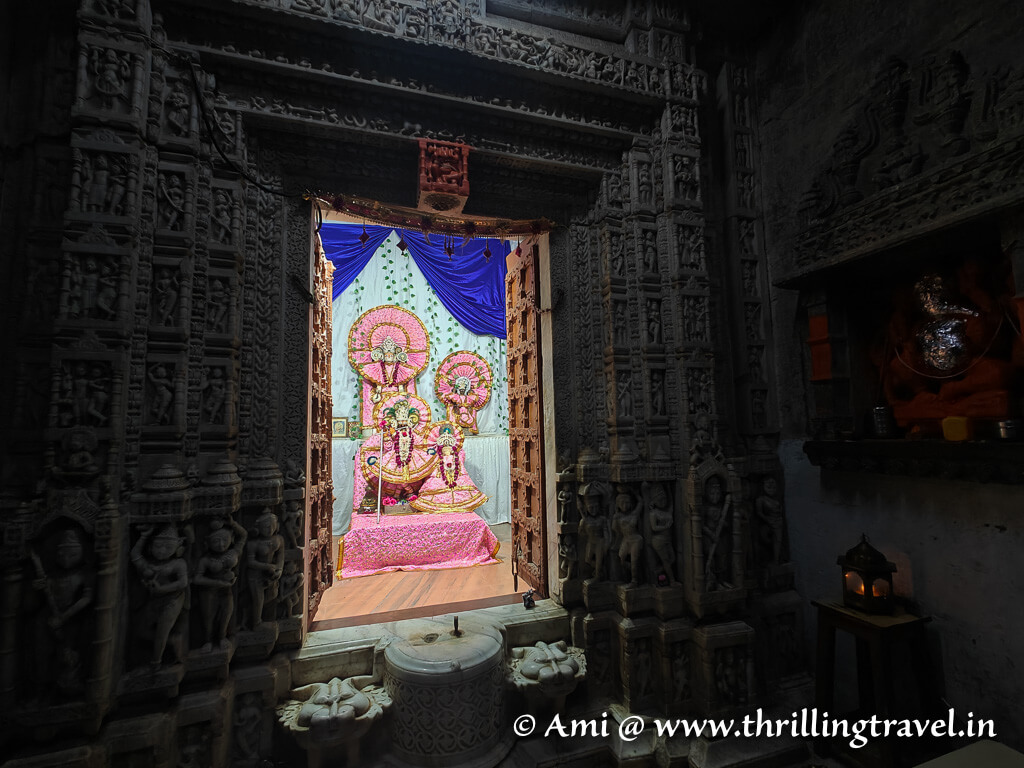
By the time you reach this point, the Toran gate, the façade, the mandapa, the narrowing vestibule — all of it has done its quiet work on you. You arrive at the sanctum already slowed down, already receptive. That, as Archit told us, was always the intention.
With that, we complete this virtual tour of Jagat Shiromani temple.There are places you visit once and remember. And then there are places you visit once, and find yourself returning to — each time finding something you missed, something that speaks differently depending on where you are in life when you walk through those doors.
Jagat Shiromani is the second kind!
I have walked through that Toran gate as a photographer chasing the perfect frame, as a heritage enthusiast tracing the fingerprints of a 17th century queen’s grief, as someone trying to understand what made Meera Bai’s devotion so extraordinary that a temple enshrined her alongside her god, and as someone simply looking for a few quiet minutes away from the noise of the world outside. Every single time, the temple has met me exactly where I was.
Whether you arrive as an architecture lover, a heritage buff, a photographer, or someone on a spiritual search — Jagat Shiromani has something waiting for you. Possibly all of the above, if you give it enough visits.
How can I combine a visit to Jagat Shiromani Temple with Amer Fort?
The temple sits right on the main road leading up to Amer Fort, so the two are a natural pairing. If you are driving, park at the Amer Fort parking area and walk down to the temple first — it takes no more than a few minutes on foot. Visiting Jagat Shiromani before the fort means you arrive at the temple fresh, unhurried, and with the energy to give it the attention it deserves rather than squeezing it in as an afterthought on the way back.
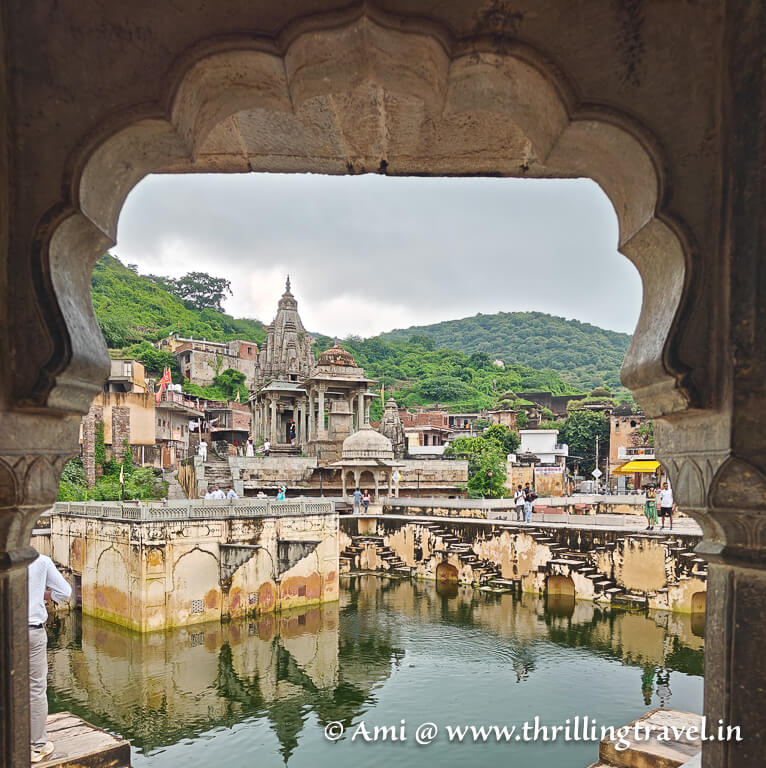
If you want to go deeper, consider doing the Amer town walking tour — it is how I discovered this temple in the first place, and it completely changed the way I experience Amer. Rather than just ticking off the fort, the walking trail takes you through the old town, past Panna Meena Ka Kund, through the Amer bazaar, and to Jagat Shiromani — with a guide who brings the stories of each stop alive. You can do a self-guided tour as well. – details and a map of which I have included in this post.
What is the best time to visit Jagat Shiromani Temple?
The best time to visit is during the winter months — October to March — when the weather in Jaipur is pleasant and comfortable for exploring Amer.
Janmashtami – usually in September is special here. If you can time your visit to coincide with Janmashtami — the celebration of Krishna’s birth — you can be a part of the festivities here. The temple is decorated specially for the day. However, expect a lot of crowd as devotees gather for special darshan and bhajans dedicated to Krishna and Meera Bai..
The Jagat Shiromani temple timings are from 6 am to 8 pm. Within the day, early morning is ideal — the temple is at its quietest, the light on the sandstone facade is at its most beautiful, and you will have the Toran gate almost to yourself for photographs. Late afternoon, just before the 8 pm closing, is the next best option — the evening light is equally flattering.
How do I get to Jagat Shiromani Temple from Jaipur?
The most convenient option is a cab or auto-rickshaw from Jaipur city directly to Amer. Ask to be dropped at the Jagat Shiromani Temple rather than Amer Fort — they are close to each other but the temple stop will save you backtracking. Public buses to Amer are also available from various points in Jaipur city and are a budget-friendly option. I have covered this section in detail in my Amer Fort blog post as well as the Amer walking tour post.
Common FAQs about Jagat Shiromani temple or the Meera temple of Amer
Is there an entry fee for Jagat Shiromani Temple?
Entry to Jagat Shiromani Temple is free. There are no ticket counters or photography fees — unlike Amer Fort which has a separate entry charge. This makes it an easy addition to your Amer itinerary without any additional planning.
Can I combine a visit to Jagat Shiromani Temple with Amer Fort?
Absolutely — and this is the recommended way to do it. The temple and the fort are within easy walking distance of each other. In fact, as you now know, there is even a secondary entrance connecting the two directly. Plan the temple either before or after the fort — or use the connecting doorway if you are visiting the fort. Either way, budget at least 30 to 45 minutes for the temple to do it justice.
How much time do I need at Jagat Shiromani Temple?
A minimum of 30 minutes is recommended if you want to take in the Toran gate, the facade, the Garuda shrine, the mandapa, and the sanctum properly. If you are a photographer or someone who enjoys absorbing details slowly, you will easily spend an hour here. On my own visits, I have never managed to leave quickly.
What are the other places to visit near Jagat Shiromani Temple?
Amer town has far more to offer than just the fort. Some highlights worth combining with your temple visit include Panna Meena Ka Kund — one of the most architecturally striking stepwells in Rajasthan, just a short walk away — the Amer bazaar for a glimpse of everyday life in the old town, and Jaigarh Fort visible on the ridge above. For a fuller exploration of the area, I have a dedicated post on the Amer town walking trail that covers all of these and more.
What should I keep in mind when visiting Jagat Shiromani Temple?
This is an active place of worship, not just a heritage site. Dress modestly, remove footwear before entering the temple, and be mindful of devotees at prayer — especially inside the sanctum.
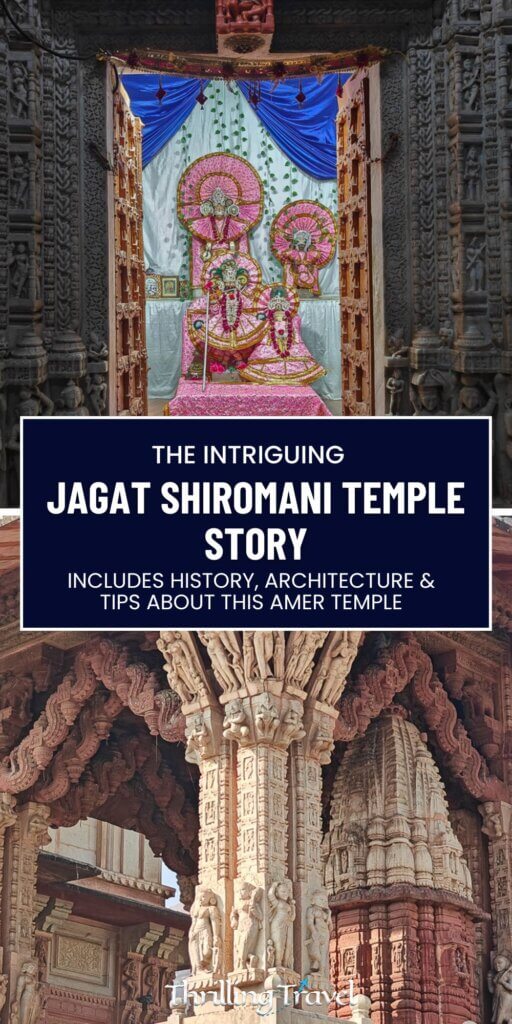
Before you go, pin this


Popularly referred to as a Restless Ball of Energy. My Mom refuses to entertain my complaints about my equally restless daughter & assures my husband that I was born with a travel bug.
I am a Post-Graduate in Marketing by qualification and a travel blogger by passion. Besides travel, I enjoy photography and if you don’t find me at my desk, I would be out playing badminton or swimming or just running. I believe in planning for every long weekend through the year. And when I cannot travel physically, I travel virtually through this travel blog. My travel stories have also, got published on various websites and magazines including BBC Travel, Lonely Planet India and Jetwings. I have recently published my first book – When Places Come Alive – a collection of stories that are based on legends, landscapes, art and culture of a place which is available in both ebook and paperback format.
You might also like these posts –
- A walking tour of Amer town, Jaipur (with a map & itinerary)
- How to plan a perfect Amer fort tour in Jaipur (what to see, tickets, timings & insider tips for 2026)
- Jaipur City Palace Royal Tour: Experience the Grandeur of Royalty
- All the things that will make you go WOW at the City Palace Jaipur
- How to plan a trip from Delhi to Jaipur by road?
- Inside the Palace of Winds: A Guide to Hawa Mahal Jaipur
- Tour of the Jantar Mantar in Jaipur
- A guide to a must-do heritage walk in Jaipur (includes insider tips on what to see & how to plan a Jaipur old city walk)
- 10 travel tips for Rajasthan
- The intriguing Jal Mahal in Jaipur
- Sisodia Rani Bagh: A royal tryst with nature
- Secrets of the Jaigarh Fort in Jaipur
- Best areas to pick hotels in Jaipur
- Places to see in Jaipur over 3 days