
Not one palace here but a layering of will,
Moorish arch, Gothic vault, sunken garden and rill,
Ten centuries deep and unfolding it still.
Visiting Alcázar Seville can be quite a thrill.

Discover one of the most popular UNESCO World Heritage sites in Seville with this self-guided tour of Royal Alcázar . It includes the famous courtyards and the corners most visitors walk straight past. Along with the key highlights, get tickets, timings, a route map and tips to plan an Alcazar Seville visit in 2026 - 27.
I have always had a soft spot for old palaces, and this one came pre-loaded with recognition — a set from Lawrence of Arabia, later a stand-in for Dorne in Game of Thrones (GOT). It went straight onto my must-do list for Seville. I ensured I booked in advance to visit Alcazar Seville. What I hadn’t quite registered until I got there: this is one of the oldest palaces in Europe still in active use by the same Spanish royalty, whose other residence in Madrid I had just visited.

That said, the Royal Palace of Madrid could not be more different from the eclectic Real Alcázar. For one, the royal residence of Seville is much older and, more importantly, a stunning fusion of architectural styles, including Islamic, Baroque, Gothic, and Renaissance. Add to that the intriguing stories that lurk in every corner of this Seville attraction. There is so much happening inside Alcazar Seville that you definitely need to be prepared for a frenzy – owing to a sensorial labyrinth.
This blog post is more than just a Royal Alcazar guide. It is a room-by-room tour for you to know what to see in Alcazar Seville. I have included not just the key Royal Alcazar highlights but also, the lesser-visited spots in the palace. With my Seville Alcazar map and route, you will be able to plan your own visit well. As always, there are insider Alcazar Seville tips that include the best time to visit, how to book the right tour and what are the current 2026 -27 Alcazar Seville ticket prices.
In short, this is the only travel guide that you will need to plan a Royal Alcazar visit in Seville.
Quick links for planning your Seville Alcazar visit
- Booking.com has several good Seville hotels and B&Bs listed on their site. You could use this link to browse and book the same.
- GetYourGuide has tons of tours, discount cards and transfer services available on their site, which would be useful for your trip. Here are five suggestions that you could consider for your visit to Seville – specifically Royal Alcazar and places to see around it.
- Viator is another good website for booking your Seville experiences and tours. Check these five tours that might be helpful in discovering Seville.
- For any of your travel needs or general shopping, consider using Amazon through this link.
Disclaimer: This article includes affiliate links. This means that at no cost to you, I will receive a small commission if you purchase through my link. Thank you for supporting me with this.
Is the Royal Alcazar the same as the Alhambra?
Not at all. Though the confusion is fair, since people often ask what is the Alcazar in Seville when they really mean the Alhambra in Granada. The two tend to get mixed up – one mistake that my better half always makes.
Both are Andalusian palace complexes, both are UNESCO-listed, and both share the same architectural DNA — horseshoe arches, muqarnas ceilings, courtyards built around still water. That overlap isn’t a coincidence. Pedro I actually borrowed Nasrid craftsmen from Granada to build much of what you’ll see on this Alcazar Seville tour. Hence, you will find several of the details made by the same hands, or the same tradition, as the Alhambra of Granada.
Each one is located in a different place but the real difference is who they were built for. The Alhambra was a Muslim seat of power, built by and for the Nasrid dynasty. The Alcázar in Seville was built by a Christian king who chose to build in that style. The later generations added their own styles to it – which is why it reads as a fusion rather than a single architectural style.
Unlike the Alhambra, which is purely a monument today, the Alcázar is still a working royal residence. The Spanish royal family stays here on visits to Seville. I will point out where that split shows up as we go through the rooms.
History of Alcazar, Seville
The word “Alcázar” comes from the Arabic Al-Qaṣr, meaning fortress or palace. In 913, the Umayyad caliph Abd al-Rahman III ordered a fortress built on this site, on ground that had already held a Roman settlement and a Visigothic basilica – all of which no longer exist.

In the 11th century, under the city’s independent Abbadid rulers, the fortress grew into a proper palace known as Al-Mubarak — “the Blessed”. The Almohads took over and expanded the Mubarak palace with stables and a few other buildings till the 12th century. They even constructed Seville’s Great Mosque, whose minaret still stands today as the Giralda.
I could see a few remnants of the 12th century Almohad rule even today in various parts of the Real Alcázar like the Patio del Yeso. The dynasty expanded their defensive walls to protect their flourishing trade along the Guadalquivir River and port. The Alcazar walls were connected to Torre del Oro and a sister tower called the Torre de la Plata, with heavy chains that were raised to seal the port off from enemy ships entirely. A fascinating detail that was shared with me during my 2-day Seville tour.

That chain held until 1248, when the Castilian admiral Ramón de Bonifaz broke through it by force, opening the river to Fernando III‘s fleet and the city to Christian conquest. The Alcázar changed hands, but rather than being replaced, it kept growing.
Alfonso XI added the Sala de la Justicia in the 1340s, its Mudéjar ceiling and Arabic inscriptions built by Christian order but in the existing architectural language. Then, between 1364 and 1366, Pedro I built the palace most visitors come to see, calling in Nasrid craftsmen from Granada to do it. A cathedral eventually replaced the Great Mosque next door too, with its minaret repurposed from a call to prayer into a bell tower — the Giralda still standing there today.
In 1987, UNESCO inscribed the Alcázar as a World Heritage Site together with the Cathedral next door and the Archivo de Indias — a joint listing for a complex that tells Seville’s Islamic, Christian and Golden Age history in one place. Today, when you visit Alcazar Seville, you will be able to spot many relics from its layered history.
Planning your Royal Alcazar tickets and tour
Before we get to the virtual Alcazar Seville tour, let me share some important points that will help you plan an Alcazar Seville tour. In this section, you will find information related to the best time to visit Alcazar Seville, types of Alcazar tickets, their prices and the various types of tours that are available. The information presented here is based on my own experience of planning and booking Alcazar Seville.

Booking tickets for Real Alcázar Seville
The first and most important tip to plan your visit is that you must book your Alcazar tickets in advance. During the peak season (June to August), it gets sold weeks ahead. Here is where you can buy the tickets for the Alcazar Seville.
On the official website
This is the most cost-effective option for getting your tickets for the Real Alcazar. Head to the official website, pick your ticket type, select your time slot and pay. As of 2026, the general admission ticket for Alcazar is €15.50 for an adult. Students EU Youth Card holders, and visitors over 65 have a subsidized rate.
The general admission Alcazar tickets cover the Antiquarium, the Triana Ceramics Museum, and the Bellver-Casa Fabiola Museum. Quite like the special tour in Jaipur City Palace that takes you to the royal apartments that are in use, you have an option here to visit Alcazar’s Cuarto Real Alto (the royal family’s upper-floor apartments). This is a timed entry that can be added to your general admission ticket and costs €5.50.
I did a self-guided tour of the Royal Alcazar without this option. There is a handy audio guide that you can download before you start your tour and that, along with the maps and useful signages is that I used to enjoy my visit here.
On-the-spot bookings
Use this only as a last-minute option. Tickets are sold at the counter in the Patio de Banderas from 9 am, but card payment only, and availability is limited.
Booking through third-party sites
This was my fallback option in case I did not get the tickets from the official website. I had picked a few options from GetYourGuide and Viator — the same platforms I used for my Alhambra tour. They have a wide range of options, from basic entry to guided tours. I have included some of these options in the booking section above that you can consider when booking your tickets.
What should I do if the Alcazar Seville tickets are sold out?
This nearly happened to me. I visited in April and only booked online a week before my visit — cutting it much closer than I would advise. I got lucky and found a slot, but the choice was thin: I’d wanted a morning entry for softer light in the courtyards, and by the time I booked, only afternoon slots were left.
If you find your dates sold out on the official site, head to GetYourGuide or Viator — tickets there run at a markup, but they’re a reliable fallback rather than a last resort.
You could also look into Real Alcázar free entry, which runs Monday afternoons only for the last hour before closing — worth knowing about, though I wouldn’t rely on it as your main plan; one hour isn’t enough for a first visit, and those slots fill fast too.
A third fallback is booking through a city walking tour that includes Alcázar entry. I’d treat that as a genuine last resort rather than a real option — most of these tours move fast and only skim the surface, which does no favours to a site with this much to actually see.
Should I take a tour of Royal Alcazar? What are the types of tours available?
Honestly, I did get a little FOMO first when I saw a group tour burst into laughter – possibly at a quirky narration of the guide. However, it was soon dispelled when I began my own self-exploration of the Alcazar. There is always a trade-off that you will have – irrespective of the choice you make. Let me just highlight your choices here.
Self-guided tour of Royal Alcazar, Seville
This is what I did, and it worked well. I relied on the Alcazar Seville audio guide, downloaded before I started, along with a printed Seville Alcazar map and the signage dotted through the complex — and honestly, that combination was enough. What it gave me was freedom: time to linger in a courtyard I liked, double back for a corner I had walked past or was too crowded earlier, and actually study the intricate plasterwork till I had my fill.
If you are leaning towards going it alone, this Royal Alcazar guide is built to make that easier than it was for me. My own route map and the room-by-room notes further down this post cover the same ground my audio guide and signage did, plus the details I only picked up afterwards — so you can walk in with a plan already in hand rather than piecing one together on the day.
Guided tour of Real Alcazar
The trade-off became obvious watching the guided groups around me. They moved efficiently through the main features of the Alcázar, but I could hear the guides dropping in the odd bit of gossip, the quirky legends — stories no audio guide mentions.
My guide at the Alhambra in Granada did exactly that, and I missed having the same here. If those human details matter to you more than pace does, a standard group tour is the way to get them.
However, note that you have to keep pace and do not have the time to see the unseen corners or examine an interesting inscription or pose for pictures. It is a bit like a whirlwind tour.
Private tour of Alcazar
Same benefit as a guided group tour, but with the guide’s full attention rather than shared with fifteen other people. You can ask as many questions as you like and set your own pace within the tour. It costs more, and it’s worth it specifically if that one-on-one time is what you’re after.
Alcazar Seville early access tour
An Alcazar Seville early access tour gets you inside before the general public. Worth it if avoiding crowds matters more to you than saving money — the courtyards photograph very differently empty. However, it does come with a price.
Combo tour with the Cathedral

If your time in Seville is tight, a combo tour covering both the Alcázar and the Cathedral is a smart way to fit two major sights into one guided block, rather than booking and timing two separate visits.
That said, remember you will only be going through the main areas of both monuments.
Which one should you pick?
- Want to move at your own pace and don’t mind missing the guide’s stories → self-guided
- Want the legends and quirky details along with your history → guided or private
- Crowds bother you more than the extra cost → early access
- Short on time and want to check off two sights at once → combo tour
What is the best time to visit the Royal Alcazar of Seville?
There is no single best time to visit Alcazar Seville — it depends on weather, light, or crowds. Here are your options
Season-wise – I recommend spring and autumn.. Summer is punishingly hot, often past 40°C. Touring inside Alcazar might not be too hard but the Alcazar gardens offering almost no shade. Winter is comfortable and far less crowded, but the light inside the palace is duller.
Crowds, though, do not follow the weather. Semana Santa and Feria de Abril are both in spring and the two festivals attract a lot of crowd. The Alcázar’s tickets are hardest to get. I found this out the hard way, booking only a week before my April visit and getting whatever slot was left.
If you want good weather without fighting festival crowds, the days just after Feria ends, or the whole of May, are a quieter version of the same season.

Time of day matters more than people expect. Morning slots give you the best light for photos, particularly in the Patio de las Doncellas, and the courtyards are noticeably calmer before the tour groups arrive mid-morning. Whatever season or time you choose, plan around the Alcazar Seville opening hours – 9:30 am to 7 pm from April to September, and 9:30 am to 5 pm from October to March. Note though, that the last entry is an hour before closing and eviction of the grounds begins 45 minutes after that. That is why I would not recommend the last slot.
I visited in April, and the temperature was perfect. I booked a week before my visit and could not choose my own time slot. I ended up visiting the Alcázar around 3pm but got lucky with the light. That said, it was hard avoiding the crowds. Even so, I had more than enough time to explore inside the Alcazar and walk through the Alcazar gardens at an easy pace.
Also, note that 2026 marks 500 years since Charles V’s wedding to Isabella of Portugal. The Real Alcázar has built a full events calendar around it, including new exhibitions and installations tied to the anniversary. You can check the same on their official website to see if it interests you.
If you are wondering what is Alcazar show and whether it is worth adding on, the answer is the theatricalised Alcazar Seville night visit. It is held between Thursday to Saturday in the evening. Currently, it is themed around that same Carlos V wedding anniversary. However, it runs in Spanish only and is for ages 8 and up.
Alcazar tips to follow during the visit
Here are a few Alcazar Seville tips to keep your visit smooth from the moment you arrive to the moment you leave.
- Keep your ticket handy — either the printed copy or the digital version with its QR code. You will need to show it at the entrance to Alcazar Seville, so do not bury it deep in a bag.
- Download the map and audio guide before you arrive. Wifi and signal near the entrance can be patchy with everyone else trying to do the same thing at the last minute.
- Reach the Alcázar at least 30 minutes before your slot. Security checks and the sheer number of visitors mean the queue moves slower than you would expect. In my experience, the call to line up came around 15 minutes before the actual entry time, so stay close enough to hear it when it comes.
- Do not miss your entry window. Slots are timed, and arriving late can mean you are simply not let in — there is no flexibility built into the system. Once you are inside, you are free to explore at your own pace and leave whenever you are done. There is no time limit once you have entered.
- There is no re-entry, though. Once you exit, your visit is over for the day, so make sure you have seen everything you want to before walking out.
- No outside food is allowed inside the complex.
- Only small backpacks are permitted. Larger bags will likely need to be left behind or checked, so travel light.
- Tripods are not allowed, so plan your photography accordingly.
Visiting Alcazar Seville really comes down to being prepared before you even reach the gate. These few tips will help you with a a relaxed morning and avoid a stressful scramble at the entrance.
The architecture and layout of the Royal Alcazar in Seville

The Royal Alcázar complex reminded me of Mehrangarh Fort. Every ruler added their own touch to the palatial home – expanding it to the structure that stands today. While Mehrangarh Fort of Jodhpur predominantly exhibits Mughal and Rajputana architecture, the Alcazar showcases a medley of Islamic, Renaissance and Gothic architecture.
If you look at the Alcazar Map, you will find three distinct zones that you will want to visit – the courtyards, the palace complex and the gardens of Alcazar. Around 80% of the 9 hectares of Real Alcázar is occupied by the gardens, while the remaining make up a splendid built-up space.
My recommended route in this Alcazar travel guide helps you explore all these zones. There are two major palaces that you will be visiting – Palacio de Pedro I and Palacio Gótico.
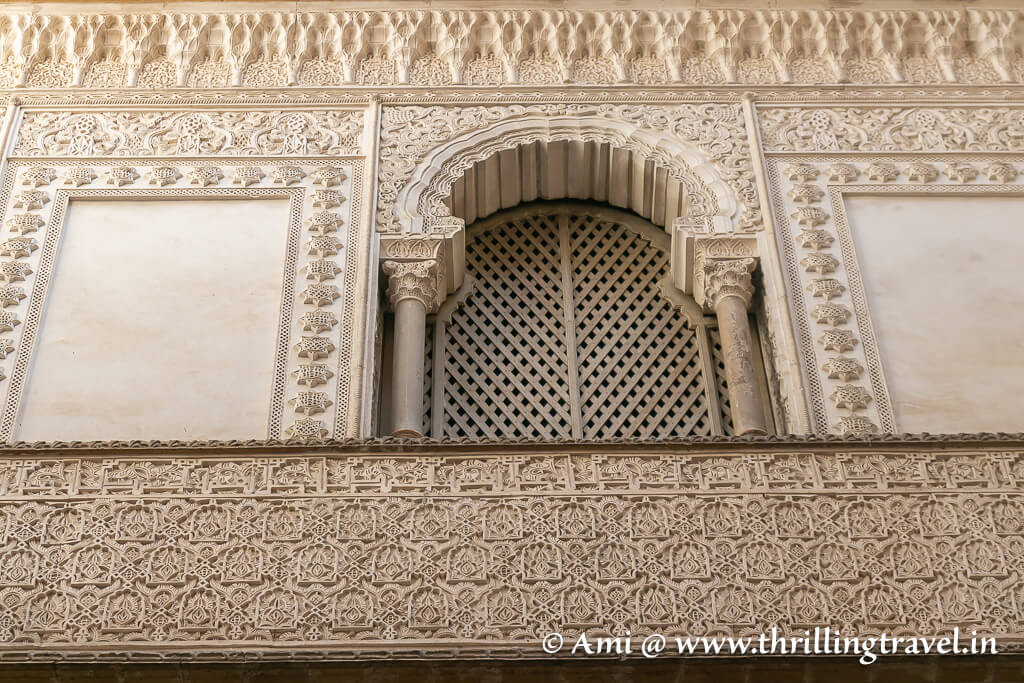
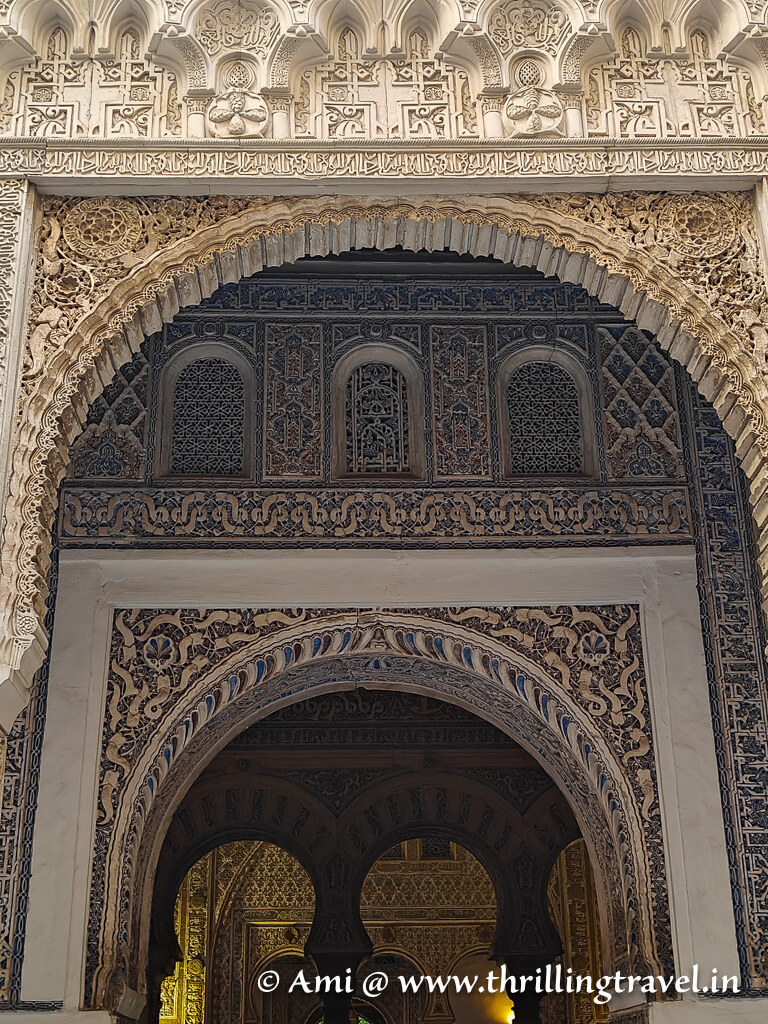
Be prepared to be stunned by the exquisite Mudejar architecture of the Pedro palace – the intricate Sebka artwork and the ornate Muqarna ceilings. Between the rooms, you will find the lovely tiled patios with soothing water bodies and shaded pavilions. This alone makes Alcazar one of the best places to see Islamic architecture in Spain.
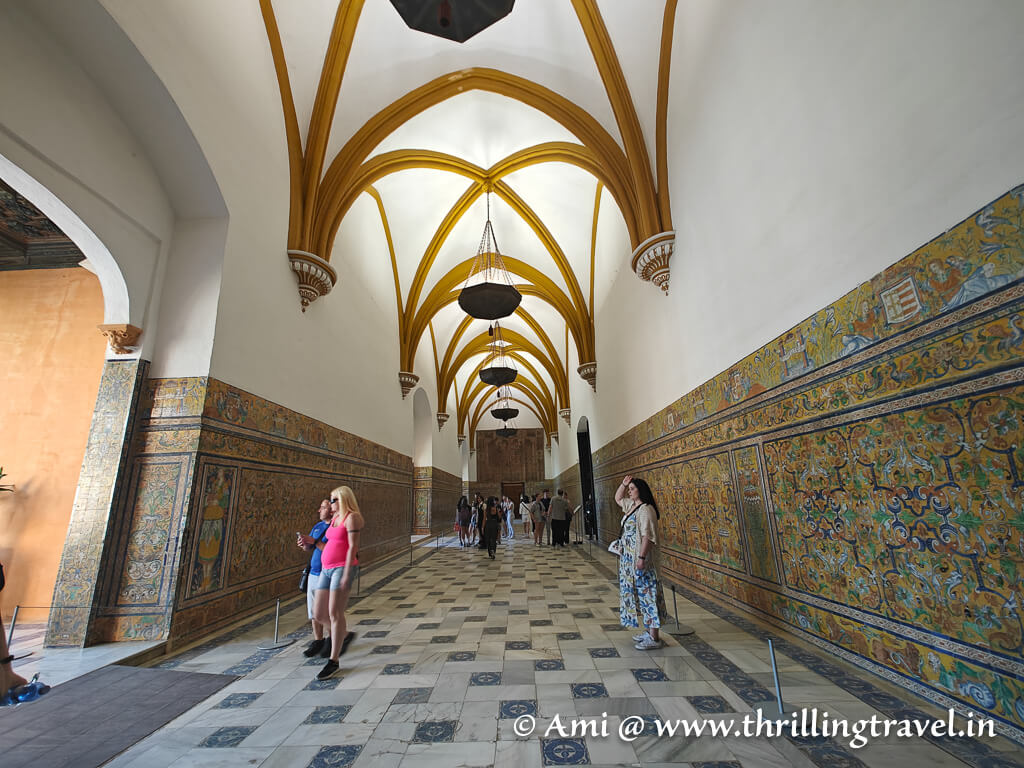
The Pedro Palace seamlessly transitions into a Gothic masterpiece with the other palace. The arabesque stucco gives way to more of the tiled artwork and the spaces change to pointed vaults. The Admiral’s Hall makes the third built-up section of this palace complex – a trading office where many historic events took place.
Then there are the gardens with fountains, ponds and beautiful orchards – each one adhering to a specific theme. Some memorable – thanks to the GOT scenes. There are so many stunning features of the Alcazar Seville that no matter how much time you spend here, you might feel it is not enough.
My self-guided tour of Royal Alcazar – room by room with a map
I admit that my expectations of what to see inside Royal Alcazar Seville were colored by my earlier visit to the Royal Palace of Madrid. Though I had seen some pictures of the place, but what I finally experienced was completely different. There was a smattering of green and blue spaces between ornate rooms, galleries that explained various facets of the palace and stories contained within those timeless walls.

The place is like a labyrinth and you will find yourself wondering if you have missed something. That common feeling when there is so much to see. This is when my Alcázar Seville map here will be handy. I have marked a route for you to follow along with the tour below. That should ensure you get to all the key attractions before you exit.
Puerta de Abd al-Aziz

Well, honestly! This was not inside Alcazar. However, I felt the need to include it in this tour of the Alcazar, as it was once the palace’s outer defensive wall.
I stumbled upon it during my walking tour of the Barrio Santa Cruz. The doorway is built into the corner of a 1919 building on Avenida de la Constitución, and it has been absorbed so completely into the streetscape.
This hexagonal tower dates to the 12th century, and it once anchored the same defensive wall that ran from the Alcázar down to the river, linking onward to the Torre de la Plata and finally the Torre del Oro. When Ferdinand III marched into Seville, he hung his victory banner here and thus the tower got rechristened to “Tower of Victory”.
If you are doing a Barrio Santa Cruz walk before or after the Alcázar, keep an eye out for it. It is easy to miss, and that is exactly why it is worth finding. In all likelihood, you might be passing through it to get to the official and main gate of the Royal Alcazar.
The Lion Gate, or Puerta del León

You will find yourself standing in queue at your time slot at this gate. I used the opportunity to check out the gate in detail. Above the doorway, worked into some 150 hand-set tiles, a crowned lion holds a crucifix in one claw, a flag beneath the other. Across its chest, in Gothic lettering, runs a single Latin phrase – AD UTRUMQUE. This means ”prepared for either”.
Don’t dismiss the Azulejos (tiles) on the gate. They date to 1892 and were made in the Mensaque workshops in Triana. The tiles replaced a painted lion in the same spot. The gate that existed earlier was a part of the 8 metres high Almohad wall. Later in the 1360s, Pedro I had a doorway cut through.
For centuries, this Royal Alcazar gate was called the Puerta de la Montería or the Hunting Gate, after the courtyard just inside. I am told that ”Puerta del León” only stuck after 19th-century Romantic writers fell for the lion.
This self-guided tour of the Royal Alcazar begins here, at the same Real Alcazar entrance. It is where every visitor still queues through today.
Patio del Léon, Alcazar (Courtyard of the lion)
Myrtle hedges lined the pathway to a small courtyard called the Lion Courtyard. It is a pleasant space filled with roses and pomegranate trees – a design laid out in the 20th century by Joaquín Romero Murube.
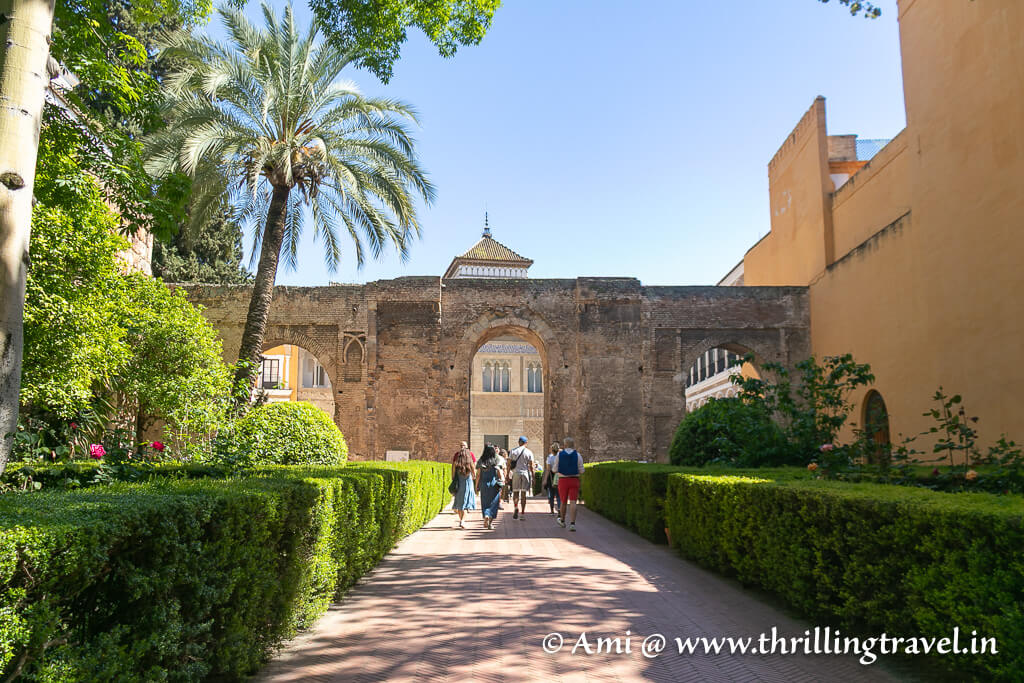
Most people rush through eagerly to get started on the more popular features of Alcazar. They tend to miss the old plastered arched wall that is right in front of them – an Almohad legacy that has survived when the rest of the 11th- 12th-century palace called Alcázar de la Bendición was demolished almost entirely to build the Mudéjar Palace.
This quiet courtyard once held the city’s largest comedy theatre, packed through much of the 17th century until fire destroyed it in 1691.
Hunting Courtyard (Patio de la Montería)
This was traditionally the waiting courtyard — where visitors gathered before being received, and where medieval Seville’s citizens once had their cases heard, right in front of the central arch of the old wall that you have just passed. They say that there were traces of the older Almohad palace found below this courtyard that was made by Pedro I in the 1300s.
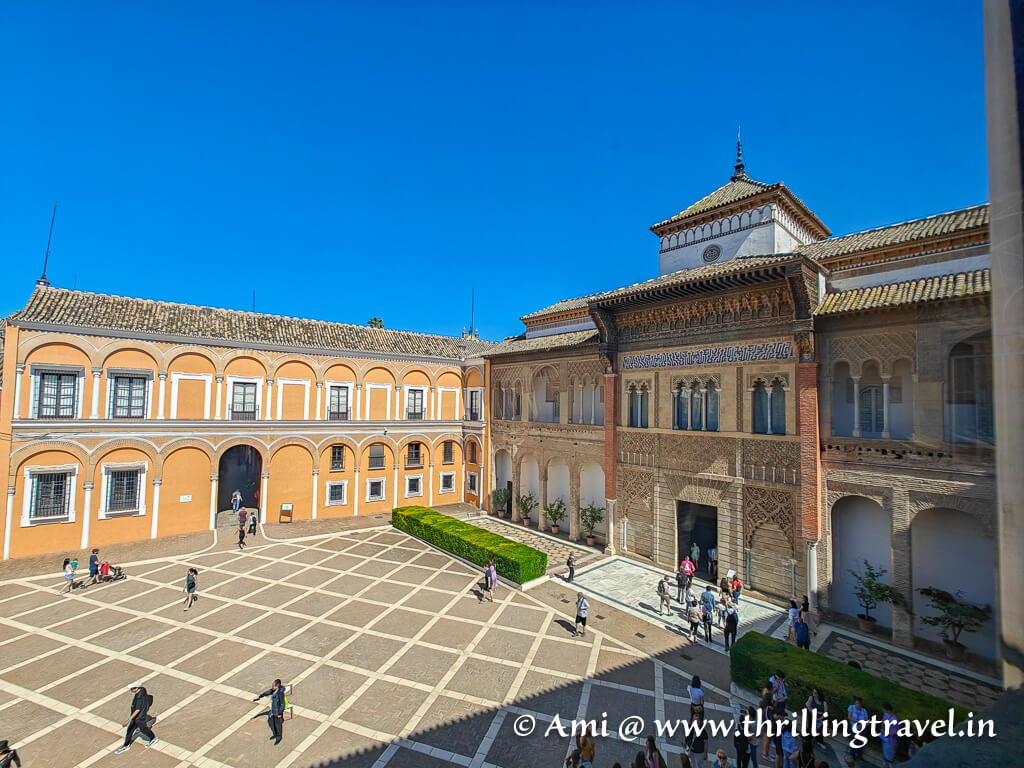
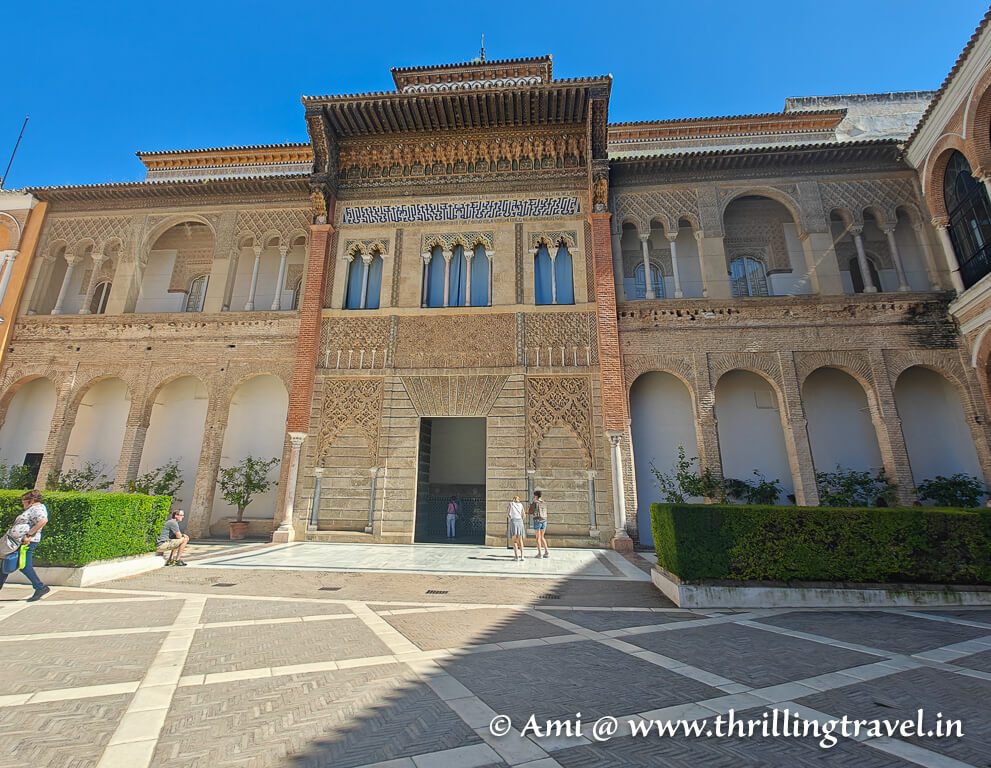
I was quite distracted by the various corners of this courtyard. On the left, steps lead to the Sala de la Justicia. Right ahead, is the ornately carved facade of the Palacio de Pedro I – one of the main palaces of the Royal Alcazar. Turn right and you will see a quieter passage that leads towards the interior patios and the Casa de la Contratación.
This is where I urge you to pay attention to the Real Alcazar Seville map that I have shared and follow the route that I recommend. That way, you will not miss out on the key features inside Alcazar Seville.
Hall of Justice (Sala de la Justicia)
Before you head to the stunning Pedro palace that is in front of you, I recommend that you take that left turn at the Patio de la Montería. Miss it, and you miss both this room and the one right after it – mostly because the two tend to get lost in the maze of the lovely palaces that you will encounter when you are visiting Alcazar Seville.
I wanted to explore this one properly, but a large tour group filed in just as I arrived. I only caught glimpses over their heads and that was enough to note that this chamber was worth the detour.
The first thing that you will notice is the qubba ceiling – the octagonal wooden dome, with its small cluster of muqarnas at the centre. Built by Alfonso XI in the 1340s to mark his victory at the Battle of Salado, it is considered the first true example of Mudejar architecture inside the Alcázar. This is the first of the many displays of Islamic craftsmanship commissioned for a Christian king. Look for the shield of the Order of the Band worked into the plasterwork – a symbol of the order Alfonso XI founded. A small marble fountain sits at the centre of the room, its water once channelled straight out to the pool in the neighboring Patio del Yeso.
The name will make it easy for you to guess what this room was used for. Alfonso XI met with his royal council, and later his son Pedro I dispensed justice.
Before that, it was known as the Sala de los Consejos, the Hall of Councils. I could vividly remember this room when I visited the Sala de Comares in the Alhambra Nasrid palaces. There is a fair bit of similarity between that and this Seville Alcazar attraction.
Courtyard of plaster (Patio del Yeso, Alcazar)
The water channel from the Sala de la Justicia leads you to the oldest surviving corner of the Real Alcázar in Seville. Though just a fraction of what it was, you can see the 12th-century Almohad portico at the far end. The plastered wall is what gives the courtyard its name.
On one side of the central pool, you will find the artistic sebka walls with its diamond-lattice brickwork pattern, while on the other side are three horseshoe arches on the plastered wall. These are all typical of the Islamic architecture that I saw in detail at the Nasrid palaces of the Alhambra.
House of Trading (Casa de la Contratación)

Walk across to the right side of the Patio de la Montería, and you reach one of the more overlooked corners of this Alcázar Seville guide — the Casa de la Contratación. The original name was Casa de Contratación de Indias. This was the institution that Queen Isabella I founded in 1503 to regulate trade and navigation with the newly discovered Americas. Seville was chosen as its seat, and this suite of rooms inside the Alcázar became its home until 1717.
There are two main rooms to see, plus a gallery of tiles and fans up the stairs.
The Admiral’s Room (Cuarto del Almirante)
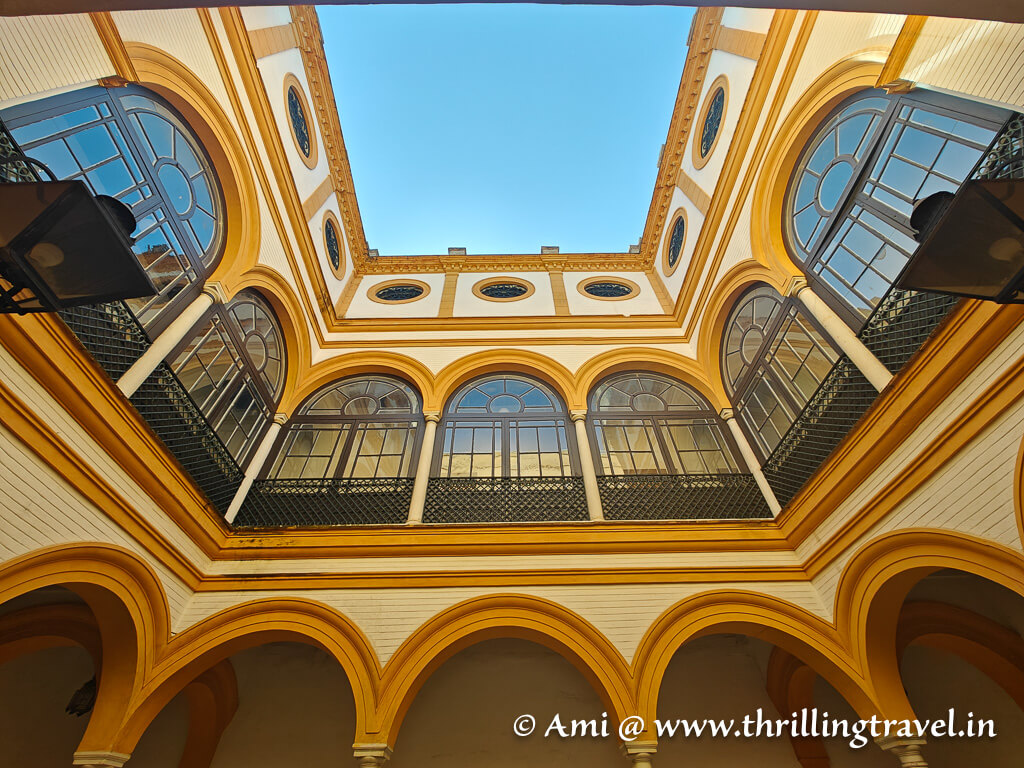
There are tons of stories that are associated with the Cuarto del Almirante. It was here that some of history’s most consequential voyages were planned, like the first circumnavigation of the globe by Magellan and Elcano. It is a bit hard to believe given that the room is a simple rectangular hall under a wooden ceiling decorated with 19th- and 20th-century paintings. It is still used today for official events.
The Chapel (Sala de Audiencias)
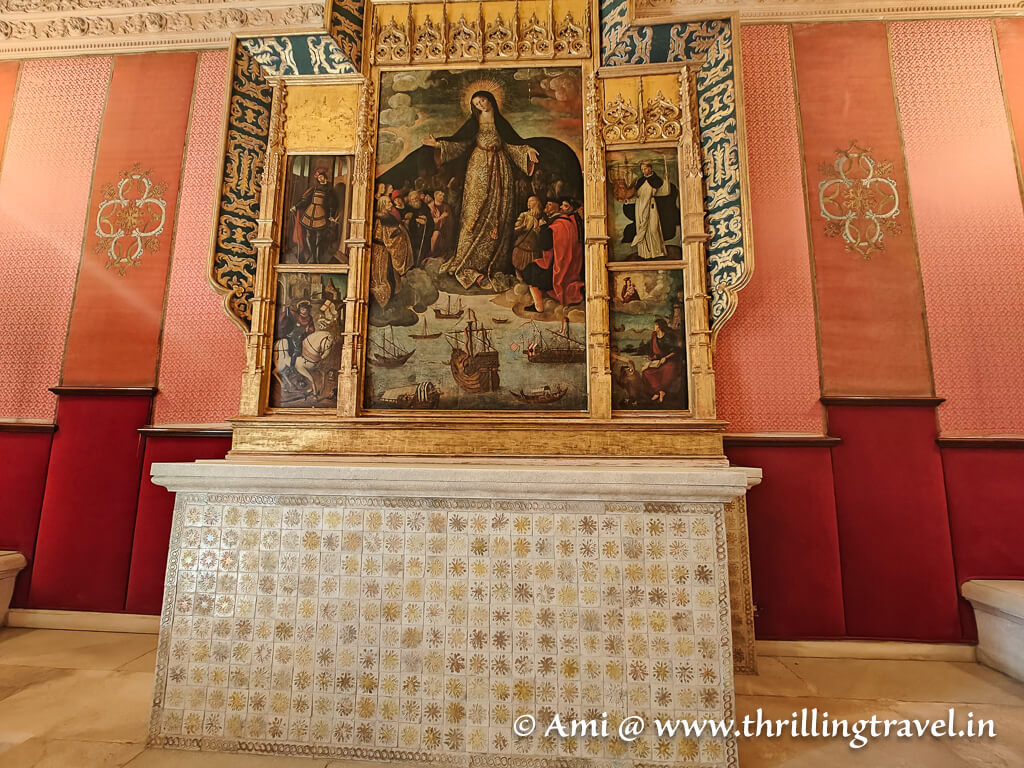
Next to the Admiral’s room is the Sala de Audiencias that doubles as a chapel. The most significant thing to see here is Alejo Fernández’s altarpiece of the Virgen de los Mareantes. This is a 1530s painting of the Virgin of the Navigators that shows Virgin looking over the ships. You will also, see some famous sailors like Columbus, Vespucci, and the Pinzón brothers in the painting. T
The Fan and Tile Gallery
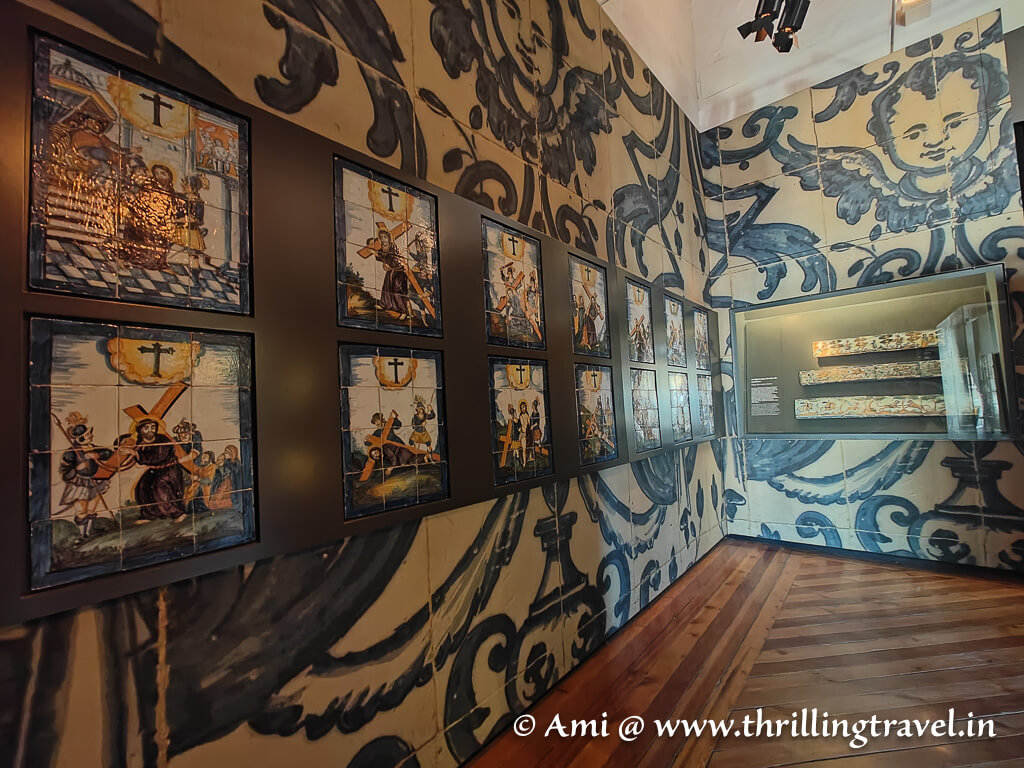
Take a few minutes for a quick climb up from the Admiral’s Room to the Sala de los Abanicos. This is where you will see a collection of nearly forty antique fans -spanning European and Oriental ones that have been donated by a private collector.
Right next to it, is the gallery that showcases Sevillian tile work spanning the 15th to the 20th centuries. It is here that I learnt about the various types of tiles that Sevilla is known for. There are arista tiles, made using a raised ridge to keep each colour separate during firing, and majolica, painted directly onto a tin glaze. It was fun discovering this and then later spotting it in the various courtyards and palaces inside Alcazar Seville for the rest of my visit.
The Staircase to the Upper Palace
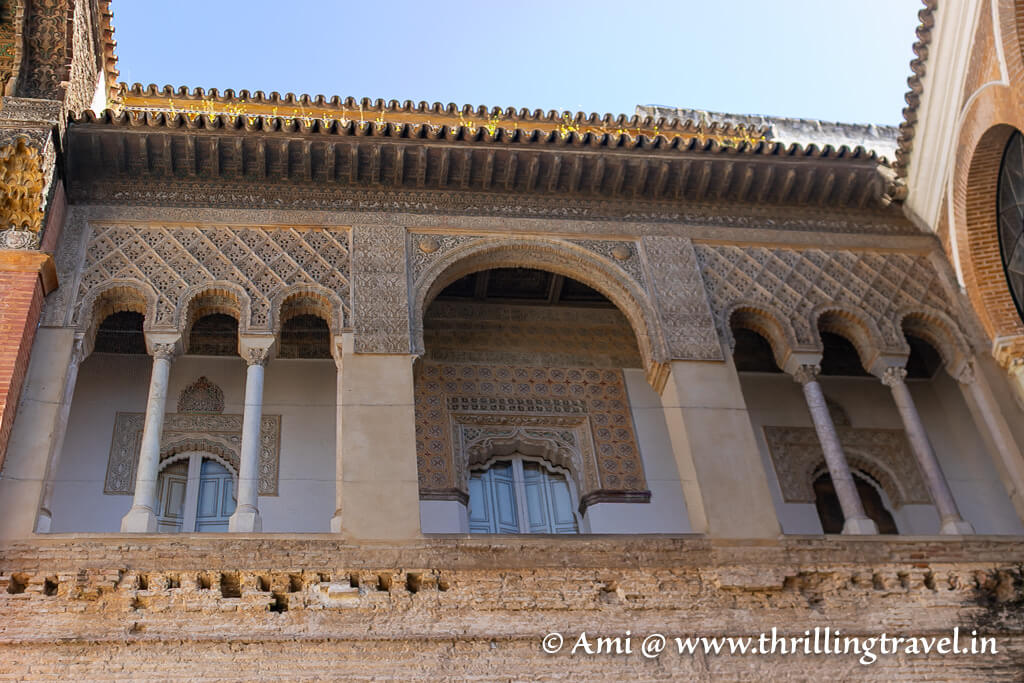
I did not take the special pass for the Cuarto Real Alto, the upper royal apartments, so I cannot tell you what lies inside from personal experience. What I can tell you is that this is not a museum wing but a genuinely lived-in one. The rooms used by Spanish royalty go back to Felipe V. From the photographs I have seen since, the elegant, tapestried interiors reminded me a little of what I had walked through days earlier at the Royal Palace of Madrid.
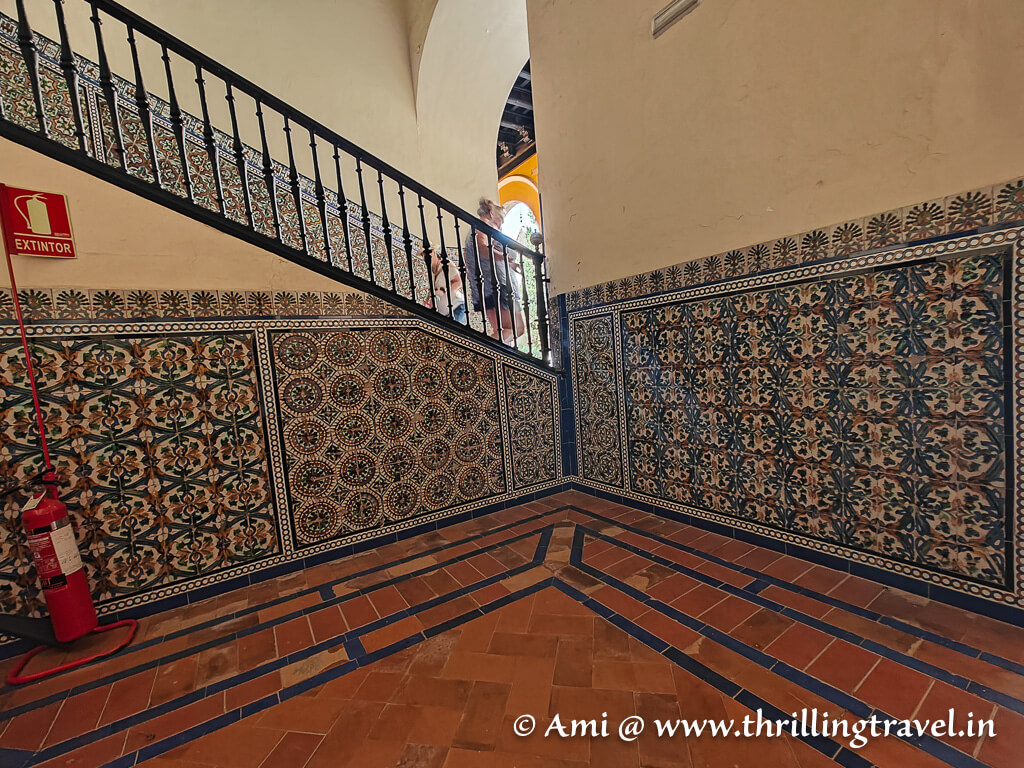
But a part of the route up there is open to every visitor, no special ticket required, and it is worth taking. The grand staircase built during the reign of Felipe II in the 16th century still stands, and a section of the gallery at the top belongs to the general visit even though the private apartments beyond it do not.
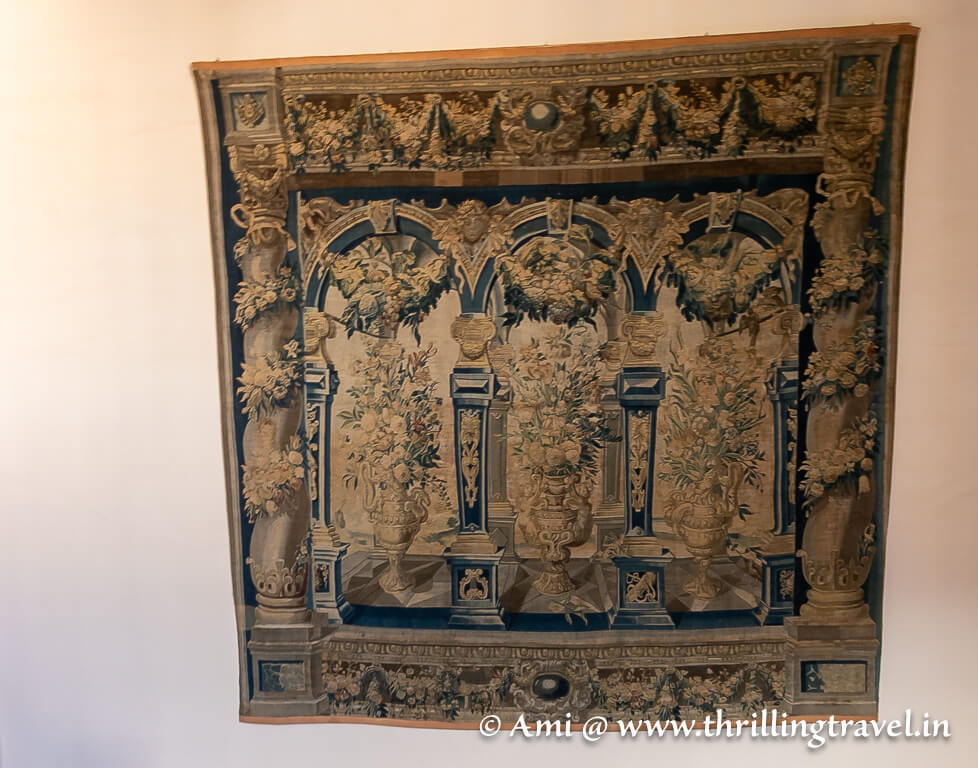
There are three details that you will find interesting. First is the tiled skirting along the walls which is actually a copy of originals preserved at the Convento de Madre de Dios in Seville. The 2nd is a glimpse of the polygonal coffered ceiling above with flowers carved on it. And the last one is the 17th-century tapestry woven in Brussels, hanging on the front wall, depicting Dido and Aeneas.
The Casa del Asistente – One of the offbeat attractions of Royal Alcazar’
I was determined to unlock every Alcazar story I could find. So instead of following the crowd back toward the Patio de la Montería. I stayed off the usual path and took the quiet corridor hidden behind the grand staircase. It leads to a cluster of small courtyards most visitors on a self-guided tour of Alcazar Seville never even know exist.
This entire wing was once the residence of Pablo de Olavide – appointed Asistente, or governing magistrate of Seville in 1767. It has a distinctly humble compared to the grandeur elsewhere in the Alcázar. This whole section was converted from part of the old Casa de la Contratación and remodelled in the 18th century into a private residence.
Patio del Asistente
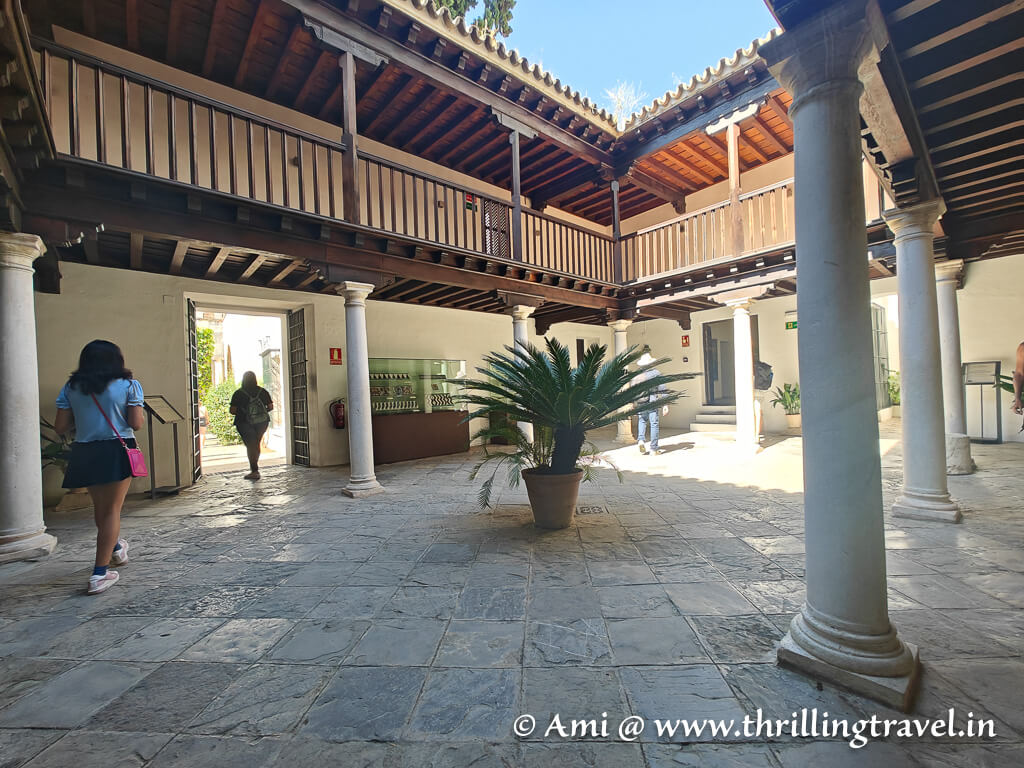
The first courtyard carries distinct Mediterranean vibes, with wooden galleries on two levels supported by slender marble columns. You will find the walls decorated with Sevillian tiles dating back to the 15th century. Try to spot the small plaque that commemorates Olavide.
Patio de los Levíes
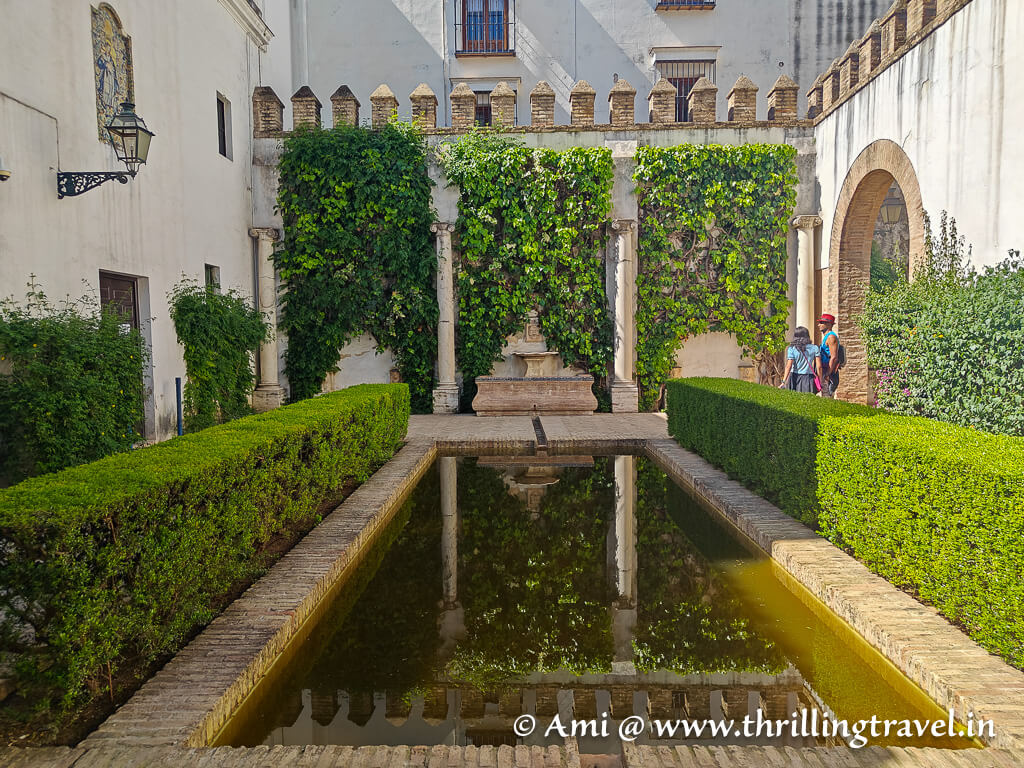
Quiet, small, and easy to miss, this one gets its name from the elegant arched gallery that presides over it. This was a part of the Palacio de los Levíes which bordered the Alcazar and was part of a home belonging to the family in Seville’s old Jewish Quarters. Semicircular arches with distinctly Baroque tilework can be seen here.
Patio de Romero Murube
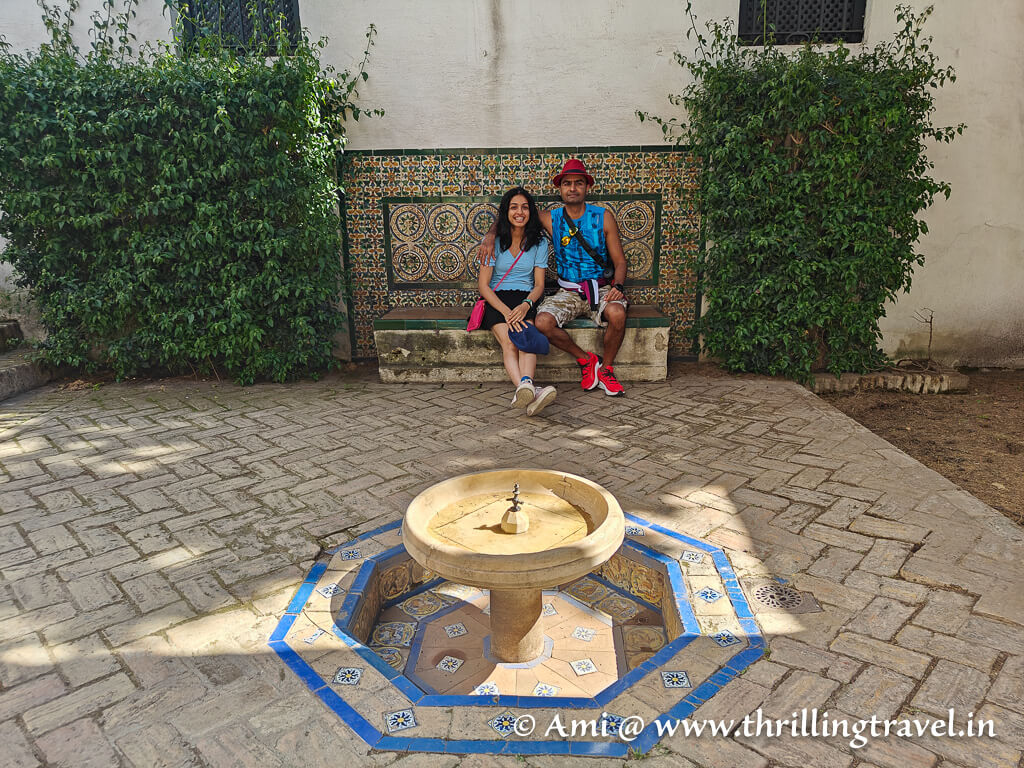
Don’t just stop at the last Patio. Continue on and turn the corner to find a serene, picturesque courtyard that immortalizes Joaquín Romero Murube. He was Alcázar’s poet and long-serving curator who redesigned gardens back at the Patio del León.
A bench, a small pond, and a marble plaque make for a picture-perfect frame that you want to capture for an amazing memory of your Alcazar Seville visit. The poetic atmosphere totally justifies its popular name – the courtyard of poets.
These three hidden Royal Alcazar attractions are a genuine detour from the main route, and worth every extra minute for exactly that reason.
Inside the Pedro Palace (Palacio de Pedro)
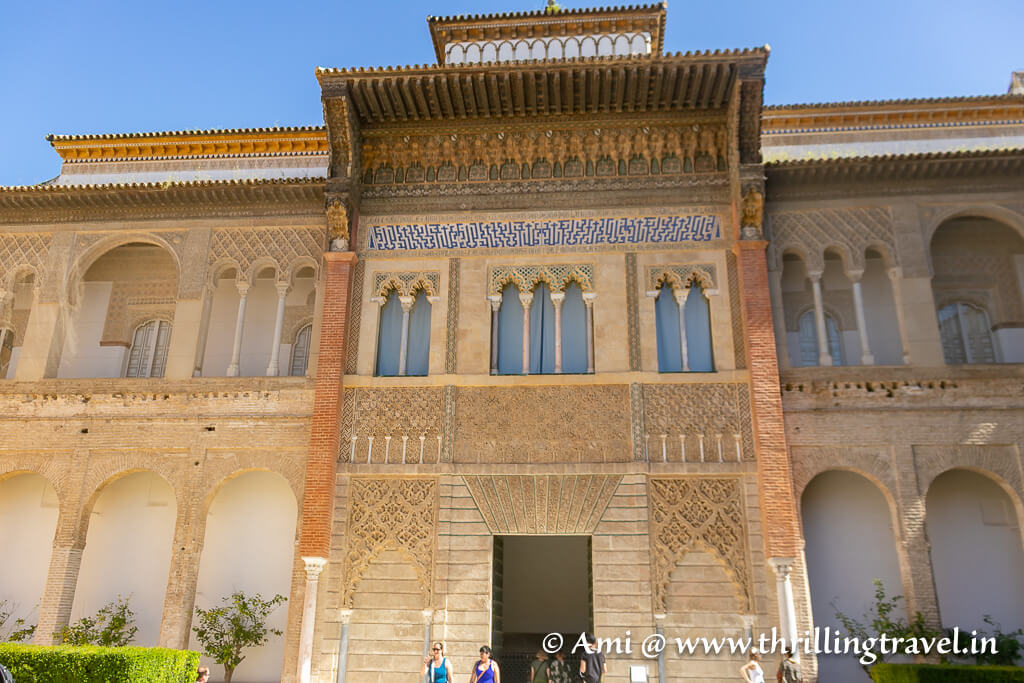
I would say that the Palacio de Pedro I is the heart of the Real Alcázar. This 14th- century Mudejar palace is what most people come to see. It was built by Pedro I – who is popularly called Pedro the Cruel. This is where you should know the story behind this name.
Pedro I was Pedro the Cruel for his enemies – who according to the legends were the so-called entitled noblemen and clergy. His supporters however, called him Pedro the Just. He had his own half-brother murdered inside these walls in a succession dispute. There are rumors of a dried blood stain on a marble floor that might have come about after this assassination but then, we have no concrete proof of the same.
Another story is attached to a rare ruby (later found to be a spinel) which he is said to have obtained from Abū Sa’īd – the deposed Nasrid ruler of Granada, after stabbing him. The prized jewel found its way to England and its now a part of the British Crown jewels.
On the other hand, he is believed to have protected the common people including the Jews and Muslims in his kingdom. This same king commissioned Islamic craftsmen to build him one of the most beautiful palaces in Europe that is spread across 2500 sq. meters.
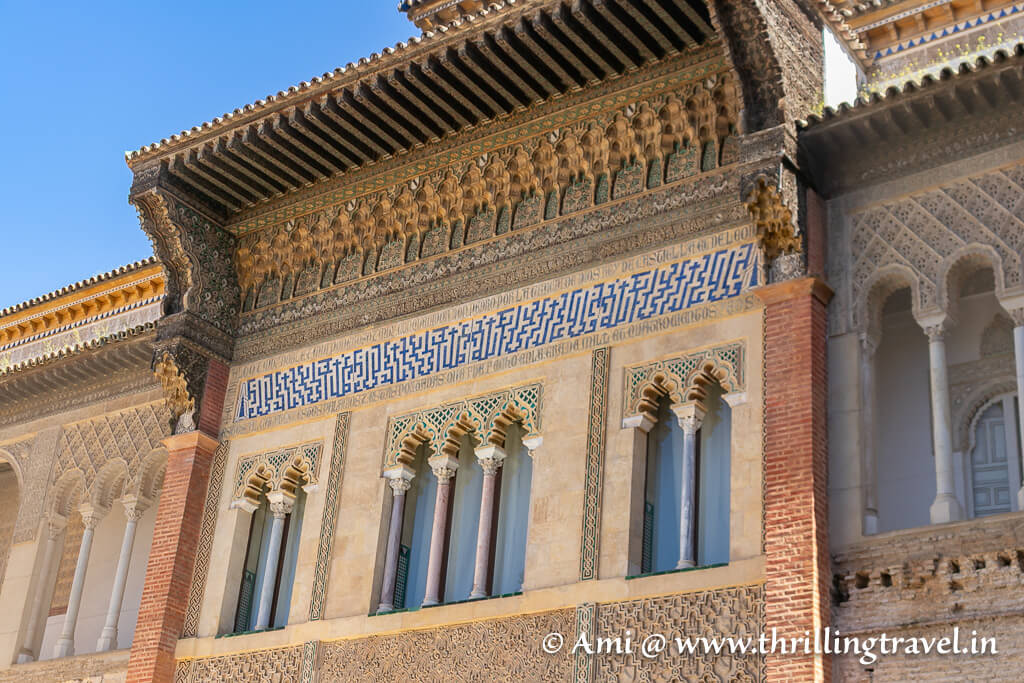
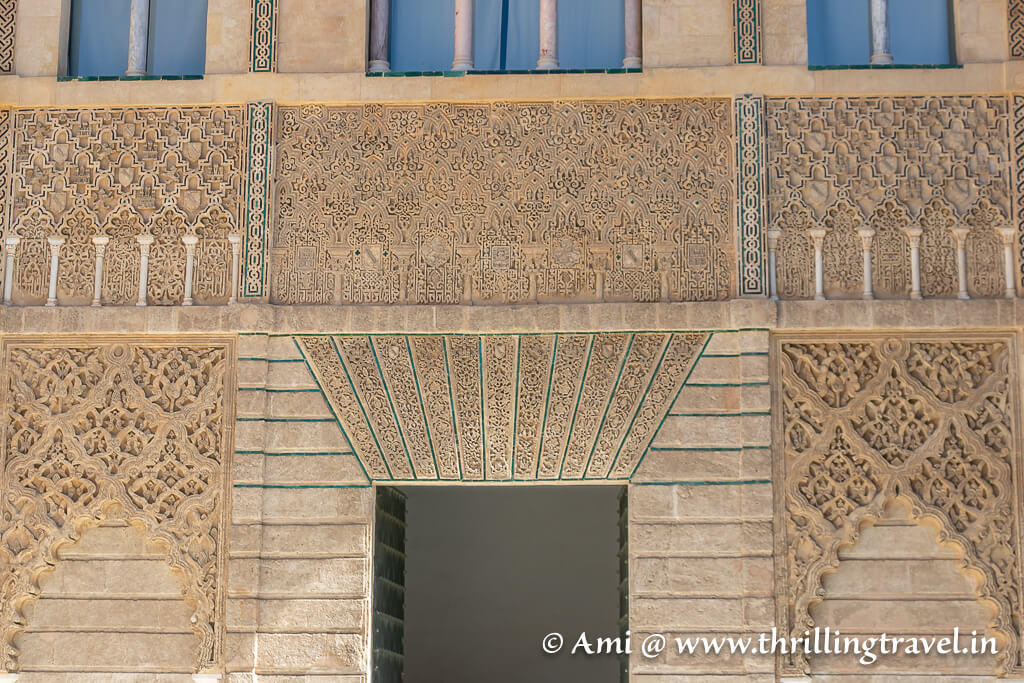
Before you go in, spare a few moments to observe the arched facade with its brick and marble columns. Notice the gables on the top – which were made by the Toledo Christian craftsmen. Below that is Arabic calligraphy in the typical Nasrid Palace, Granada style. It repeats a single phrase, “none but Allah conquers,”. And around it is a border in Gothic lettering, naming Pedro I as the man who built it all. That is the one of the true amalgamation of architectural styles that you will see inside Royal Alcazar, Seville.
Once you step through, you will be find yourself in a labyrinth of tiled corridors, carved ceilings, and courtyards. There are so many details that will want to absorb and that can sometimes get overwhelming. I had this constant FOMO as I moved through the interconnected rooms. This is where my recommended route will come handy. Follow it and I assure you that you will not be missing out on any of the Royal Alcazar highlights and stories.
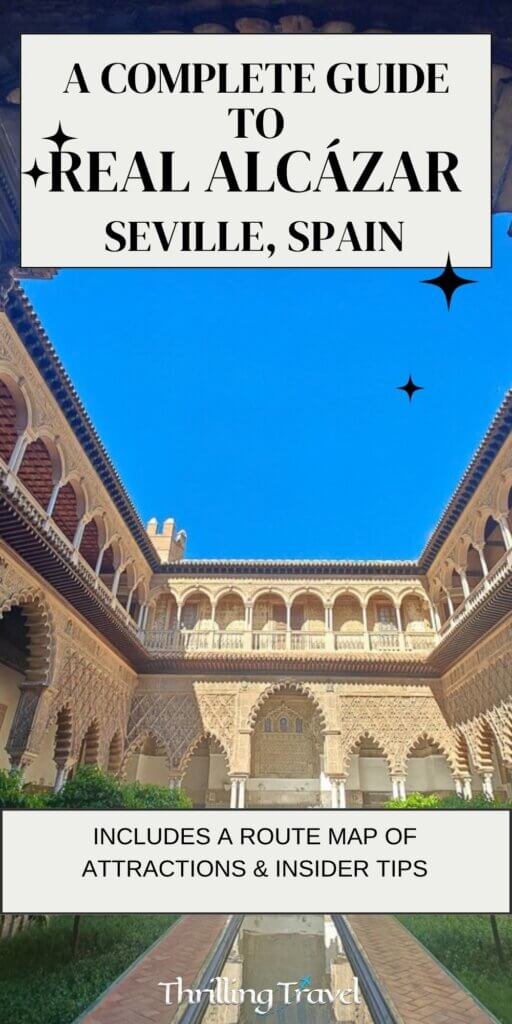
Courtyard of Maidens (Patio de las Doncellas) – one of the prettiest patios inside Royal Alcazar Seville
You will find yourself with a choice once you are in the tiled corridor that follows the entrance of Pedro I’s palace. There is a small secret passage on the right and a wider opening on the left. Take the left, and you arrive at the Patio de las Doncellas or the Courtyard of Maidens.
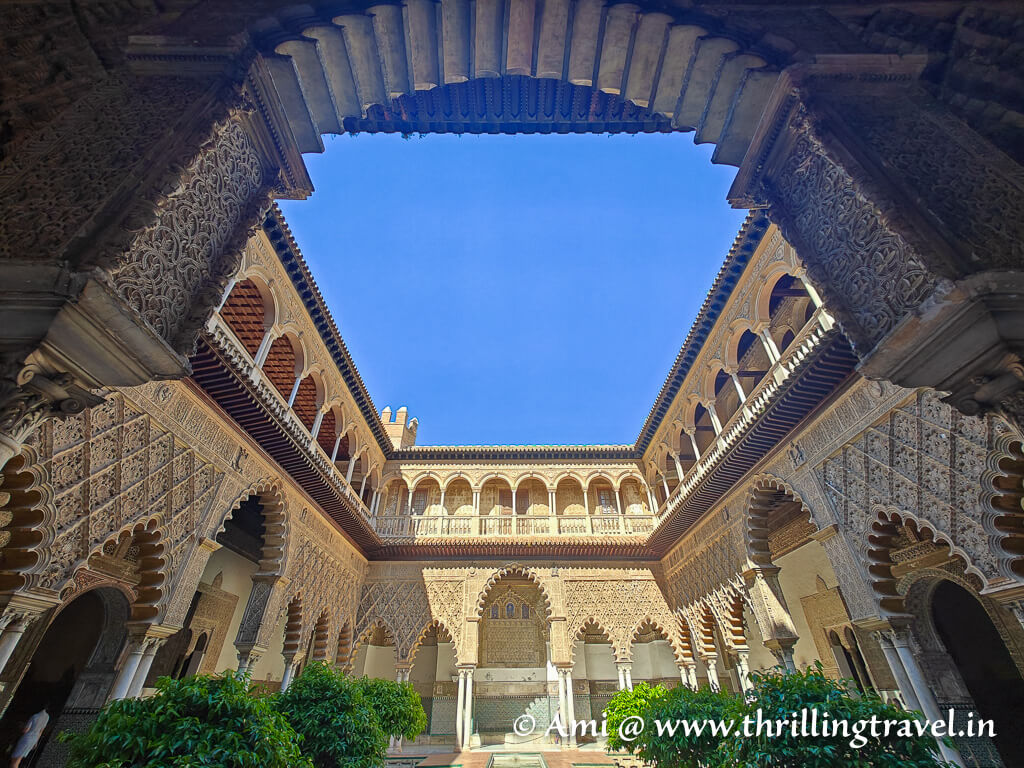
If you are a GOT fan, you will instantly recognize it as the Water Gardens of Dorne in Game of Thrones. However, beyond the screen recognition, this place will awe you. It is one of the most significant courtyards in the entire Alcázar. It is here that visitors and courtiers once waited before being received in the Salón de los Embajadores or the Hall of Ambassadors.
I was mesmerized by the perfect reflection of the ornate arches that surrounded it. This however, was not the original 16th-century design. Turns out, it is older than that. For almost 500 years, this space was covered over with marble flooring and a Renaissance fountain added by Charles V. In 2002, an archaeological dig uncovered an Almohad-era garden. This was restored to what might have been its 14th-century form.

I could just do with another Royal Alcazar trip to see the intricate details hidden in the arches. There are so many symbols hidden within the sebka work like the Hand of Fatima. The details are just stunning.
The upper floors are designed in an Italian renaissance style by Charles V. They were built in the 16th century and included private chambers of Queen Isabella and Charles V. Here you will find various coats of arms including Pedro I’s own Castile and León shields and the two headed eagle. Arabic calligraphy runs across the friezes too, phrases praising God rather than any king, carried over from Pedro I’s original construction.
The Courtyard of the Maidens has an interesting lore attached to its name. It might not be factual but is quite interesting. They say that back in the 8th century, the Asturian king Mauregato struck a deal with the Emir of Córdoba, Abd al-Rahman I, trading his throne’s security for an annual tribute of one hundred virgin maidens. The arrangement is said to have ended decades later but well, the courtyard is connected to them.
As mentioned in the beginning, one of my insider Alcazar Seville tips is to visit this courtyard first and budget a little time to enjoy the craftsmanship here. You can always visit this in the end by turning right at the vestibule but I feel visiting this first will give you a good context when you tour the other interconnected rooms of Palacio de Pedro I of Alcazar.
Alcoba Real – a quick stop in your Royal Alcazar tour

Take the right exit and you will find yourself in the Alcoba Real. This is the Royal Bedroom and is also known as the Dormitorio de los Reyes Moros . It has the signature horseshoe arches and two connected chambers divided by an arcade decorated with carved shells.
The inner room, cooler and less sunlit than the outer one, was specifically the king’s summer bedroom. The location on ground floor shielded the interiors from the Seville heat. During winters, the king shifted to the upper chambers where the rooms caught more light and warmth.
I found myself genuinely fascinated by the colourful wooden door here, its geometric star pattern picked out in reds, blues, and gold, weathered just enough to look centuries old rather than restored.
The Hall of Lost Steps

From here, you will pass through a narrow corridor connecting the palace’s public and private wings. This is the Salón de los Pasos Perdidos or the Hall of Lost Steps. The name has no story linked to the Royal Alcazar. It is in fact, a name borrowed from old French court buildings, where visitors would pace for hours waiting to be received, their footsteps going nowhere.
I am pretty sure you will not be looking anywhere but up at the coffered ceiling. It is quite striking – a contrast to the rich plasterwork.
Courtyard of Dolls (Patio de las Muñecas) — One of the Most Charming Royal Alcazar Attractions
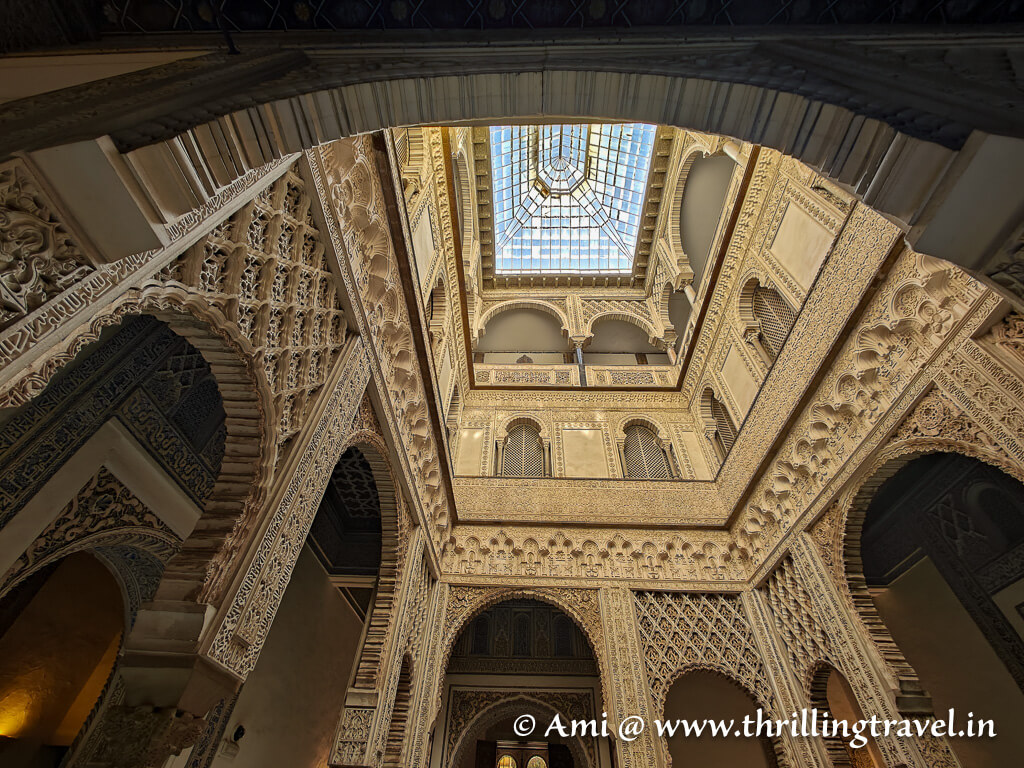
The next space had me completely mesmerized from the moment I entered it. The sebka and stucco artwork on the walls and arches seemed to glisten in natural light. I wondered how this room deep inside the Pedro palace was able to catch so much sun until I moved forwardinto a wide courtyard.
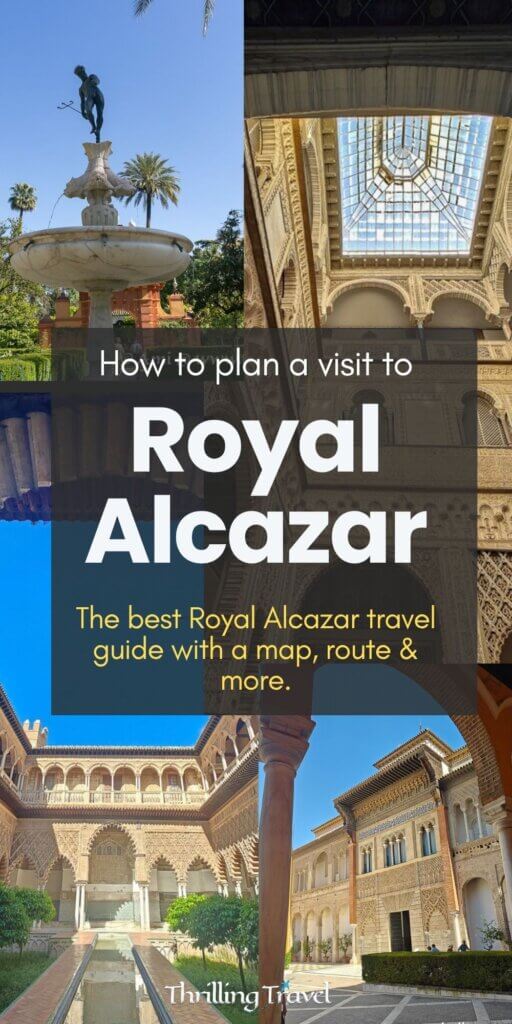
Looking up, I found the answer with the beautiful glass ceiling dome that allowed the scintillating rays to light up the gorgeous carvings in this space. I was just amazed with the details like the muqarnas tucked into the corners.
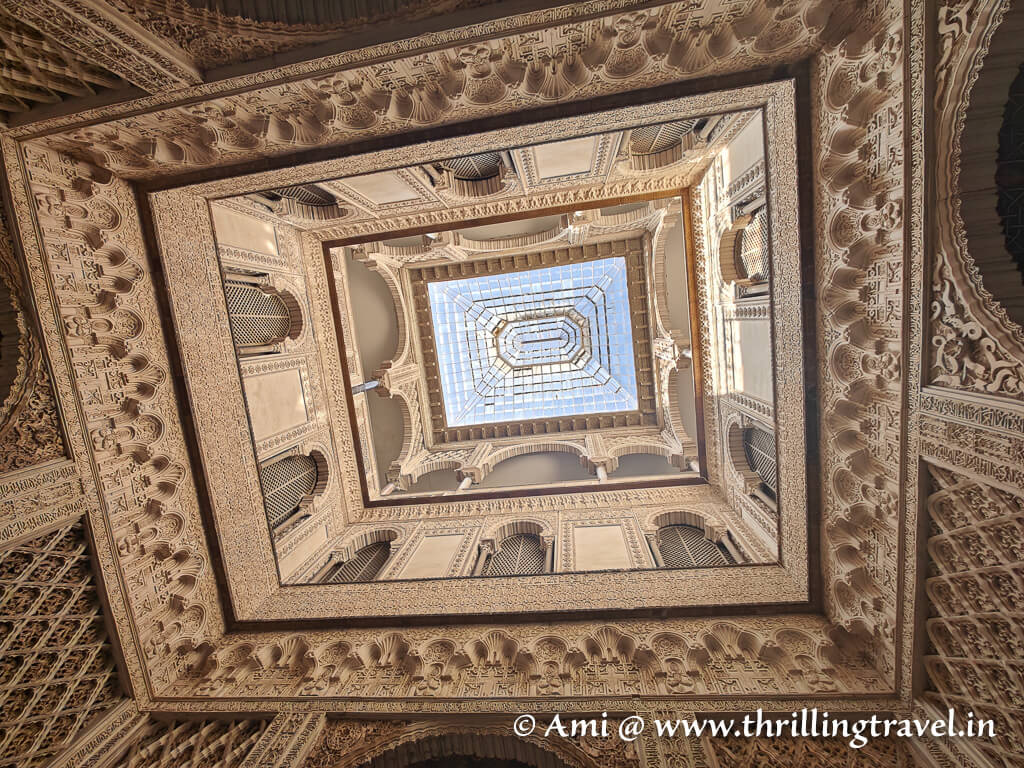
This is the Patio de las Muñecas or the Courtyard of the Dolls. You will know why it is called so when you look at the base of the arches in this room. Hidden in the plasterwork, are tiny carved faces of dolls. There is a belief that if you spot these faces, you might bring yourself some good luck. All the more reason to spend a little time here.
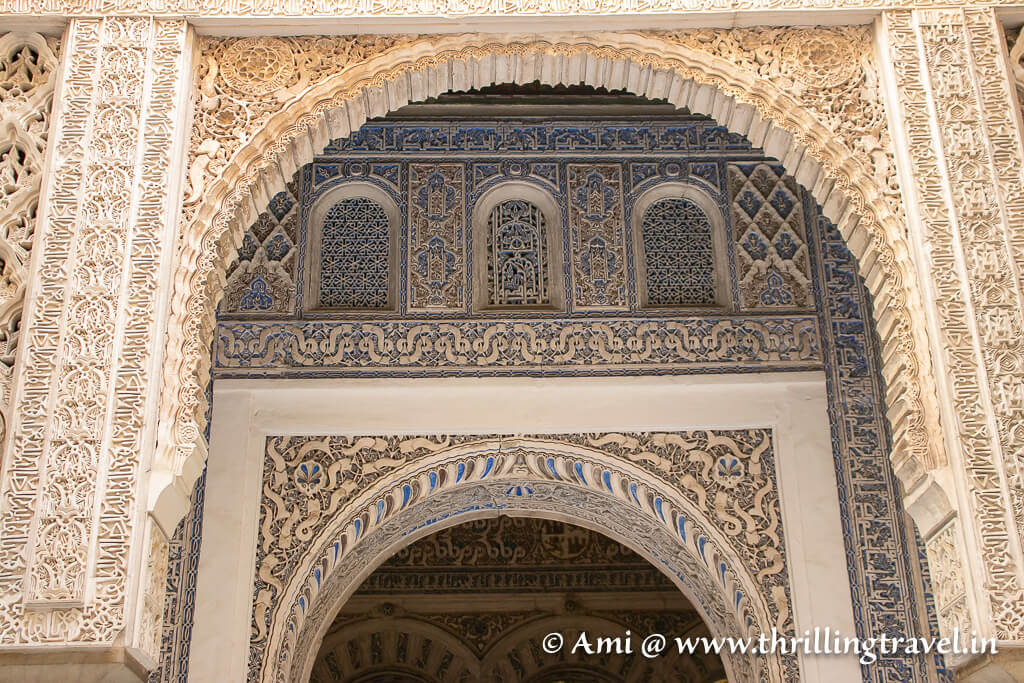
This courtyard is a prime example of how various eras have added their touch to the same palace. The lower gallery with its Mudéjar work is the 14th century space while the upper floor, along with that glass ceiling, is a 19th-century addition. Before that, the courtyard had no upper gallery at all, open straight to the sky.
Quite unlike the Courtyard of Maidens which was a public space, this courtyard of dolls was a private space of the Pedro Palace – open to the King and his family – including the women and children.
The details here make this one of my favorite stops and a highly recommended one for all those visiting Alcazar Seville.
Chamber of Catholic Kings (Sala de los Reyes Católicos)

From here, you should enter another connecting room with a ceiling that holds numerous details.The Chamber of Catholic Kings is a square room has a coffered wooden ceiling dating to Ferdinand and Isabella’s reign in the late 15th century.
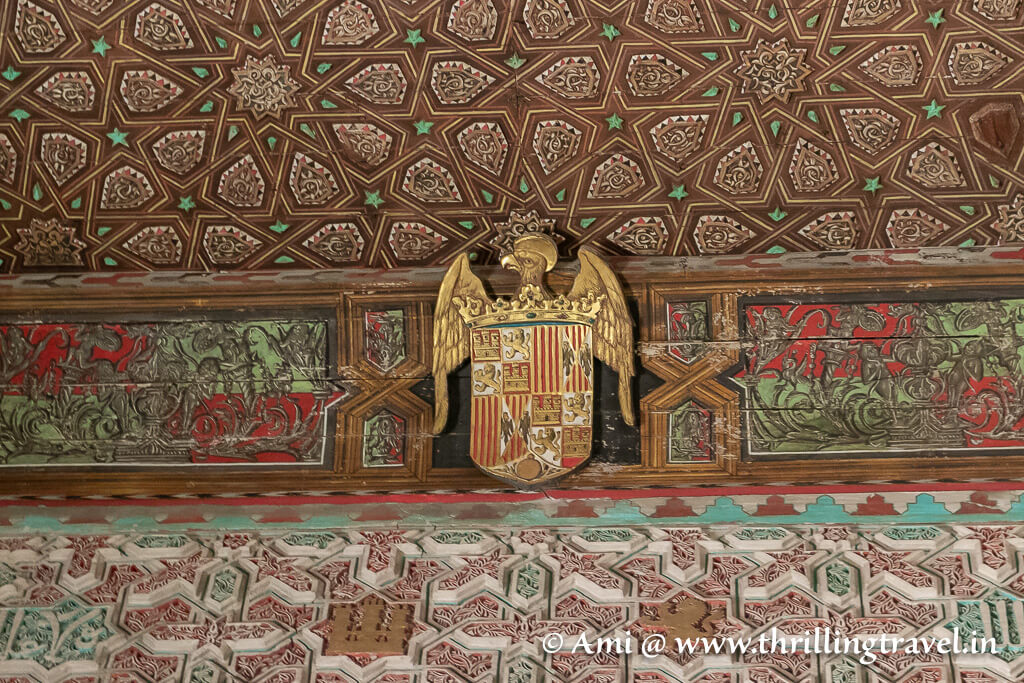
Stare up and you will find several emblems – one of which is a yoke and a sheaf of arrows alongside the motto “tanto monta,” meaning their two crowns carried equal weight. The coat of arms unites the kingdoms of Castile and Aragon. Try to spot the pomegranates in the panels. These date the ceiling to after 1492, once Granada had fallen to Spain.
On this tour of Royal Alcazar, one more interesting detail to note is the floor here. It is one of the original ones in this palace.
Hall of the Ceiling of Philip II (Salón del Techo de Felipe I)
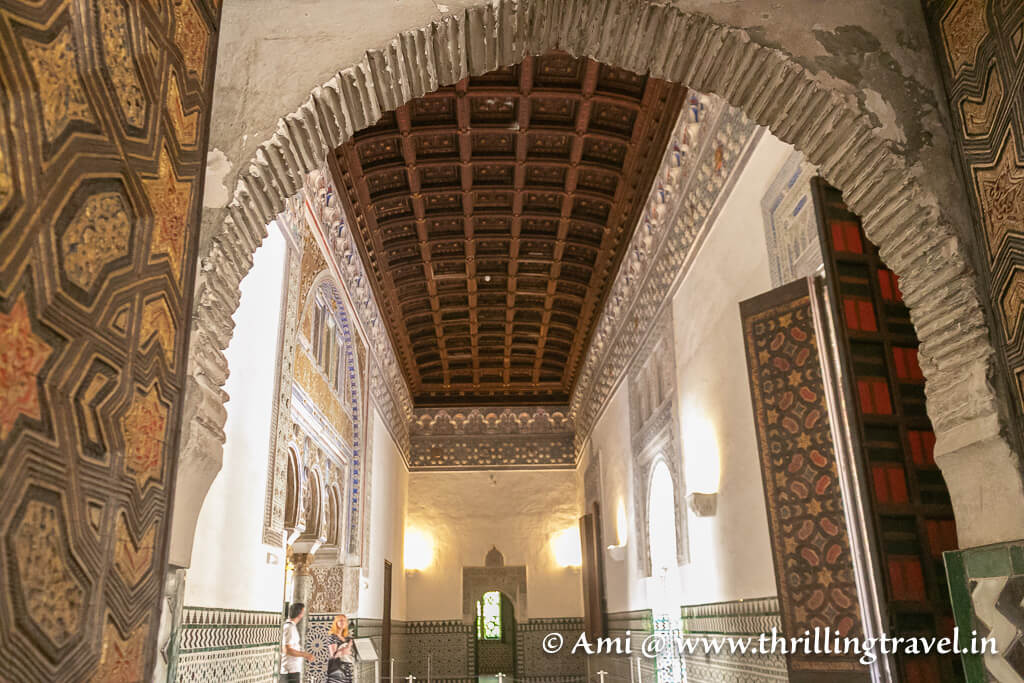
The next stop on your self-guided Royal Alcazar tour is this long, narrow hall called the Salón del Techo de Felipe II . It has a striking curved, half-barrel ceiling. The ceiling was carved during Felipe II’s time and once painted in gold.
There are tons of details that you can spot in the plasterwork along the walls – Islamic artwork seamlessly blends with the Christian vine carvings. You will even see peacocks inspired by the old Persian fabric designs.
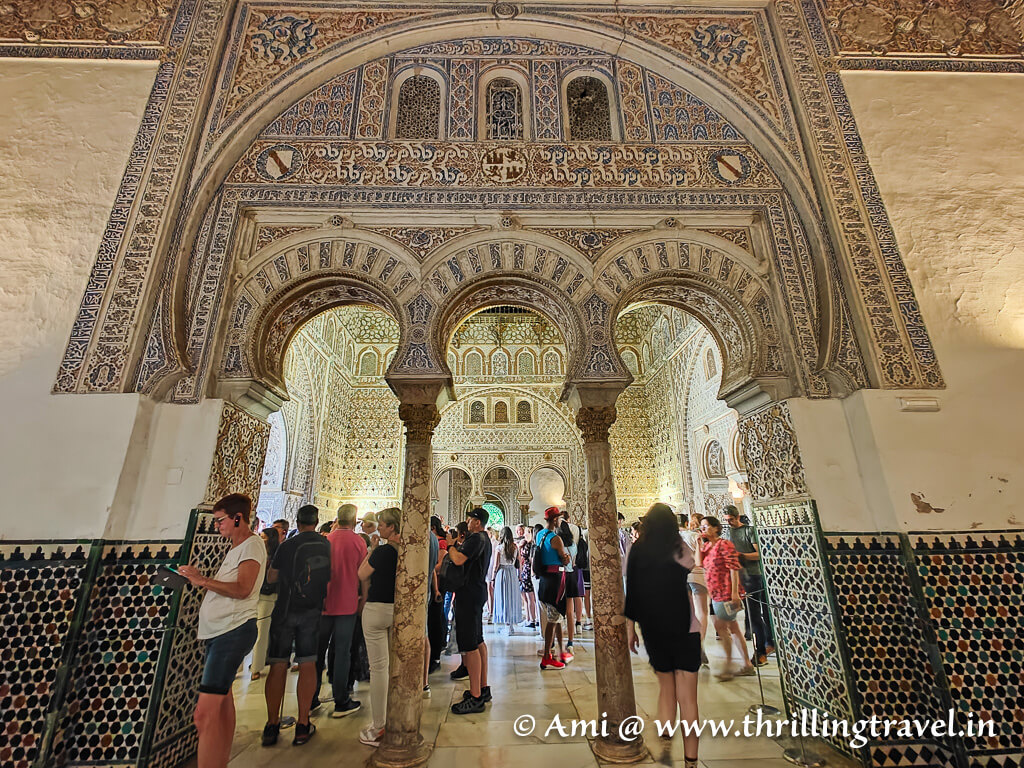
The best part of the room – the one I still remember vividly is the grand exit called Arco de los Pavones, or the Arch of the Peacocks. These have the exotic birds carved right into the arch above. The reason I recall them is owing to a similar arched gateway in Jaipur City Royal Palace – which is largely Rajputana style but finds the same peacock inspiration.
This room used to be the antechamber or the waiting area just outside the Hall of Ambassadors. From here, you will step straight into the Salón de Embajadores – another one of the most breathtaking rooms in all of Pedro I’s palace.
Hall of Ambassadors (Salón de Embajadores)- one of the key Royal Alcazar highlights

Moti Mahal in Mehrangarh Fort or the Sheesh Mahal of the Amber Fort in Jaipur – these were the throne rooms in their respective palaces. All ornate and masterpieces of their forts. On similar lines, the Hall of Ambassadors is the centre piece of the Pedro Palace of Alcazar Seville. It was here that Pedro I received ambassadors and his most important guests.

An older hall stood here first. It belonged to the 11th-century Abbadid palace, and was known as the Sala de las Pléyades. It faced a different direction and could only be entered through the same Arch of the Peacocks that we walked through. Back them it was a classic Qubba square room symbolizing Earth. This was covered by a half-dome representing the heaven or the universe.
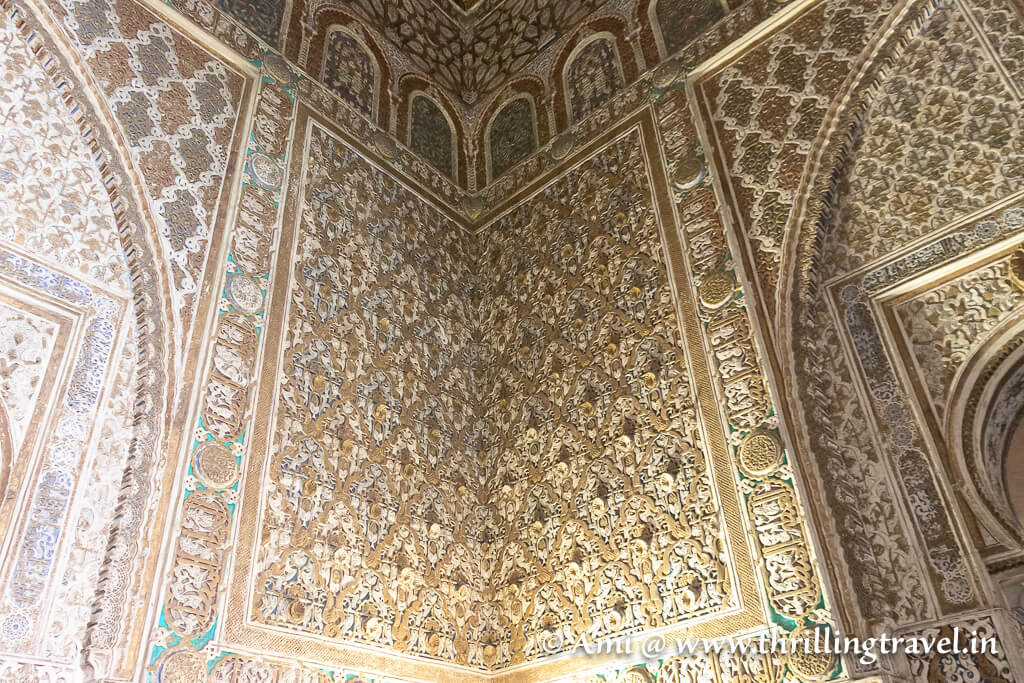
The layout you see today is Pedro I’s own 1364 rebuild, the same layout along with the triple horseshoe arches on marble columns. The dome overhead was rebuilt in 1427, under Juan II, keeping that same earth-and-heaven symbolism alive. Further additions included the tiled skirting stucco grill-work filters the windows above and then later on, wrought-iron balconies.
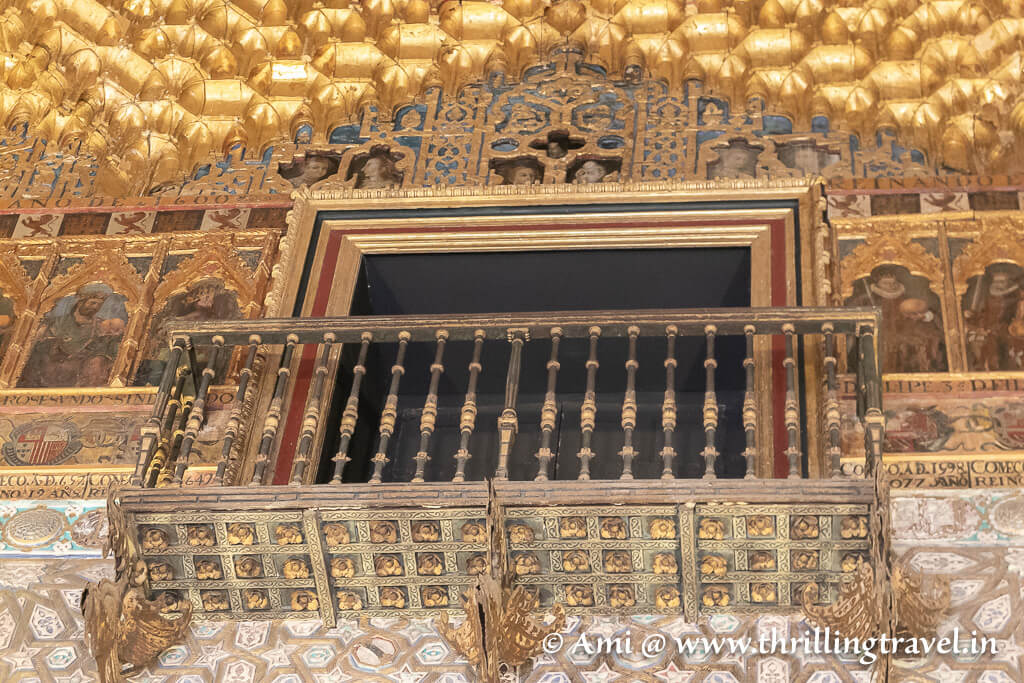
The dome is one reason why this hall is also called the “hall of half orange”. Gilded with star patterns, the round dome still represents the universe. I felt that the golden muqarnas at the corners added more glitz to this representation of heavens.

While you are looking around, don’t miss the wooden frieze beneath the dome. It has 56 painted portraits of Spanish monarchs – from the old Visigothic kings to Felipe III. The southern wall has Pedro I himself.
Grand as it is, this hall is believed to have hosted festivities linked to Charles V’s wedding to Isabella of Portugal in 1526. And I agree when people say that this might be the grandest rooms inside the Royal Alcazar.
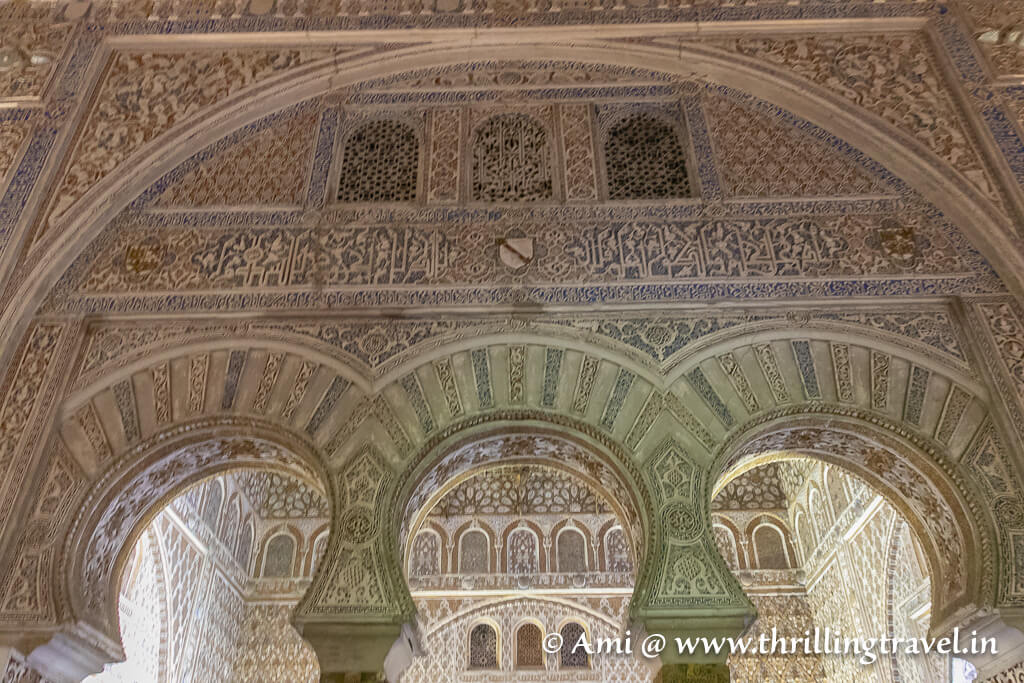
The Prince’s Room (Cuarto del Príncipe)
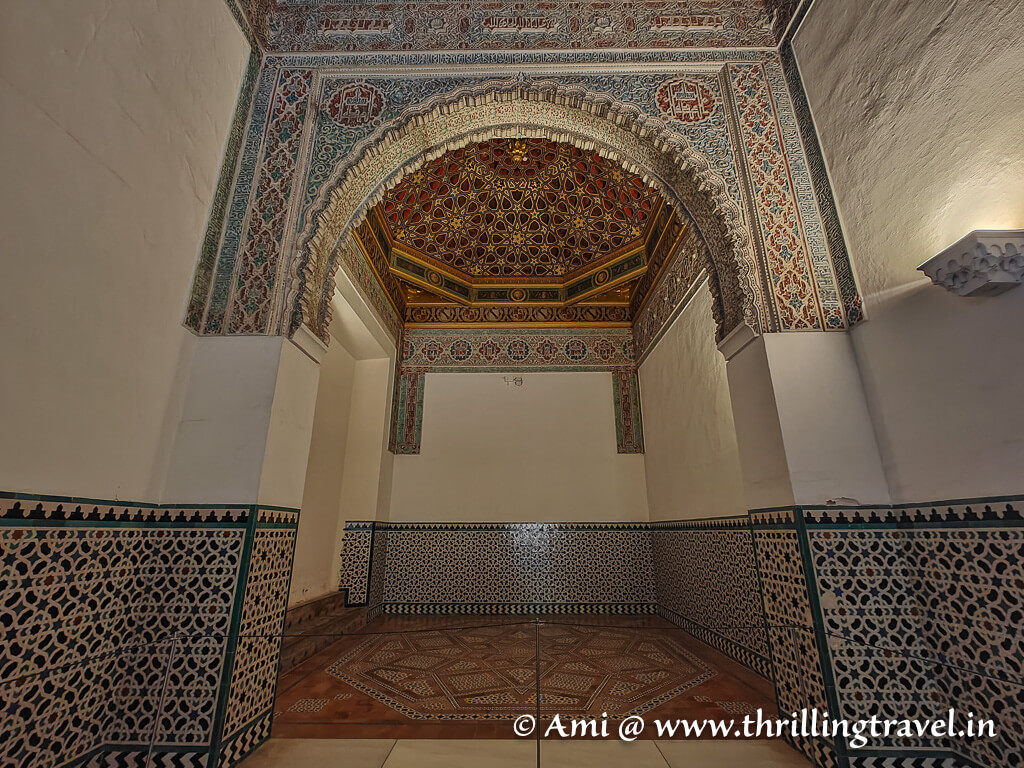
As one can guess, the room takes its name from a prince. In this case it was Prince Juan, who was born here in 1478.
The room is divided by plaster arches in three spaces. The central one has a geometric ceiling with muqarnas. On one side of this is the Queen’s own room with an octagonal, colored wooden ceiling and on the other is the prince’s small chamber with its sixteen carved and gilded paneled ceiling.

Charles V ceiling room
This room was once the palace’s own chapel, and its name comes from the very event that eventually gave it a new identity. Charles V married Isabella of Portugal here in 1526, and it was some years later, in the 1540s, that he had the ceiling you see today commissioned in its honour.

Look closely at the central coffers and you will spot carved busts of a knight and a lady among the floral panels, believed to be Charles and Isabella themselves. Once a new chapel was built on the upper floor, this room lost its religious role. However, you can see one remnant of this in an old inscription by the doorway.
This concludes the Pedro Palace visit, and from here, you exit into the gardens of Alcazar Seville. Do not skip it. It is a much-needed respite for your heightened senses after seeing the grandeur of the Pedro Palace. It will calm them down before you return for the next palace on this Alcazar tour.
The Gothic Palace is what waits on the other side of that break, a contrast to the current Royal Alcazar attraction you are exiting.
Gardens of Alcazar Seville
This Royal Alcazar guide would not be complete without a walk through the gardens themselves. I will admit that you might find it hard covering them all. I too, kind of skimmed through most as I was keen to use my limited time in exploring the Gothic palace. To help you, I am sharing an order that you can use to make the most of your Alcazar gardens visit.
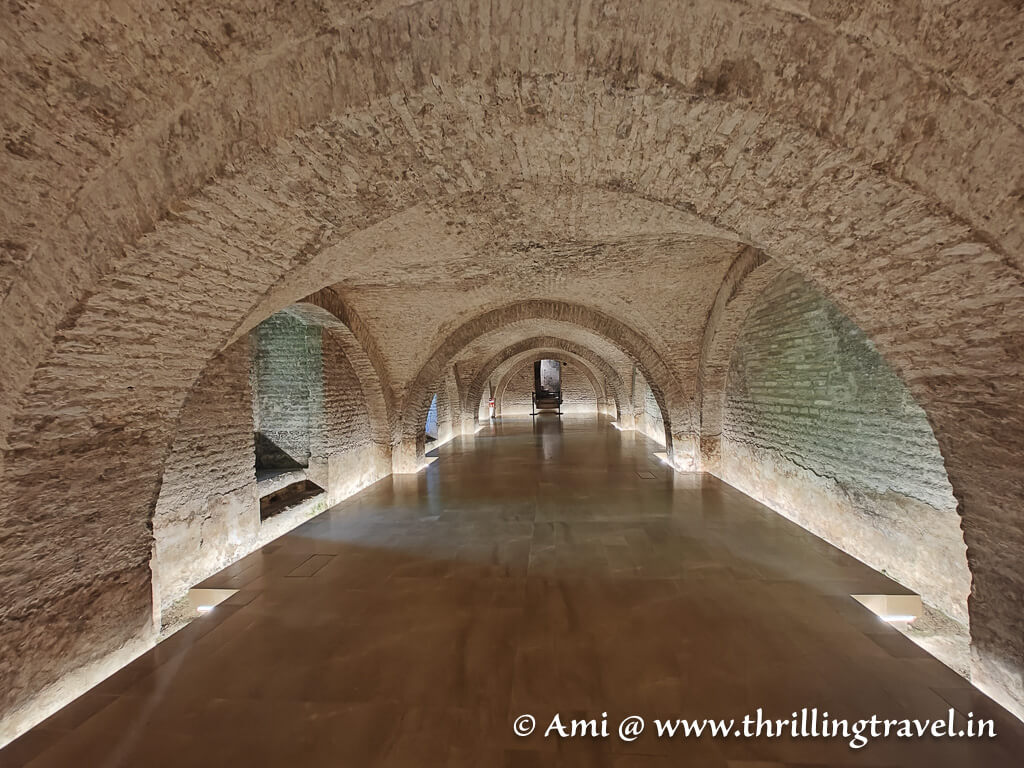
Follow the path that takes you below Pedro’s Palace. You will pass through a stretch of vaulted underground cellars – the plain stone sótanos that were once used for storage. It is now an exhibition space that leads you straight out into the gardens. From here, you can check out the following gardens in the order that I have shared.
Flower Garden (Jardín de las Flores)
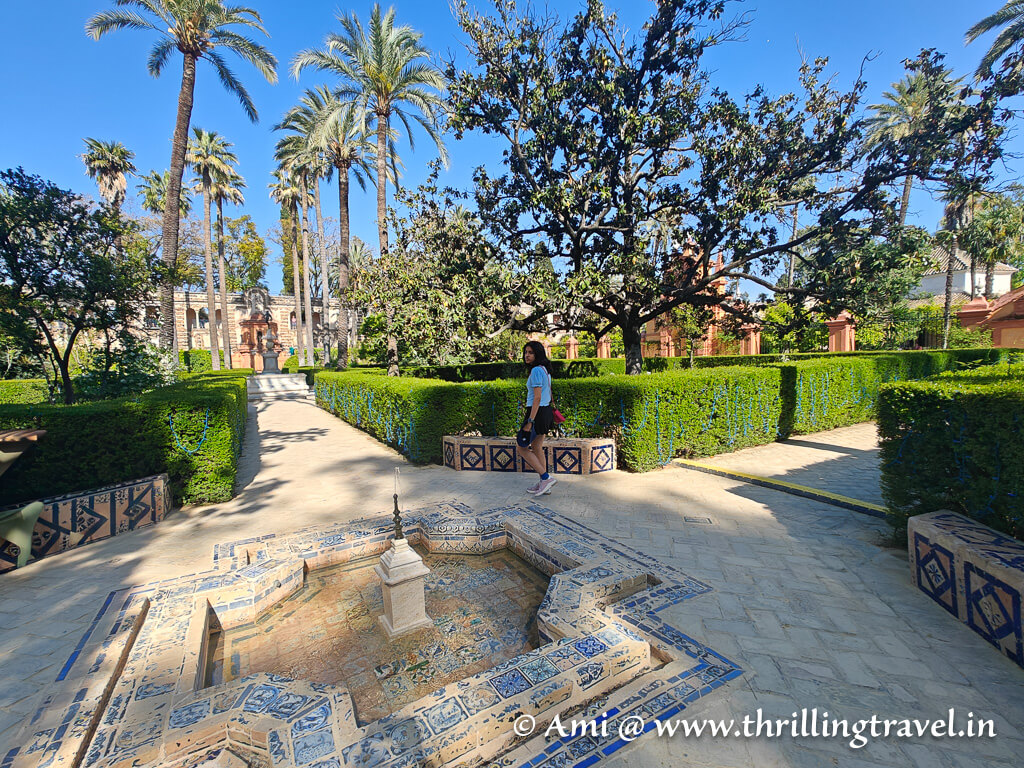
You will exit into this one. It has a typical Islamic layout that you can see in Alhambra or even in the popular Indian monuments like the Taj Mahal and Humayun’s tomb. The classic four sectors around a large pond that is decorated with 16th-century tiles. Orange trees and fragrant flowering plants fill it today.
Prince’s Garden (Jardín del Príncipe)
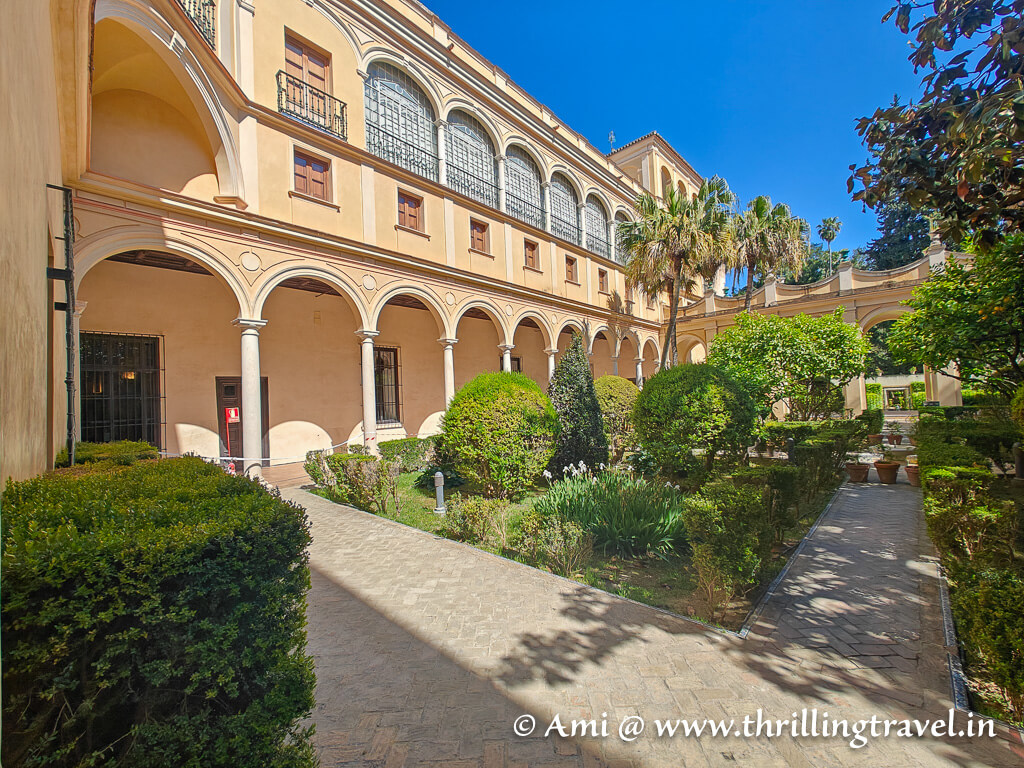
This was named for the same young prince born inside the palace. It sits closest to the old walls of the Pedro Palace and you can actually get a glimpse of it when you visit the Prince’s chamber.
Galley Garden (Jardín de la Galera)
I actually saw this when I was transiting to the Charles V ceiling room. The name has a playful bit of history.
The myrtle hedges here were once clipped into the shape of galleys – that help stage mock naval battles with jets of water standing in for cannon fire. Nothing of those ships remains now. It now has four beds of Mediterranean flowers and shrubs.
It connects directly to Pedro I’s palace through a pergola carried on pillars decorated with Renaissance relief work. At its centre stands a marble column honouring Al-Mutamid, the poet-king who once ruled Seville. You can go closer to see the inscription of his own verse expressing his wish to die in the city and be buried among these very gardens – which as I understand did not happen.
Troy Garden (Jardín de Troya)
You will find this patch covers with magnolias and palms – before the wall opens up.
Garden of the Ladies (Jardín de las Damas)
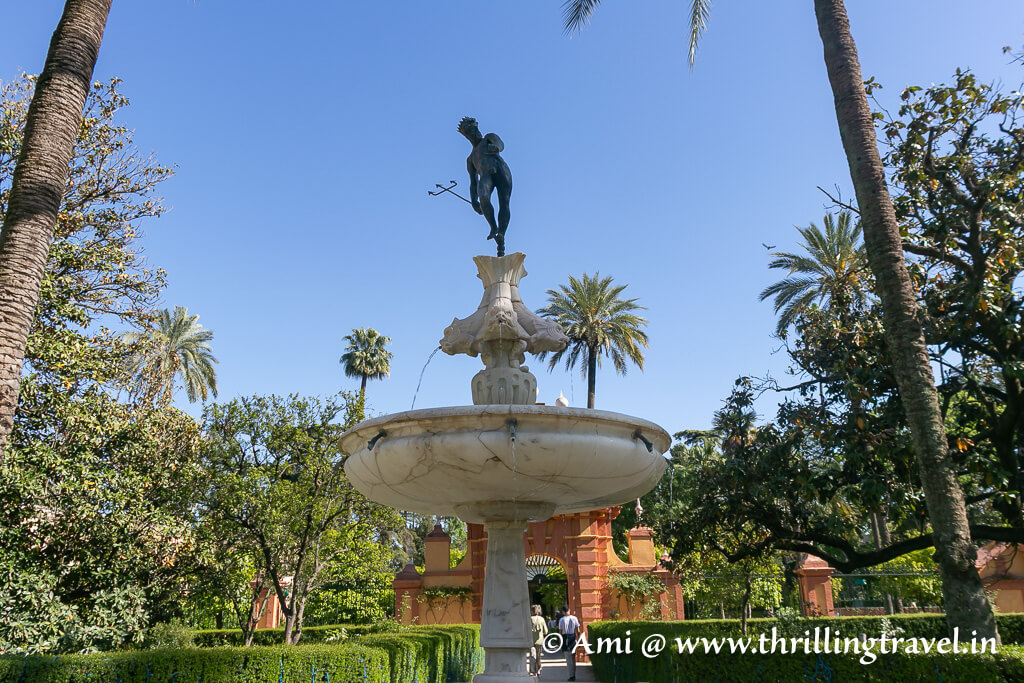
Welcome to a different style – a formal Renaissance rectangle. You will find it divided into eight sections around a central axis – anchored by the monumental Fountain of Neptune. As I understand this has been styled after the fountains of Bologna.
Garden of the Old Labyrinth (Jardín del Laberinto Viejo)
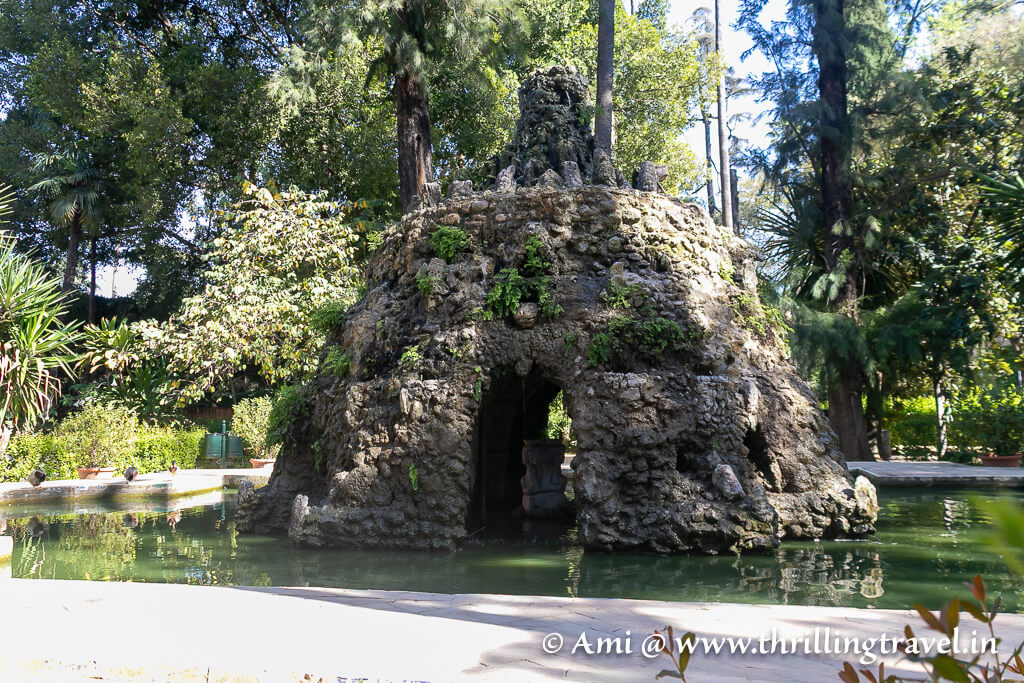
This space is also, called the Garden of Cross and can be reached through the Door of Hercules. The door is called so owing to the painted scene above it of Hercules wrestling Antaeus.
Once upon a time, there as a real maze here but it vanished in 1910. Only a fountain from that time survives. At Note the Sultanas’ Grotto (Gruta de las Sultanas), an artificial rock mound built to represent Mount Parnassus in the center.
Carlos V Pavilion (Cenador de Carlos V)
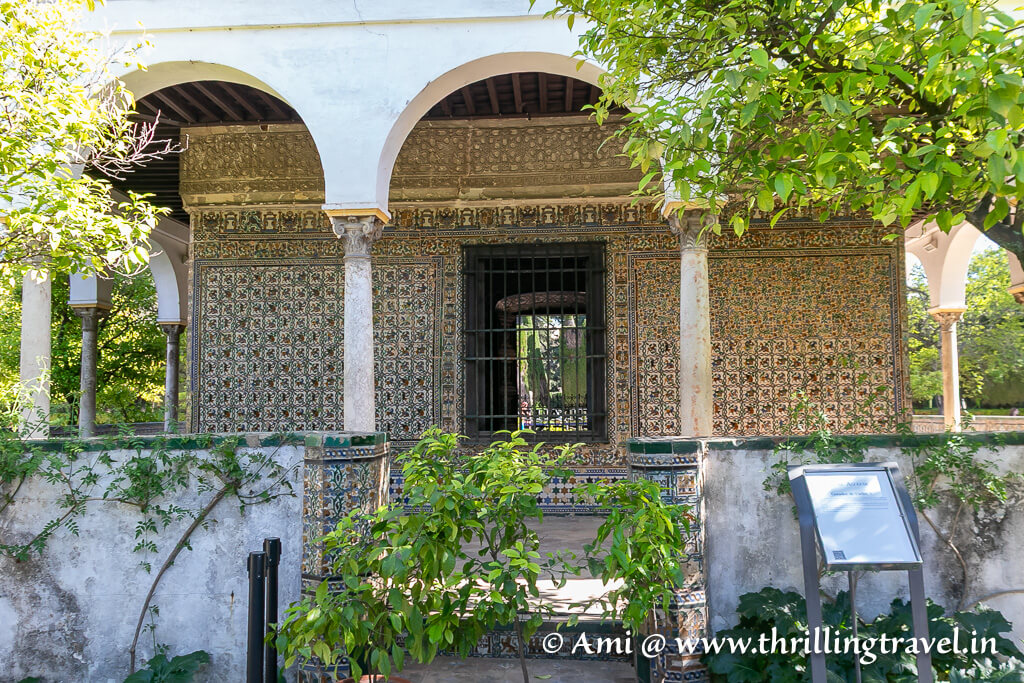
I recommend walking to this Real Alcázar garden to see the mishmash of styles packed into one small structure. This pavilion was built to mark the marriage of Charles V. I could see its 16th-century tilework tracing the outline of an old labyrinth pattern. I definitely recognized this for its presence in the famous GOT.
Grutesco Gallery (Galería del Grutesco)

Now you will come to a raised walkway which was built right on top of the old Almohad city wall. You can still see the decoration of fantastical carved figures giving the gallery its name.
Along it sits the Puerta del Privilegio – the Door of Privilege. This is a 17th-century doorway linking the Garden of Poets to the Carlos V Pavilion.
Garden of Poets (Jardín de los Poetas)
Interestingly this land was still a farmland till the early 20th century. The current shape is owing to same Joaquín Romero Murube whose patio you had visited earlier. He created this space to honor local literature and poetry
From here, you can choose to go to Jardín Marqués de la Vega Inclán and enter the Gothic Palace through the Marchena gate or walk a little further to the Mercury garden – which is what I recommend.
However, if you choose to exit through the Marchena Gate, let me share a little about it.
Marchena Gate (Puerta de Marchena)
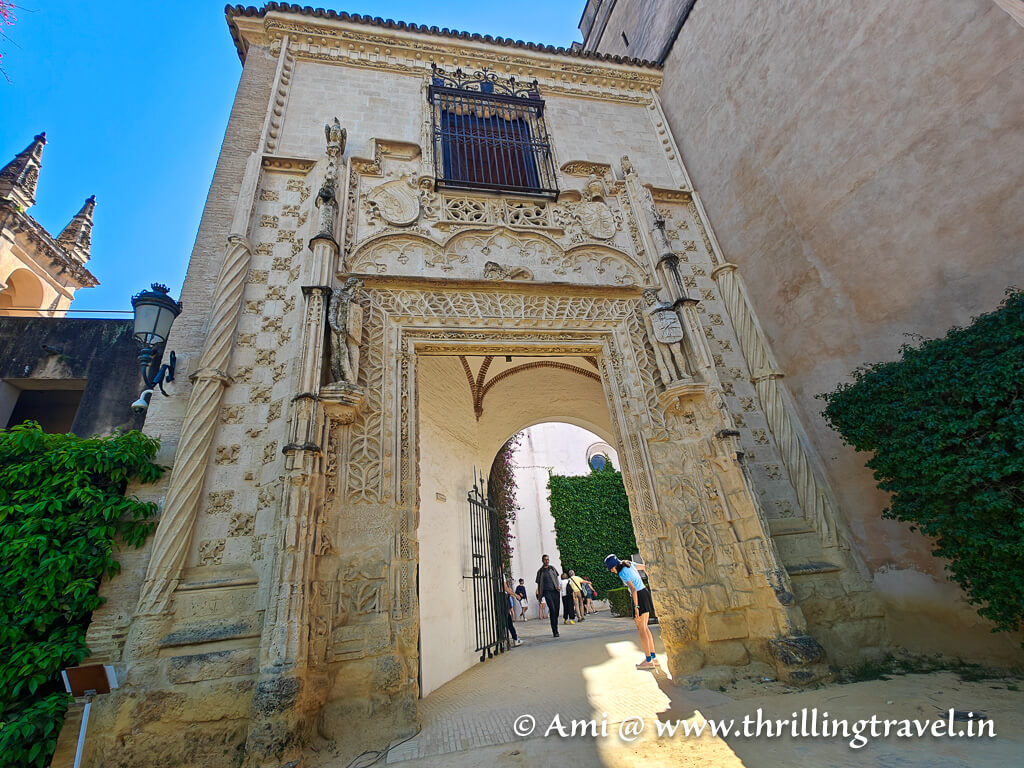
This is a Gothic doorway carved in 1492 for a noble family’s palace in the town of Marchena. It was bought at auction in 1913, dismantled stone by stone, and rebuilt in these gardens. Try to spot the ceramic panel of Saint Fiacre – the patron saint of gardeners,
Mercury Garden (Jardín del Estanque de Mercurio)
Centred on its pond, with a bronze statue of Mercury cast in 1576, this one of the most photographed corners of the whole complex.
Alcazar Seville Game of Thrones fans will recognize this stretch as the Water Gardens of Dorne. It is where Jaime Lannister is brought before Prince Doran.
Garden of Dance (Jardín de la Danza)
There are two reasons that I came across for the name of this garden. The first comes from the belief that there was a statue of a dancing satyr and nymph that once stood here. The second comes from a more logical tale that this was a stage for many celebrations and dances.
With that you complete the tour of the Real Alcazar of Seville gardens. I do think they are genuinely among the standout Royal Alcazar attractions of the entire complex. Just wish I had more time here.
Baños de Doña María de Padilla
Now come an interesting Alcazar story with the Baños de Doña María de Padilla or the Baths of Maria Padilla.
Pedro I gave María de Padilla, the love of his life, her own apartments somewhere in the Mudéjar wing of the palace. She was not his official wife but the King was devoted to her. Legend says she bathed here alone, and that Pedro loved her so deeply he forbade anyone else from ever using the pool again. Legend or not, it does add a touch of intrigue to what actually was a12th- and 13th-century Almohad cistern that was open to the sky. It was built to collect rainwater long before Pedro or María existed.
Under Alfonso X, it was covered with the Gothic crossed vaults you see today, and Renaissance muralists later painted the walls and arches, work that survives faintly here from the 1560s and 70s. It was only after the 1755 Lisbon earthquake that this underground space that you are walking through was re-created.
The hushed, golden gallery, its vaulted ceilings that mirrored perfectly in still water definitely adds that romantic touch. It definitely made me lean towards believing the Padilla story though there is no evidence of it.
The Baths of Maria de Padilla in Alcazar, Sevilla were yet another Game of Throne location where a tense meeting between two great houses took place. From here, a climb back up brings you out of the basement and straight into the Gothic Palace.
The Gothic Palace (Palacio Gótico Alcazar)
Stepping out of Pedro’s Palace and into this one felt like a completely different era. The Gothic Palace is actually the older of the two palaces that was built by Alfonso X “the Wise” between 1252 and 1284. He invited stonemasons from Burgos and built over the ruins of the old Almohad palace.
Unlike his descendent Pedro I who clearly favored Islamic style, Alfonso X stayed away from it. His ideology was to represent the triumph of Christian ideology over Seville’s Muslim past.
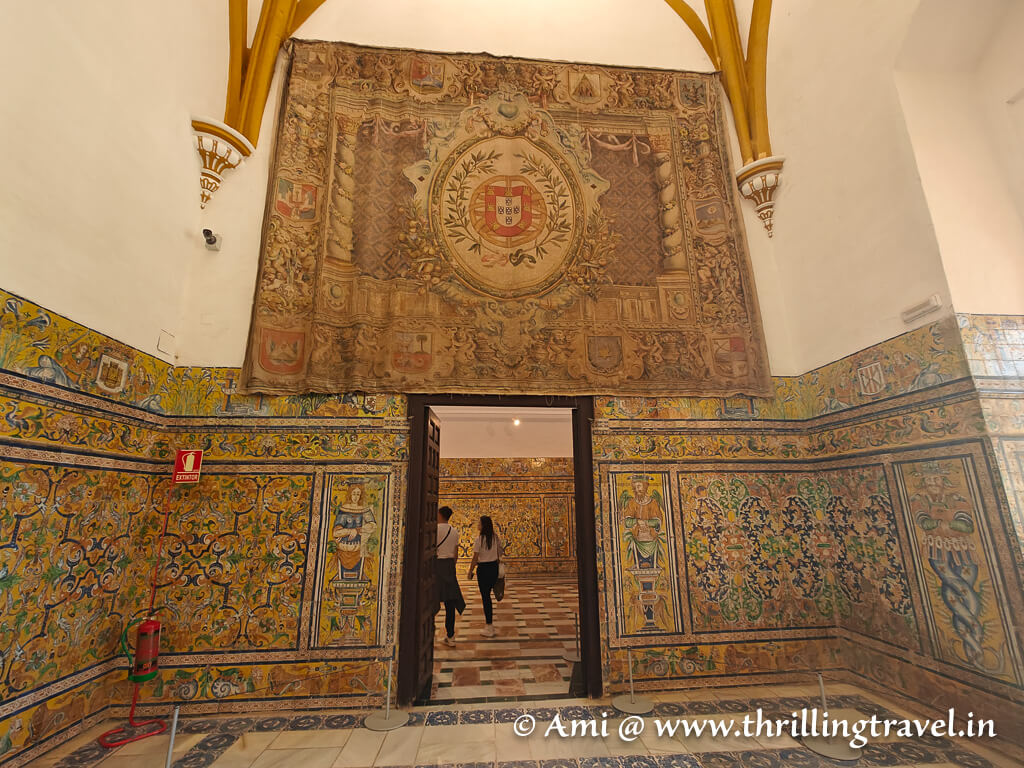
I am sure you will not miss this distinct change between the two palaces. The muqarnas ceilings give way to plain ribbed vaults.. The intricate carved walls are replaced by tiled skirting, cherubs, mythological beasts, and flowers. n the 16th century, the palace pillars that held the vaults were replaced with decorative corbels. Large windows overlooking the Royal Alcazar Seville gardens and tiled facings were added to these rooms.
Honestly, after the extravagance of the Mudéjar palace, this felt a little muted. It also felt a little minimalist compared to the Royal Palace of Madrid that I had just visited. But it grew on me with its own quiet beauty.
Hall of Charles (Vaults Hall)
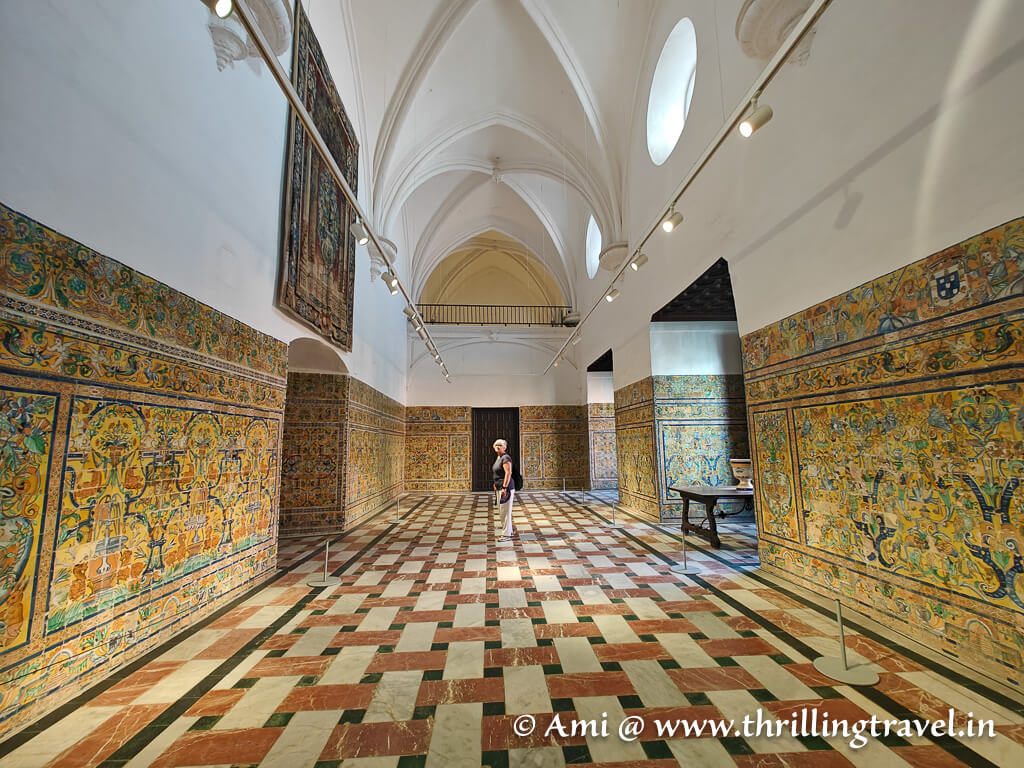
As the name suggests, this hall is linked to Charles V and was in fact, marked for his wedding to Isabella of Portugal. Also, called the Hall of celebration, you will find several decorative elements like cherubs, chandeliers and mythological figurines. There is also a central portrait to show Charles V and Isabella themselves.
Tapestries Hall (Salón de los Tapices)

The room takes its name from the huge tapestries covering its walls, depicting Charles V’s 1535 conquest of Tunis. However, note that what hangs here today is not the original set. They are replicas of the 1540s masterpieces made in the 18th century under the reign of Philip V, most likely because the originals were destroyed in this hall by the 1755 Lisbon earthquake.

The Chapel

Tucked behind a side door, this small oratory still holds its original medieval vaults. The most important part of this hall is the altarpiece of Virgen de la Antigua. However, this too, is a copy of any original that you should check out in Seville Cathedral when you visit there. It was painted directly onto the old Mosque’s wall when the building converted to Catholic worship in the 13th century, making it one of the oldest pictorial images anywhere in the city.
With that, this self-guided tour of Royal Alcazar Seville ends. I am sure you are reeling from the sights of the layered courtyards of Pedro’s Palace, the calm restraint of the Gothic Palace and vibrance of the patios and gardens. Walking through the Alcázar means walking through centuries of Seville’s history. And it is all inside Alcazar Seville.
How Long Do You Need for Visiting Alcazar Seville?
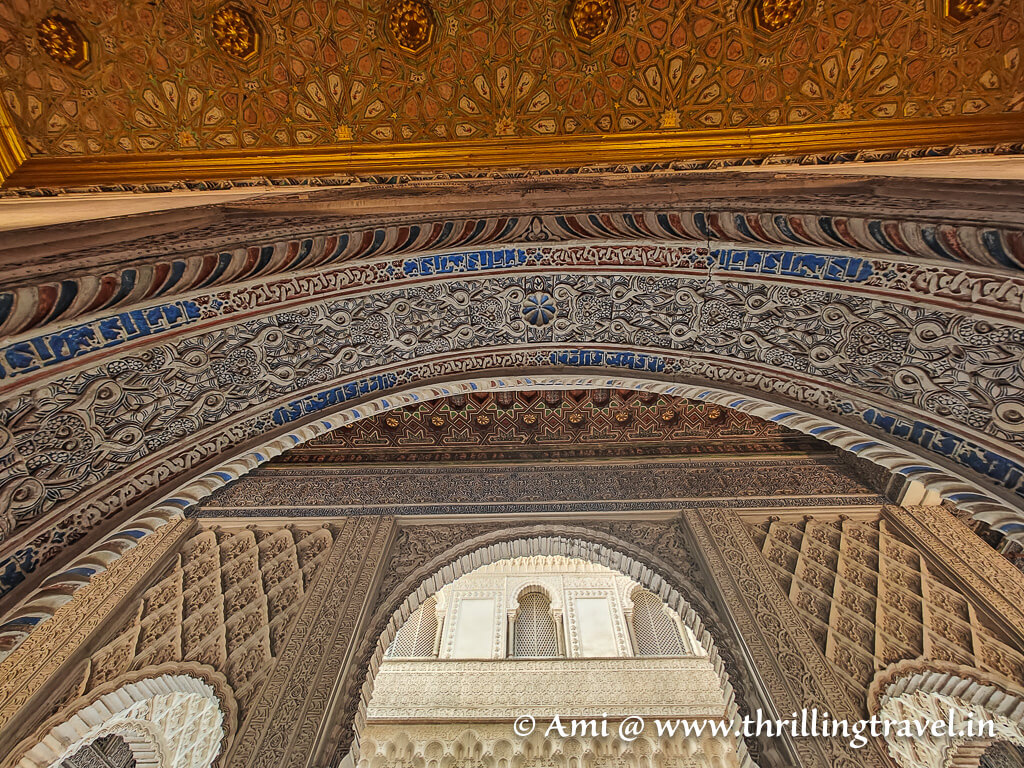
I recommend that you plan for at least 2.5 to 3 hours if you want to see everything covered in this guide on what to see in Alcazar Seville. If you are like me who enjoys various lores and offbeat corners, then you will not want to rush through the Royal Alcazar in Seville.
If you only have 90 minutes, then you will need to be selective. This is when you will have to follow the main route and avoid the offbeat detours like the tile gallery, the Casa de la Contratación, and the smaller patios around the Casa del Asistente. Stick to the route through Pedro’s Palace and the Gothic Palace. In the Real Alcázar gardens, skim through just the two main ones, Mercury Garden and Garden of Dance, rather than the full sequence.
Remember to build in a buffer near the Royal Alcazar Seville entrance for the security queue before your slot even starts.
What Are the Other Places to See Near the Royal Alcazar of Seville?
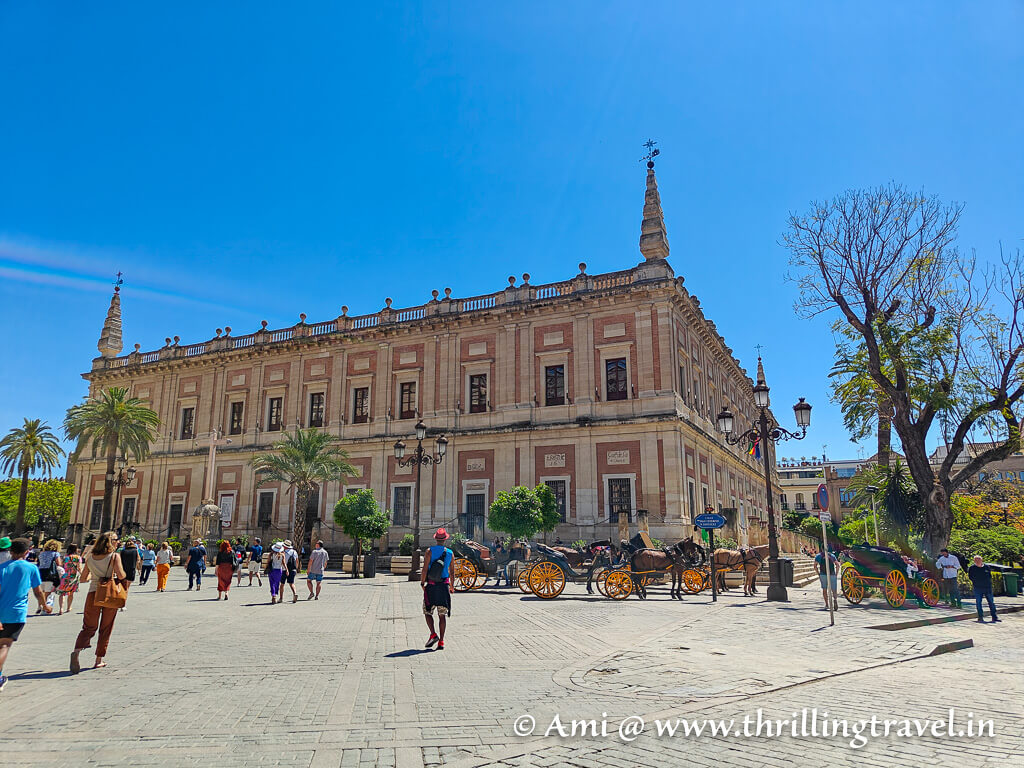
I am sharing this list so you can pick the right time slot when booking your Alcazar tickets, ideally to pair your visit with one or two of these without doubling back across the city. For full details on each, head to my other Seville blog post.
- Seville Cathedral and the Giralda — right next door, and most visitors combine visiting Alcazar Seville with the Alcazar and Cathedral in Seville on the same day.
- Archivo de Indias — a short walk away, and included in your Alcázar ticket.
- Barrio Santa Cruz — the old Jewish quarter, easy to wander into straight from the Alcázar’s gates.
- Plaza de España — a little further, but worth the walk.
Common FAQs About the Royal Alcazar of Seville
How long should I spend at the Royal Alcazar?
Budget at least two and a half to three hours if you want to see everything. Wondering how long to visit Alcazar Seville on a tighter schedule? Ninety minutes works if you stick to the core route and skip the offbeat detours.
Is the Royal Alcazar the same as the Alhambra?
No. They share real architectural kinship, since Pedro I brought in Nasrid craftsmen from Granada, but the Alhambra was built by and for Muslim rulers, while the Alcázar was commissioned by a Christian king. The Alcazar vs Alhambra question comes down to this: the Alhambra is a preserved monument, while the Alcázar is still a working royal residence.
Is there parking near Alcazar Seville?
The old town’s narrow streets make driving in impractical, so most visitors arrive on foot, by taxi, or by public transport instead of hunting for parking near Alcazar Seville.
Is Alcazar Seville suitable for kids?
Generally yes, and the courtyards and gardens give children room to explore. Visiting Alcazar Seville with kids works best if you build in breaks and skip the audio guide’s finer historical detail, since younger visitors tend to engage more with the spaces themselves than the stories behind them.
Before you go, pin this


Popularly referred to as a Restless Ball of Energy. My Mom refuses to entertain my complaints about my equally restless daughter & assures my husband that I was born with a travel bug.
I am a Post-Graduate in Marketing by qualification and a travel blogger by passion. Besides travel, I enjoy photography and if you don’t find me at my desk, I would be out playing badminton or swimming or just running. I believe in planning for every long weekend through the year. And when I cannot travel physically, I travel virtually through this travel blog. My travel stories have also, got published on various websites and magazines including BBC Travel, Lonely Planet India and Jetwings. I have recently published my first book – When Places Come Alive – a collection of stories that are based on legends, landscapes, art and culture of a place which is available in both ebook and paperback format.
You might also like these posts –
- How to plan a 2 days in Seville itinerary – includes top things to do , stay and other insider tips
- A complete guide to a day trip to Frigiliana – the prettiest village in Andalucia, Spain
- A travel guide for a day trip to Nerja, Spain
- Tips on picking the best Madrid cycling tours (& my experience of exploring the city)
- 15 amazing facts about Royal Palace of Madrid & reasons why it is worth visiting
- What to see inside Royal Palace of Madrid? History, Interiors & Tips for your visit
- All about Spain tourist visa for Indians (Schengen visa): how to apply, documents required and fees
- Madrid in two days | The best Madrid itinerary for 48 hours
- Best of Barcelona Attractions
- A perfect 3 days in Malaga itinerary – with the best things to do, stay & eat
- The ultimate 3 days in Granada itinerary – with best things to do, stay and other insider tips