
The Royal Alcázar's palaces and the Cathedral's majestic dome,
The labyrinthine lanes of Barrio Santa Cruz that make you feel at home,
Orange blossom streets and Moorish sunsets nothing short of extraordinary,
You can live it all through this perfect 2 days in Seville itinerary.

Explore the the 4th largest city of Spain with this travel guide to Seville. Discover the top things to do in Seville in 2 days, with insider tips on where to stay, what to eat and the ideal time to visit. Get suggestions on how to plan 3 days or just 1 day in Seville.
The romantic spell of Seville had ensured that I include this Andalusian destination in my Spain itinerary. The city came with a reputation of vibrant cultural experiences, architectural extravaganza, and tons and tons of stories. Having spent 48 hours in Seville, I can totally attest to this reputation and assure you that you are in for a treat if you are planning to visit Seville.

Seville was like a gateway to the hotpot of cultures Andalucia is known for. The blend of Islamic culture with its Spanish roots is so evident in every part of the city and makes it unique — the scent of orange blossoms in the air, the sound of flamenco drifting out of a bar and the sheer grandeur of monuments. My 2-day Seville itinerary took me from the ornate halls of the Real Alcázar to the soaring heights of the Giralda tower, from the cobblestone charm of Barrio Santa Cruz to the sweeping grandeur of Plaza de España. I wove in tapas stops, a flamenco show and even a leisurely walk along the Guadalquivir river.
In this travel guide, I will be helping you plan your visit to Seville. I will be sharing my own Seville itinerary for 2 days, along with handy tips on where to stay in Seville, what to eat and how to get around the city. I have also listed alternative things to see and do in Seville that you can swap in based on your interests.
And if you have a little more or a little less time on hand, I have got you covered with suggestions for Seville in one day and 3 days in Seville as well. All in all, this Is the only Seville guide that you will need for your planning your trip here.
Quick links for planning your Seville trip
- Booking.com has several good Seville hotels and B&Bs listed on their site. You could use this link to browse and book the same.
- GetYourGuide has tons of tours, discount cards and transfer services available on their site, which would be useful for your trip. Here are five suggestions that you could consider for your visit to Seville.
- Viator is another good website for booking your Seville experiences and tours. Check these five tours that might be helpful in discovering Seville.
- For any of your travel needs or general shopping, consider using Amazon through this link.
Disclaimer: This article includes affiliate links. This means that at no cost to you, I will receive a small commission if you purchase through my link. Thank you for supporting me with this.
Where is Seville?
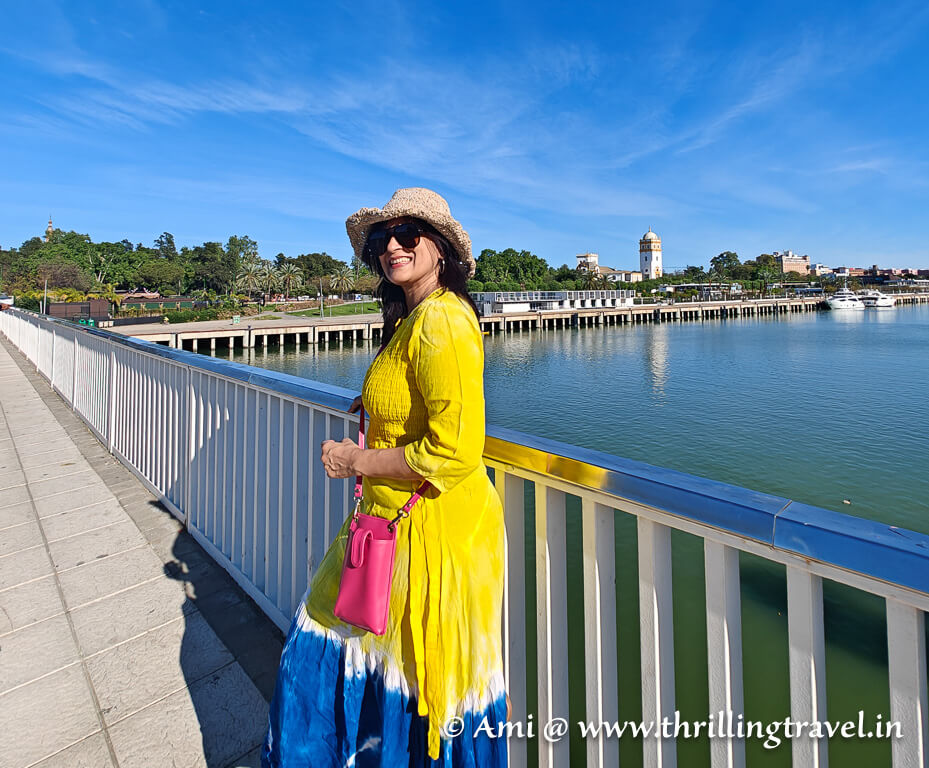
Let’s first get the pronunciation of Seville right. It is Se-vi-ya and is also written as Sevilla. Along the banks of the Guadalquivir River, this city is the capital of the Andalucía region in southern Spain. It is the only major inland port city in Spain, a fact owing to which the city has a rich history and a medley of cultures.
It is around 200 km west of Málaga, 250 km southwest of Granada and about 550 km southwest of Madrid. Now you can see why weekend breaks in Seville are perfect.
History of Seville, Spain
I believe that this section is almost mandatory in this Seville guide. Almost every monument, every lane and every tradition that you encounter over your two days in Seville, Spain, has a story that stems from this history.
Seville’s history stretches back over 3000 years, with the Iberians who first settled along the Guadalquivir River. It became Hispanic under the Romans, who arrived in the 2nd century BC.
The Visigoths followed the Romans and then, in 712 AD, the Islamic rule took over and made Seville one of the most important cities of Al-Andalus. It was then called Ishbiliyya and was an important port. A lot of the architectural and cultural identity of the city was shaped during this period. In fact, the iconic Giralda tower – a place that is a must-visit in Seville- was built during this era.
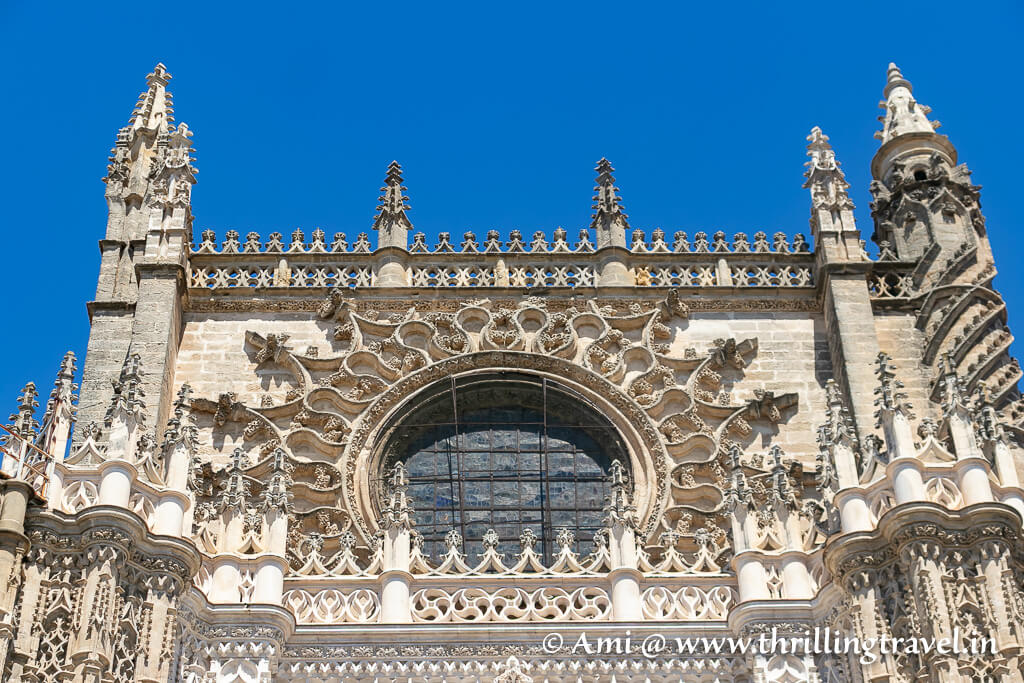
The Caliphate of Cordoba that ruled Seville was overthrown and then, came in the reign of Ferdinand III in 1290s. This is when a lot of development happened in Seville. Hospitals were built, famous painters like Miguel de Mañara and Velázquez contributed to the art scene of the city. It became even more prosperous after Christopher Columbus set sail in 1492 and discovered the New World. Seville became the gateway to this New World — the sole port authorized to trade with the Americas. The wealth that grew funded the grand cathedrals, palaces and public squares that you will be exploring as a part of your Seville itinerary.
Sadly in the 17th century, when the trade monopoly shifted to Cadiz, the city’s fortunes declined. Adding to the woes were some periods of epidemics. The city was occupied by the French troops during the Napoleon era and post the same, even participated in the civil war in the 19th century.
That said, Seville reinvented itself beautifully — hosting the 1929 Ibero-American Exposition, which gave the world the magnificent Plaza de España,- another important attraction of Seville that you will see during your trip here. Today, it has become one of the most visited and popular cities in Europe.
With so much colorful history, it is not surprising that your Seville trip plan will include a lot of UNESCO World Heritage sites.
What is the best way to visit Seville?
Seville is very well connected to the rest of Spain and Europe — which makes planning a weekend in Seville or a longer trip fairly straightforward. Whether you are flying in or taking the train, here are your options for getting to one of the most beautiful things to visit in Seville.
By Air
The main airport in Seville is Aeropuerto de Sevilla (SVQ) — located just 10 km from the city center. It has good connectivity to not just the Spanish cities like Barcelona and Madrid but also other European cities. This makes it perfect for domestic and international travelers.
There are several options for airport transfers in Seville. You can use any of the following ways to get to the city center from Seville airport —
From Seville airport to the city center by bus
The Seville Aeropuerto Especial (EA) runs every 30 minutes and connects the airport directly to the city center. It has stops at Puerta de Jerez and the Santa Justa railway station as well as the city center. The journey takes around 35 minutes – 1 hour depending on your stop. and costs approximately €5 per person.
If you are opting for a Seville city pass, then you can even include this as a part of your card offerings. I will be covering this in detail later in this Seville trip planner.
Bus is the most economical option for airport transfers in Seville – especially, if you are traveling solo or as a couple without too much luggage.
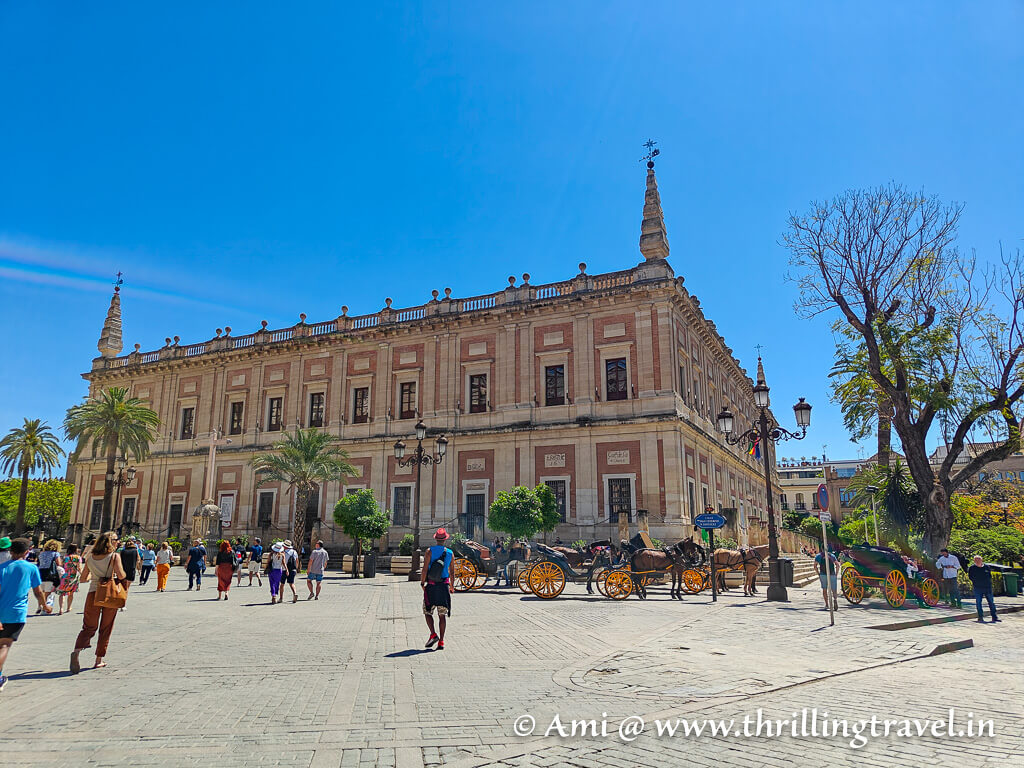
Seville airport to the city center by taxi or cab
This a great option if you are traveling in a group or have lot of luggage as the taxis will drop you directly at your booked accommodation in Seviile. Taxis are readily available outside the arrivals terminal. The fare to the city center varies between €25 – €30 depending on the time of the day.
You can also, opt for popular app-based services like Uber and Cabify which could work out slightly cheaper. Check the rates beforehand and then pick your option.
At this point there is no metro or train option from the Seville airport to city center.
By Rail

If you are visiting as part of a wider 2 days in Seville Spain trip or a multi-city Andalucian adventure, the train is hands down the best way to arrive. In fact, I chose to travel from Madrid to Seville by rail over a flight for various reasons. For one, the travel time (adding the pre-flight checkin and the flight time) was almost the same. Two, low-cost airlines have their own luggage restrictions which I did not want to get into given my multi-city Spain journey.n
I used RENFE’s high-speed AVE train from Madrid to Seville. The journey took just 2.5 hours, the seats were comfortable and I arrived right in the heart of the city at Santa Justa station, ready to start exploring.
Journey times from other key cities are as follows —
- Madrid to Seville — 2.5 hours
- Barcelona to Seville — 5.5 hours
- Málaga to Seville — 2 hours
- Granada to Seville — 3 hours (via Antequera)
- Córdoba to Seville — 45 minutes
Most of these cities have multiple departures through the day to Seville – which is another reason why you should consider using them for your Seville trip.
I highly recommend that you book your tickets well in advance on RENFE as fares are dynamic and rise significantly closer to the date of travel. Iryo is another operator worth checking for competitive fares on select routes. Also, note that the RENFE website can sometimes be quite buggy. If so, you can book using this website or through OMIO.
By Road
Seville is well connected by road and several bus services operate from major Spanish cities. The main bus station — Plaza de Armas — is centrally located and well served by operators like ALSA. Your tickets can be booked through OMIO.
You can also rent a car and drive to Seville. However, I would like to warn you that driving and parking within Seville’s historic center is quite restricted and can be expensive. I would recommend using the car only for intercity travel and rely on public transport or walking once you are in the city. More on that coming up in another section of this Seville travel guide.
What are the best areas in Seville for a stay? (accommodation in Seville)
When you plan a trip to Seville, choosing the right neighborhood for your stay becomes very important — especially since we are attempting to cover all the must-see things in Seville in just 48 hours. The good news is that Seville is one of the most walkable cities in the world and if you find that perfect location, you can do all the top things to do in Seville on foot.
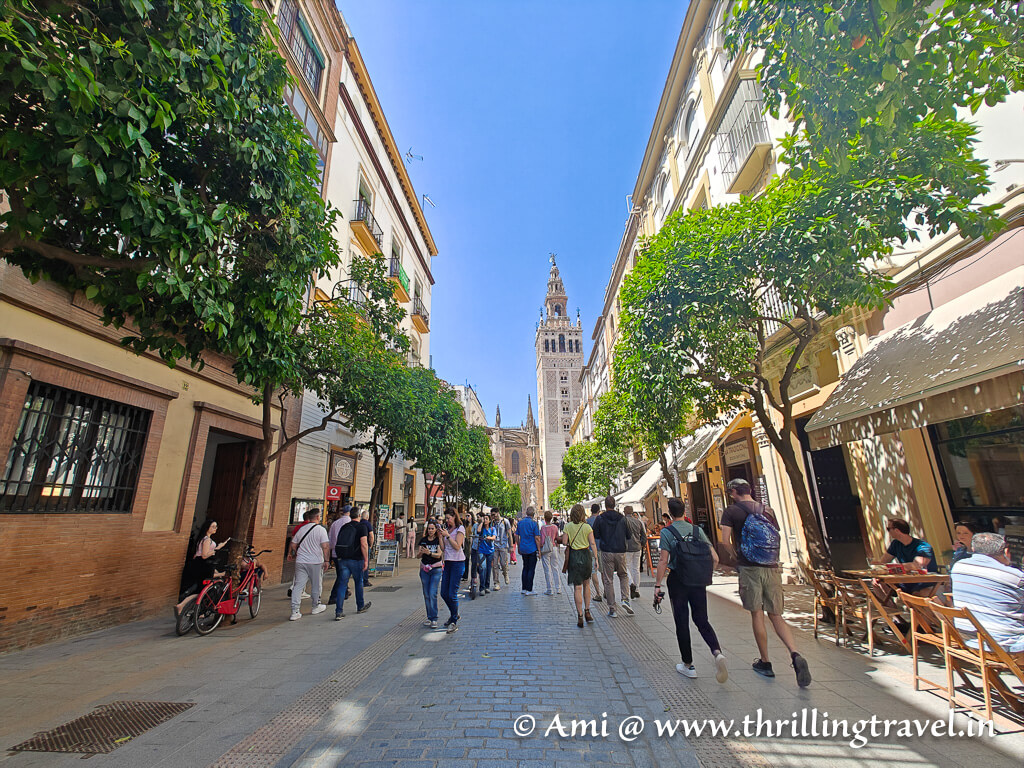
For my own trip, I considered three areas in Seville that you should definitely consider when you are booking your accommodation. Given the cryptic addresses of AirBnbs in Seville while you are booking, I ended up discovering a 4th area, which I am happy to include in this list of recommendations.
- Barrio Santa Cruz – The old Jewish quarters is almost like the pulse of the city. You will have the key attractions like Real Alcázar, the Seville Cathedral and the Giralda tower within walking distance and tons of cafes, tapas bars and restaurants around you. This was my first preference when I was planning a Seville in 2 days itinerary. I found a good mix of boutique hotels, apartments in Seville Spain and guesthouses across various budgets here but sadly, I I could not get my shortlisted options on my chosen dates.
- Seville Centro – Also called Casco Antiguo, this is as central as you would need for your two days in Seville. It has all the major attractions within walking distance along with a bustling market and food and drink places. Unlike the narrow lanes of Barrio Santa Cruz, this has wider roads and squares.
- Triana – This Seville neighborhood offers you a very local experience. It is right across the Guadalquivir river and is known for Seville’s flamenco culture, ceramics, market and its riverside tapas bars.
- Los Remedios – This is where I stayed during my Seville trip. It is a lovely residential area that is almost parallel to Triana. It is just 10 minutes to the city center as well as Plaza Espana across the river. Quieter yet with enough restaurants and cafes, it is a perfect place to wind down after a full day of activity in Seville.
Here are quick links to my shortlist that you can now use when planning your itinerary for Seville.
- Luxury hotels in Seville – Radisson Collection Hotel – Magdalena Plaza, Vincci Selección Unuk 5 GL, Hotel Colón
- Boutique hotels and mid priced options – Catalonia Giralda, Zenit Sevilla, Hotel Becquer
- Apartments in Seville – ELEVEN Real de la Carretería, by Homing U, Bypillow residence Abril
- Hostels in Seville – La 15 Triana Residence By Soho Boutique
Planning a 2 days in Seville itinerary
This section is not just about what to see in Seville in 2 days. It includes a few suggestions on what to eat and routes to follow so that you can make the most of your trip to Seville.
From the map, you can see that there are three major clusters of attractions in Seville. My two days in Seville itinerary covers these hubs in different day parts – which will allow you to swap the day parts based on your convenience. Note that a lot of this would be based on your tickets and timings for the Real Alcàzar or the Cathedral and the Giralda.
I have also, included a section later with alternate suggestions that you can substitute in your plan for 48 hours in Seville or add if you have 3 days in Seville. More tips as we go along, let’s get started.
48 hrs in Seville itinerary: Day One
Key highlights: Torre del Oro, Barrio Santa Cruz, Real Alcázar, Seville Cathedral & Giralda
Grab a coffee and start your morning at Torre del Oro (Golden tower)
There is no better way to ease into your first morning in Seville than with a walk along the Guadalquivir riverbank to the Torre del Oro. This striking 13th-century watchtower — whose name translates to the Tower of Gold — was originally built by the Moorish Almohad dynasty as part of the city’s defensive fortifications. There are two stories behind why it was called the Tower of Gold.

The most popular and seemingly rational tale revolves around the golden sheen that the hay and limestone roof gave it. The mysterious version has it that the gold that once passed through here from the Americas was stored here.
There is a lot of debate about this, but the one thing everyone does agree on is that it makes for a spectacular first sight of Seville. The 36m high tower was not built at once. Quite like the Qutub Minar in Delhi, it was built in parts, with the 1st level constructed by the Arabs, the 2nd added later by the notorious Peter of Castille in the 14th century and the last one built in 1755 after the damage caused by the Lisbon earthquake.
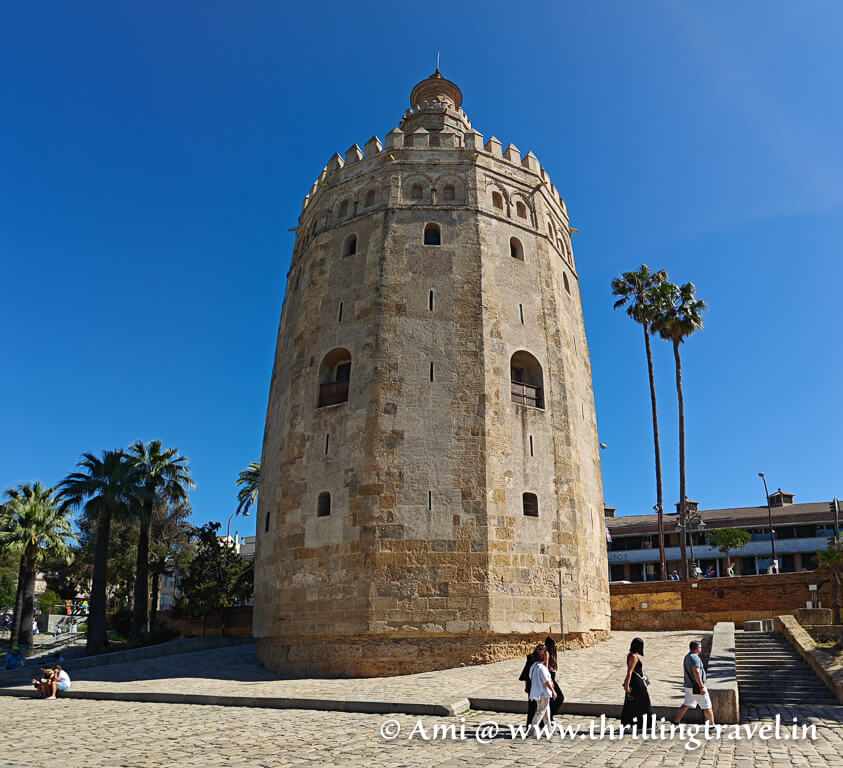
The tower is a 12-sided polygon (dodecagonal) except for the third level, which is circular. Through its history, it has been used for various purposes – from being a gunpowder storage facility to a prison, to offices of a Naval command, and also, a dating venue for King Pedro I. Today, it has a small naval museum and you can climb up the tower for some delightful views.
The Torre del Oro of Seville not just guided ships but was the first line of defense. It was connected to a silver tower – Torre de la Plata with heavy chains and also to a defensive wall that was built around the town. You can no longer see the chains, but you can still see some parts of the walls and the Silver tower (which is in a neglected state) near the Alcazar.
The tower still continued its role as a beacon, guiding my path as I walked across the river on the Puerta de San Telmo (San Telmo bridge) from my Bnb in Los Remedios. Still impressive, I did not go inside but instead chose to just stand by it, enjoy the tales connected to it, while witnessing the city waking up to a new day.
Do a walking tour of Barrio Santa Cruz – one of the interesting things to do in Seville
I spent around 20 minutes near the Torre del Oro before joining the guided walking tour of Barrio Santa Cruz. I signed up for this as part of the Hop-on-Hop-off bus itinerary. However, if you are not doing the hop-on hop-off bus, you can book a standalone guided walking tour of Barrio Santa Cruz that I have included in the quick links section. I would strongly recommend a guided option over exploring on your own — the labyrinthine lanes are easy to get lost in and the history is rich enough to deserve proper storytelling.

Barrio Santa Cruz is like the heart of the historic center. It is an old Jewish quarter and one of the most enchanting neighborhoods in Seville. The Jewish community thrived in this area until the 14th century, when they either were forced to convert to Christianity or flee.
What is left now is a bustling locality filled with cafes, shops and pretty corners. There are tons of stories behind the whitewashed walls, the pretty patios and the tiny squares that are fragrant with orange blossom. Here you will find the narrowest streets of Seville – some where you can literally touch the two walls that border the street.
My walking tour of Barrio Santa Cruz took me past the popular Plaza Doña Elvira, which is photographic with a central fountain and its orange trees. Then there is the Callejón del Agua or the water alley that runs alongside the Alcázar walls and the Plaza de Santa Cruz itself where an ornate iron cross marks the spot where a church once stood.

You also, get your first glimpse of three of Seville’s top attractions – the Giralda, the cathedral and Real Alcazar – all a part of your Seville itinerary for 2 days. I could not have enough of 45 minutes tour of Barrio Santa Cruz that started from Torre del Orro. I realized I should have signed up for a more detailed tour.
Nonetheless, I took the time after the tour to explore the place on my own – finding tales along the way – all of which I shall put together in a separate post. Trust me, there is enough to take at least 2 hours of your 48 hrs in Seville.
Grab lunch in Barrio Santa Cruz

There is no dearth of cafes, tapas bars and restaurants in Barrio Santa Cruz. You will find them buzzing with crowds – so much that I found many of the recommended places had a waiting time. Nonetheless, I found two amazing options near Plaza de La Contratacion – a few meters from my next Seville stop – Alcazar.
The first is Islamorada for its warm, relaxed atmosphere and a menu that introduces you to the flavors of Andalucia. And the 2nd is more of a local tavern feel with Abacería del Postigo. I went in with the 2nd option for lunch and absolutely loved their collection of local cheese.
Explore the Real Alcázar – a must-visit in Seville

After lunch, head to what is arguably the crown jewel of Seville — the Real Alcázar or the Royal Alcazar of Seville. This is the oldest working royal palace in Europe and is a stunning potpourri of architectural styles – from Islamic to Gothic and Baroque. One step through the gates and you will know why the Alcazar tour is an uncompromised part of any Seville itinerary.
The palace is a delightful layout of ornate chambers that take your breath away and serene green spaces that allow you to absorb it all in. On one hand, you have this riot of geometric tilework, the horseshoe arches, stunning murals and art pieces, while on the other, there are pretty patios and landscaped gardens. The Real Alcázar is a sensory overload.

The Royal Alcazar was originally built by Moorish rulers and then expanded by the Christian kings after the Reconquista, which is why you see such a mishmash of cultures and eras. I took over 2 hours to explore the place and yet, I feel as if I left a lot unseen.
If you are a GOT (Game of Thrones) fan, you will have to add this to your 2 days in Seville itinerary.. You will recognize this for Water Gardens of Dorne as well as a few other spaces. The palace was also, featured in many other movies like Lawrence of Arabia.
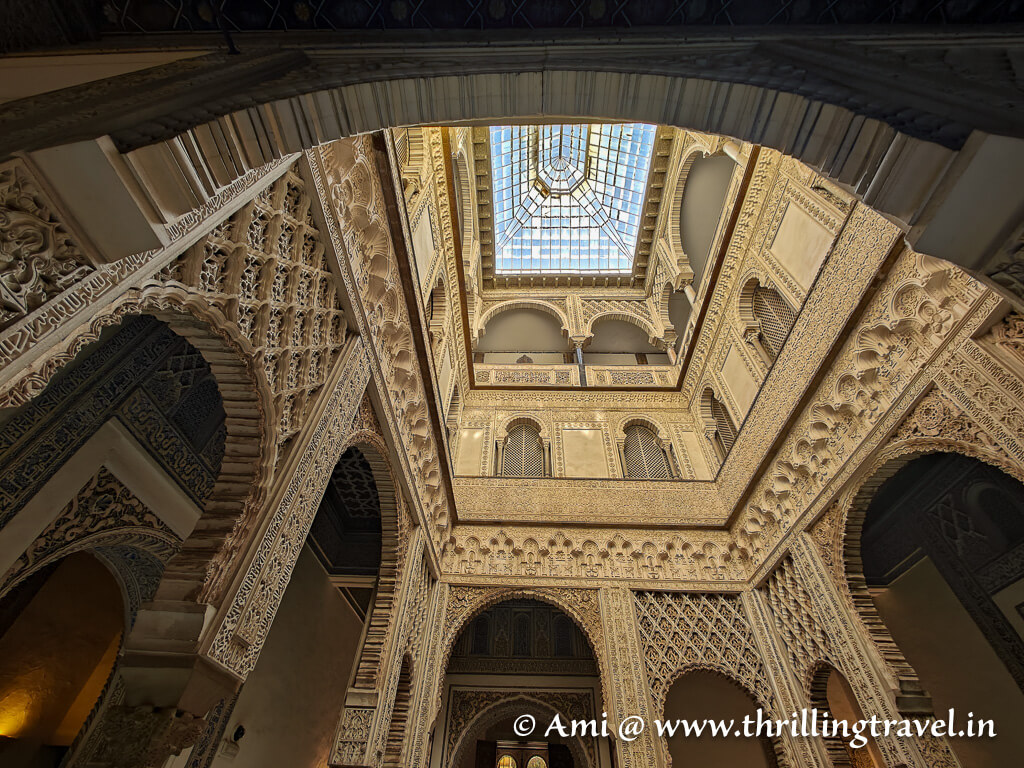
One of the most important tips here is. – Book your Alcazar tickets in advance. Being one of the top things to do in Seville, Espana, the tickets, especially in spring and summer, get sold out early. Though getting them was a tad bit easier than the Alhambra in Granada, it still required some pre-booking for me.
The Alcázar entrance tickets cost €13.50 per adult. You can book tickets through their official website or this link. You can also opt for a combination ticket like this one for the Alcazar, Giralda and the Cathedral – all of which are designated UNESCO World Heritage sites.
Note that you have to pick a time slot when you book your Seville Alcazar tickets. You need to be there at least 15 minutes before your time; otherwise, you will not be allowed to enter.
Based on the time that you have booked, you might have to move around the Day one events of this Seville itinerary, which honestly will not be difficult, as the entire day is around this location.
Take a quick coffee or Gelato break

After a scintillating tour of Seville’s Real Alcazar, I recommend cooling off with a break. You always have the option of grabbing coffee near the exit of the Alcazar but I would suggest picking one of the many coffee shops in and around the square. However, I ditched that in favor of gelato at Amorino Gelato. I was quite spoilt for choice with their menu -each flavor calling out to me.
With a few moments of gluttony, I was back up and ready for my next Seville attraction – the Cathedral and the Giralda.
Climb the Giralda and explore Seville Cathedral

I would not be surprised if, after the first glimpse at the Catedral de Sevilla, you have it pegged as a must-visit in Seville. I did too and totally regretted not buying the tickets in advance when I saw the huge crowd in front of it. I knew then I just had to satisfy myself by exploring what I could from the outside of what was the largest Gothic cathedral in the world and a UNESCO World Heritage Site. It has around 80 chapels inside it.
However, that is your big Seville tip – Book the tickets for the cathedral and the Giralda in advance to avoid the lines and missing out on the inside. Among the highlights within are the tomb of Christopher Columbus — whose remains are believed to rest here — and the vast gilded altarpiece that is one of the largest in the world.
What makes this cathedral unique, especially over St. Peter’s Basilica, is the fact that it was built over a mosque. As the story goes, there was a mosque built by the Almohads in the 1100s, which, after the Christian conquest, was gradually converted into a mosque. The subsequent rules added to it, so much so that it became a symbol of Seville’s wealth in the 1400s.

I got a glimpse of its Moorish past with the Giralda, which actually was the minaret to the mosque and now a gigantic bell tower. You can climb this tower for some stunning views of the city and the climb is easy enough as there are gigantic ramps instead of stairs. The interesting reason for this is that the 104m high tower was the tallest of its times. The muezzin used to ride up a horse all the way – five times a day for the prayer calls. Now, naturally, the best thing for him was to have ramps – not stairs. I know that otherwise, I would have quit the role.
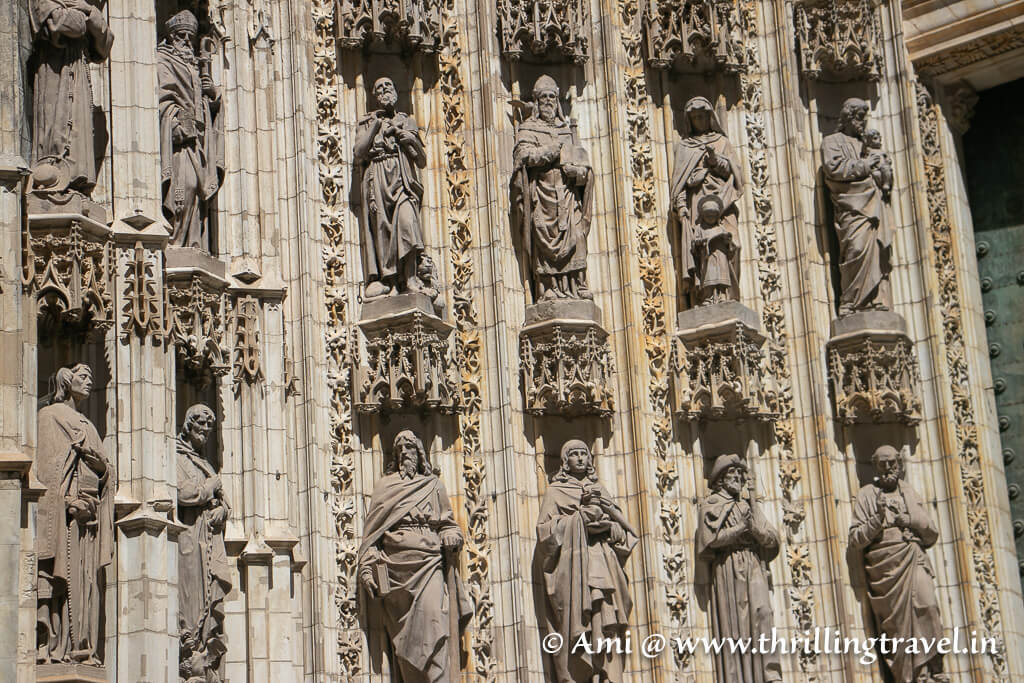
While I did miss out on the interiors – the stunning doorways, 200 odd carved figures along the longest naves and the pretty Patio de los Naranjos (Patio of orange trees), which once was the courtyard of the mosque, I did enjoy what I saw of its awe-striking exteriors. Every facade was a work of art and that itself, took me a good one hour.
The Cathedral and Giralda tickets cost €12 per adult and include entry to both. Again, book in advance to avoid the queues — you can do so through this link.
End your first day in Seville with a Flamenco show and tapas
If you are in Seville and have not seen a flamenco show, then your visit is not complete. And if you are in Barrio Santa Cruz, you are in luck with some of the finest and most atmospheric flamenco venues in all of Spain. You can book a table or two online – which is what I did and enjoy an evening of energy, vibrancy and passion. Most of these venues are within walking distance of each other.
While loitering around the neighborhood, I even discovered a place where you can watch the show for free (while just paying for your drinks and tapas). This is the La Carboneria, which has no entrance fee and informal flamenco shows three times a night from 8:30 pm, each lasting 30 minutes. It is quite popular with tourists as well as locals and if you don’t arrive early, then you won’t get a table.
I could sense the raw energy even from outside but since I had already bought my share of online tickets, I reluctantly let go of this experience – something that you should consider as your finale for the first day of the 2 days in Seville.
Alternate suggestions for your day one of the Seville itinerary for 2 days
If you have followed my itinerary as above, you likely will not have too much time on hand. That said, you might not want to climb the Giralda or possibly have missed buying tickets for one of the key attractions of Seville, then there are a few alternatives that you can consider, including on your first day in Seville.
Plaza de Toros – the epic bull-fighting arena and museum
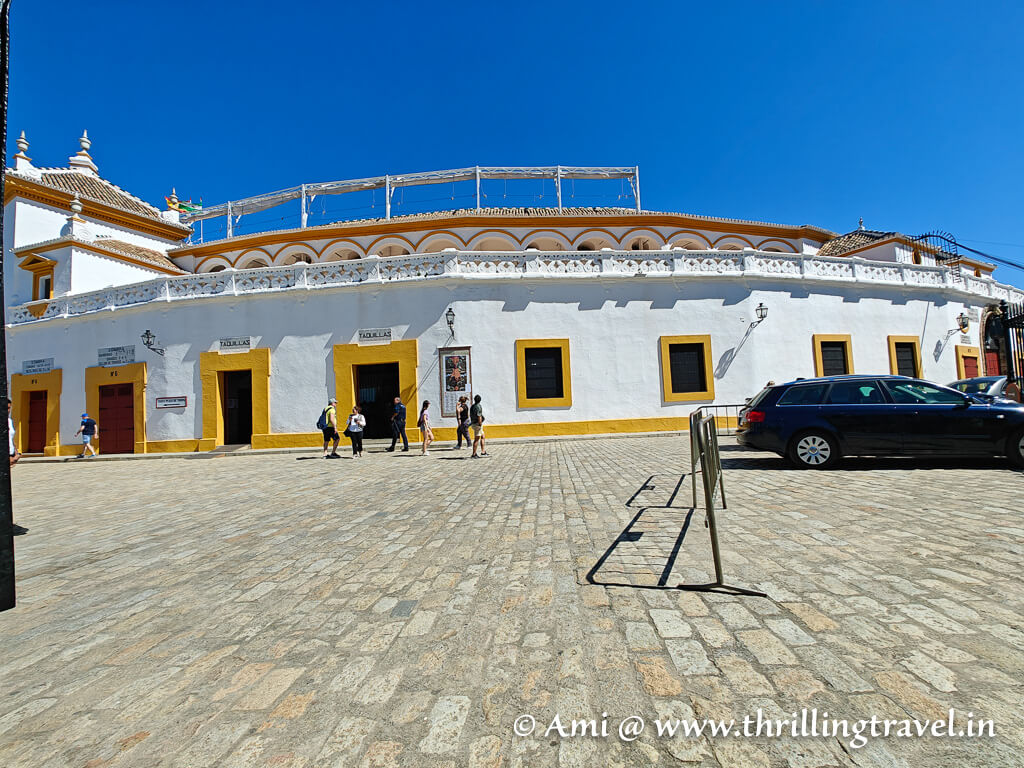
At one point in time, bull-fighting was a popular sport in Spain and Sevilla was one of the key places for it. Plaza de Toros was the largest one in Spain with a capacity of 13000 spectators. Though there is no more bull-fighting here, you can visit this arena and its museum, just for the stories of what it was, the famous matadors, the various tools used, and old paintings.
Also, called Real Maestranza, this bull-ring is across the Golden tower and is walkable from Barrio Santa Cruz. It is open from 9:30 am to 7:30 pm on all days and a guided tour will cost you €25 per adult. You can even book your tickets here.
Espacio Exploterra museum – one of the cool things to do in Seville with kids
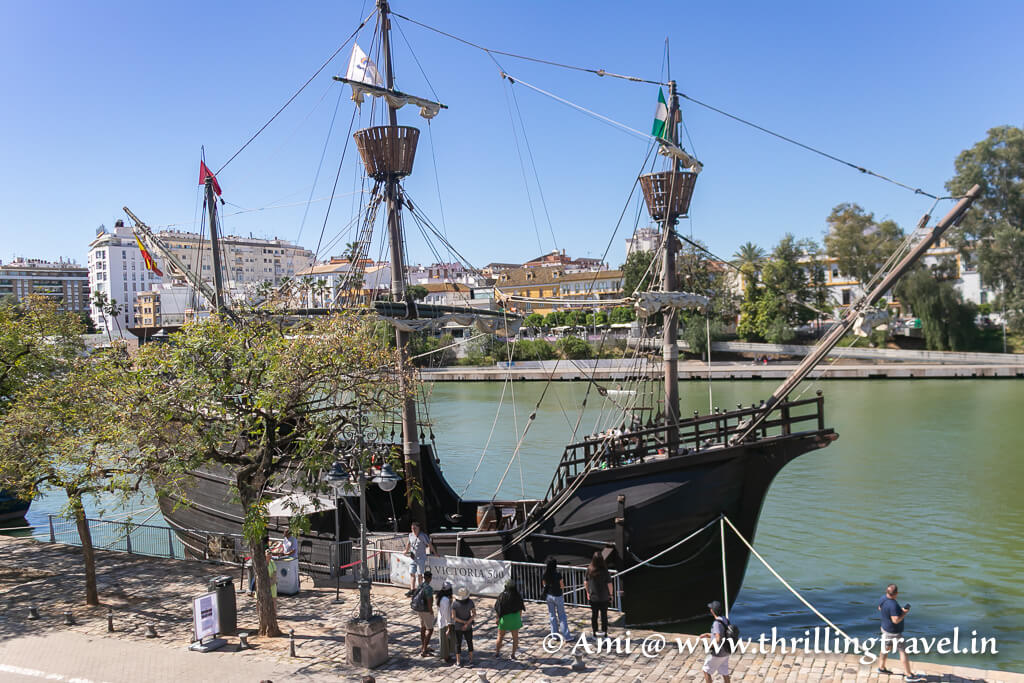
Just a few meters from Torre del Oro, along the river, is a line of old ships. These are the replicas of various historic vessels that made their journey to the New World. Espacio Exploterra offers you an interactive journey to this world. You can not only learn about the various journeys but also get onto these ship replicas and see the conditions that the navigators faced.
This is a fun activity to do with kids while teaching the history of seafaring.
Tapas crawl
I highly recommend a Tapas crawl or walk in this area for foodies. There are just tons of authentic Spanish dishes available here for you to try. You can book a guided crawl here or just embark on your own.
2 days in Seville: Day two
Key highlights: Parque de María Luisa, Plaza de España, Triana, Mercado de Triana, Metropol Parasol (Setas de Sevilla)
Have a picnic breakfast at Maria Luisa Park, Seville
After a busy day one in Seville, I started my day two in a slow and beautiful way with a picnic breakfast in Parque de María Luisa. I recommend the same for you – all you have to do is pack your coffees (or juices) with the delicious Spanish pastries and sandwiches from a cafe or supermarket and head to Maria Luisa park. From my Airbnb, it was just a 10-minute walk to the Puente de los Remedios.
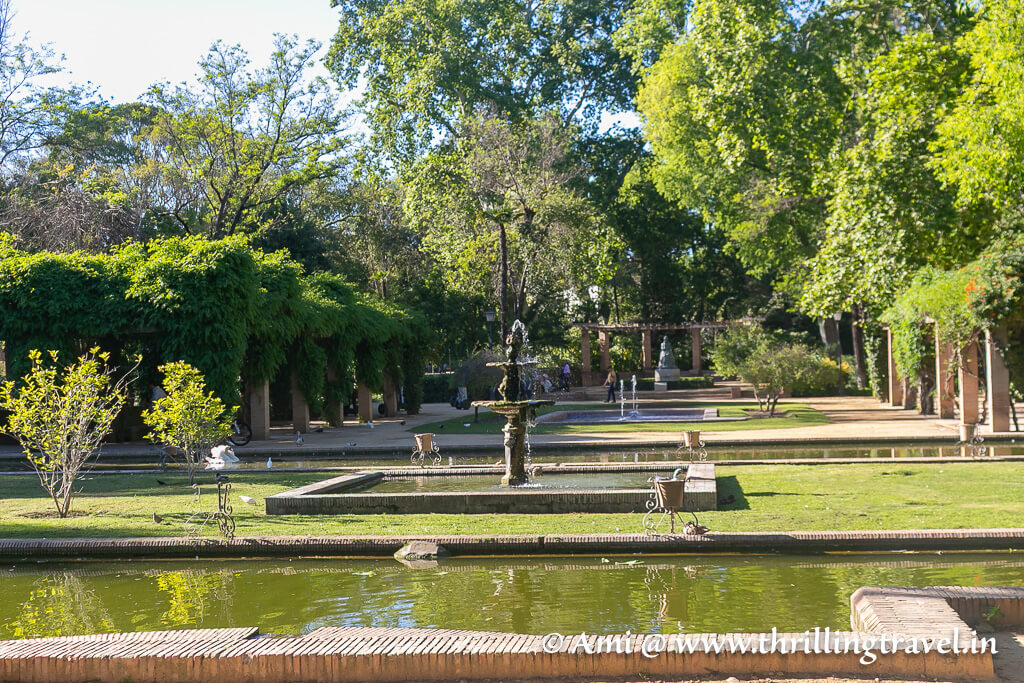
María Luisa Park is a gigantic 34-hectare park that was once a part of the Palacio de San Telmo. In 1893, the then Duchess Maria Luisa donated it to the city of Seville and since then, it has become a public park. The park is filled with gazebos, fountains, ceramic -tiled benches, and a Lily pond too. Find a place that you find serene, and enjoy the belligerent swans and quacking ducks waddling around.
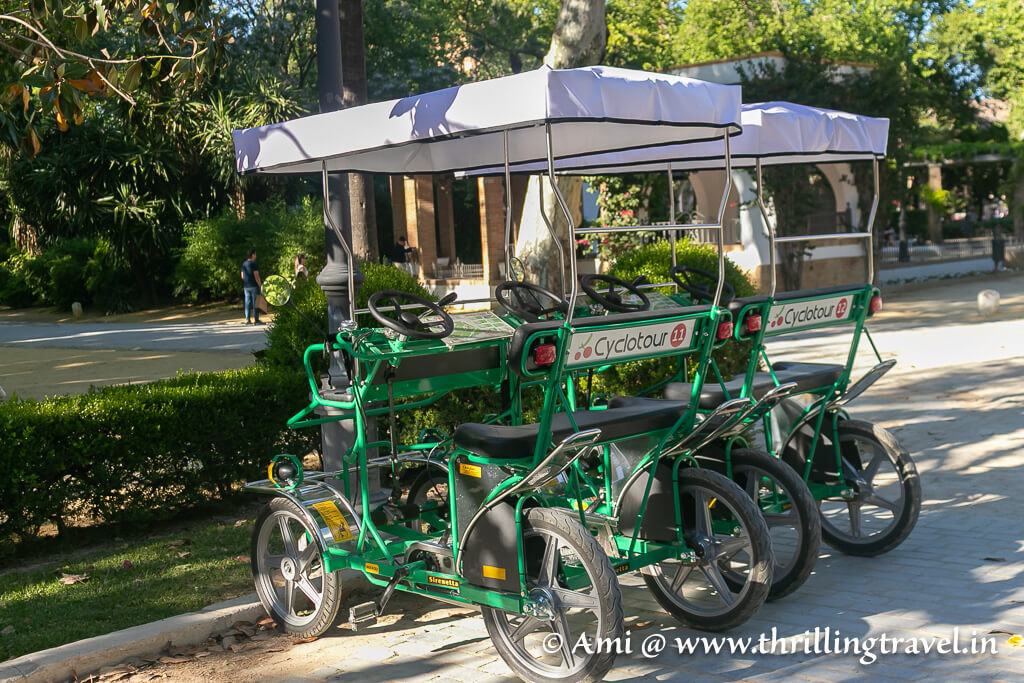
Maria Luisa Park is a botanical treasure with tons of native as well as exotic flora. At any time of the day, you will find the place cool and refreshing. You can either walk around or rent a bike to tour the place. There is also an option of a four-wheel bike that you can enjoy with your family.
The historic park was redesigned in 1929 by architects Jean Claude Nicolas Forestier and Anibel Gonález, who added a set of buildings that were used in the Ibero-American exhibition. That incidentally is what we will head to next but before we do, here are some highlights of the park that you should consider spotting when here –
- The Fuente los Leones or the Fountain of Lions – where the lions spit out water into the center. It was one of the many sculptures installed by Jean Claude.
- Estanque de los lotos (water lily pond) – where I recommend finding a place and enjoying your breakfast
- Statues of the famous authors – Cervantes
- Glorieta de Béquer statue – a gorgeous portrayal of Cupid and three maidens representing ypes of love – one that is found, one in the present and one that is lost. This one is inspired by a poem written by Gustavo Bécquer.
Explore Plaza de España – one of the free things to do in Seville
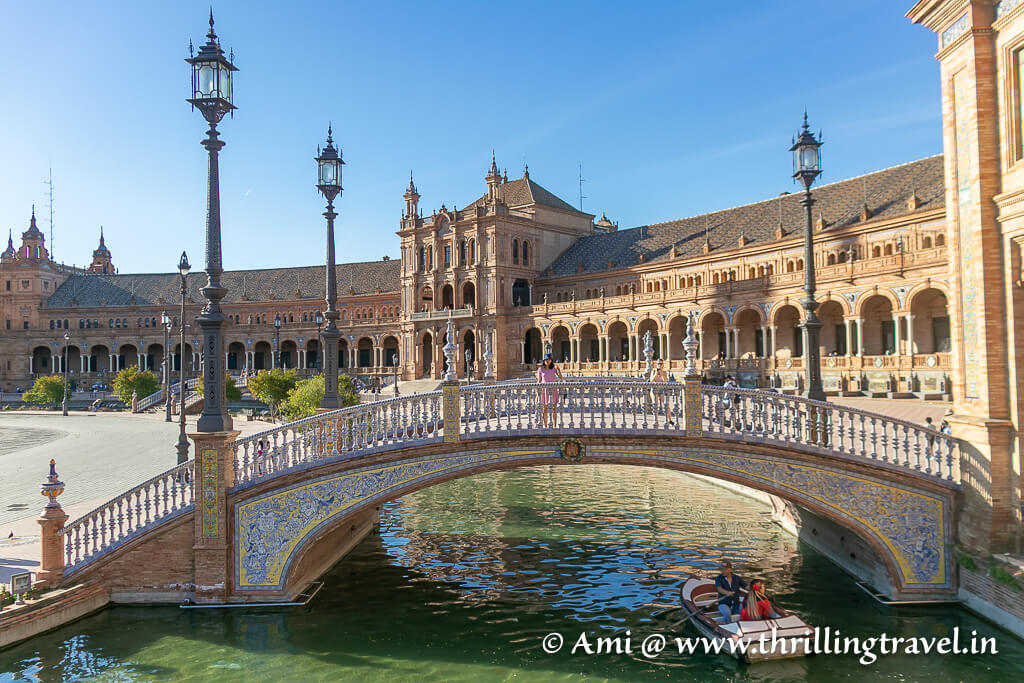
All paths inside Maria Luisa park lead to Plaza de Espana – the gorgeous Spanish square that looks like a palace. The vast semicircular square with its terracotta and azulejo-tiled buildings curves around a central fountain. It is flanked by two ornate towers and is surrounded by a symbolic river or moat with vibrant bridges.
Built for the Ibero – American exhibition, there is a theme story to this Seville landmark. It is suppose to represent the 48 Spanish provinces and the moat would be the sea. It has a fusion of architectures – Baroque, Renaissance and Moorish styles.
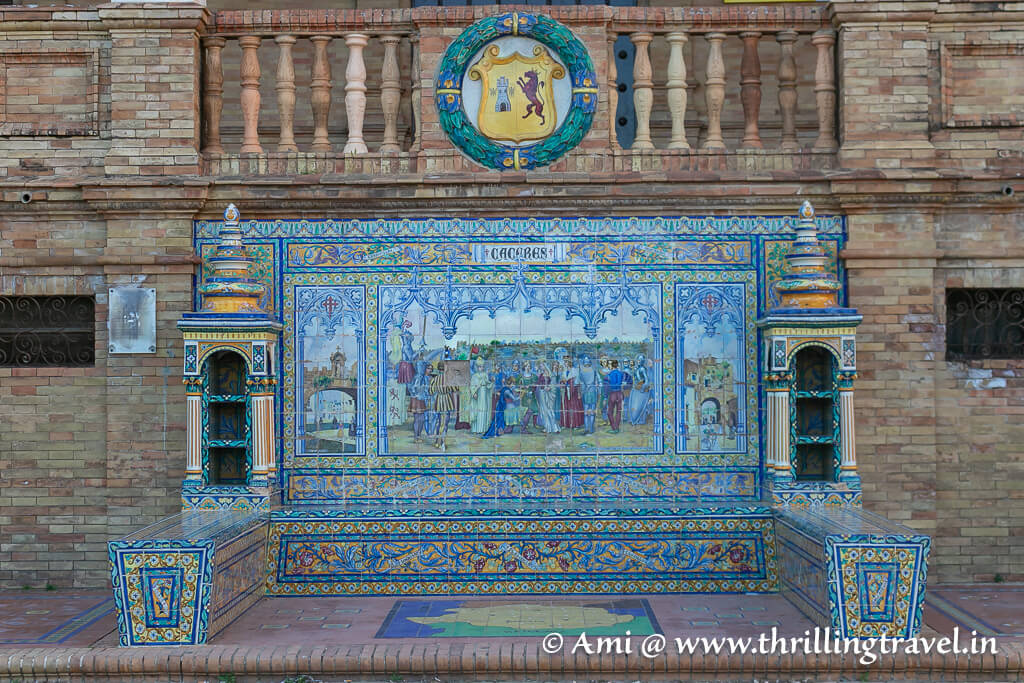
I loved the huge balustrades, arched entrances and the colorful staircases. Walking across the bridges and watching the boats (which you can hire) row under reminded me of Venice. At the same time, watching those horse-drawn carriages go around the central fountain to the arched foyer was something out of an English classic like Pride and Prejudice.
Watch out for the tiny stories in the 48 tiled alcoves – each depicting scenes from one of the Spanish province’s history. And if you are lucky like I was, you can catch a live Flamenco performance here.
The place is a paradise for photographers and Instagrammers, with each corner offering you a different backdrop.

I recommend at least one hour to wander around the Plaza Espanza. You can even sign up for some of the fun activities in Seville here – starting with a ride on the horse-drawn carriages, rowing a boat under the bridges or just watching the bubble artists around the fountain.
Drop by the Costurero de la Reina (Queen’s sewing box)

Right across the street, there is a sight that you cannot miss. A colorful mini castle with turrets piqued my attention. This striking structure is termed as the Queen’s sewing box and was once a shelter for the delicate Queen who could not bear the sun. She used it as a space to enjoy the park and sew with her ladies. Now it functions as the Seville tourist office.
This is apparently the oldest Neo-Mudejar-style building in Seville. To me, it looked like a structure straight out of Lego.
Catch the Hop-On Hop-Off bus to Triana
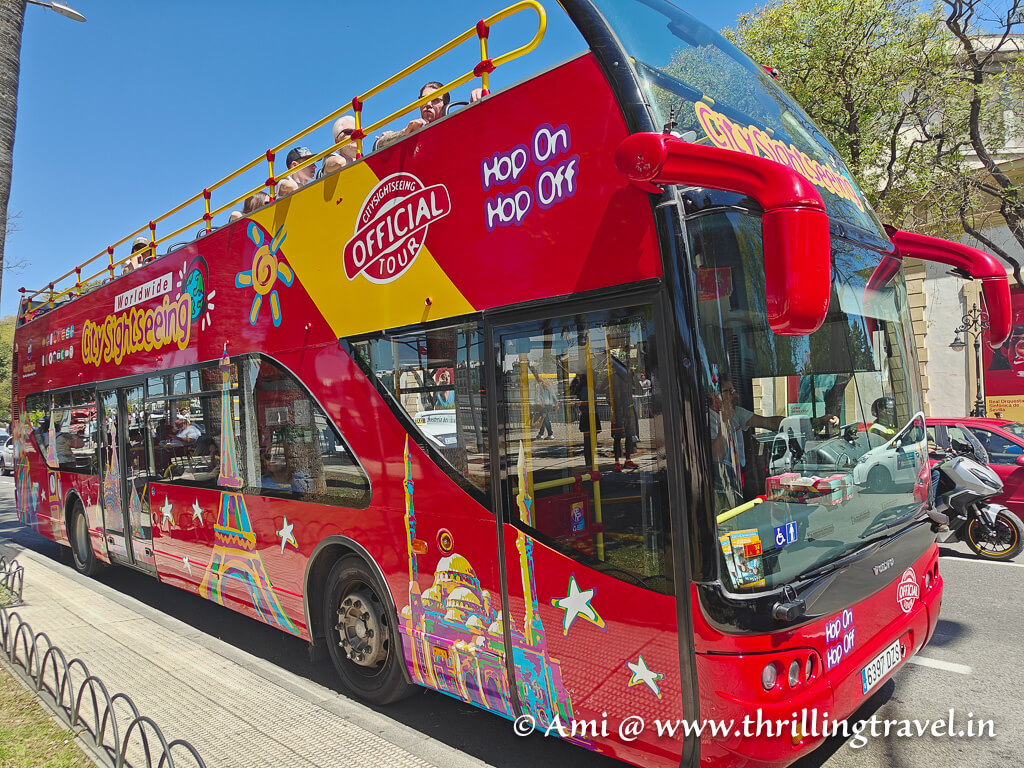
Just walk up to the nearest Hop-on-Hop-off bus stop near Plaza de España and catch a ride to the old settlement of Triana. This is on the other side of the Guadalquivir River that has its own distinct identity, history and pulse.
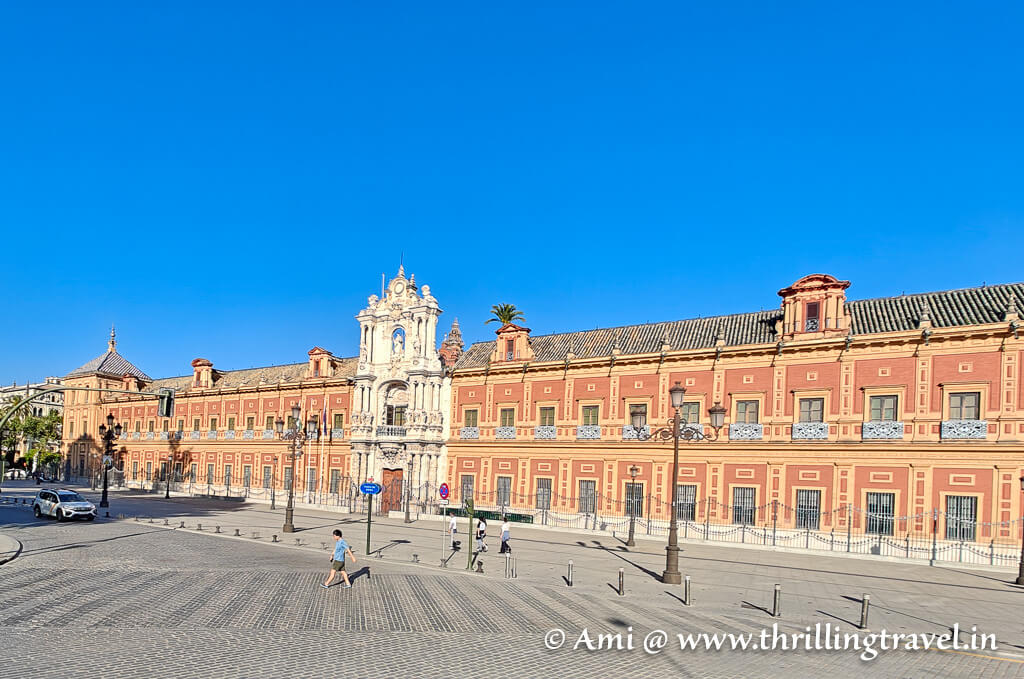
I loved the HoHo ride as it is a good way to cover ground between the two sides of the city during your weekend in Seville. The Seville city sightseeing bus helped me get a glimpse of the San Telmo palace, of which Maria Luisa park was a part. The impressive building is built in a Baroque style, and its original purpose was to be a Maritime college. It has several purposes, including that of a hospital, an orphanage, and later a residence for the Duke of Montpensier. Now it functions as the center for the Andalusian Autonomous Government.
There were several other impressive places to see in Seville that I discovered on the HoHo bus tour of Seville. The audio guide included is amazing and the best part, you can disembark at various points to get a closer look at whatever interests you and get on back on when you are done. Of course, based on the plan that you have taken, you have a few restrictions, but a 48-hour pass is more than enough to discover Seville in 2 days. You can book the same online using this link.
I found the HoHo to be an unexpectedly good way to pull everything together — after two days of exploring neighborhood by neighborhood, the loop gives you a bird’s eye sense of how the whole city connects and sits. By the time you step off, Seville will feel like a place you genuinely know.
In any case, I got off at my next point of excursion – the Triana district.
Explore Triana on a walking tour
If Barrio Santa Cruz is the heart of Seville, then Triana is its soul — and to understand this city properly, you have to cross the river and spend time here.
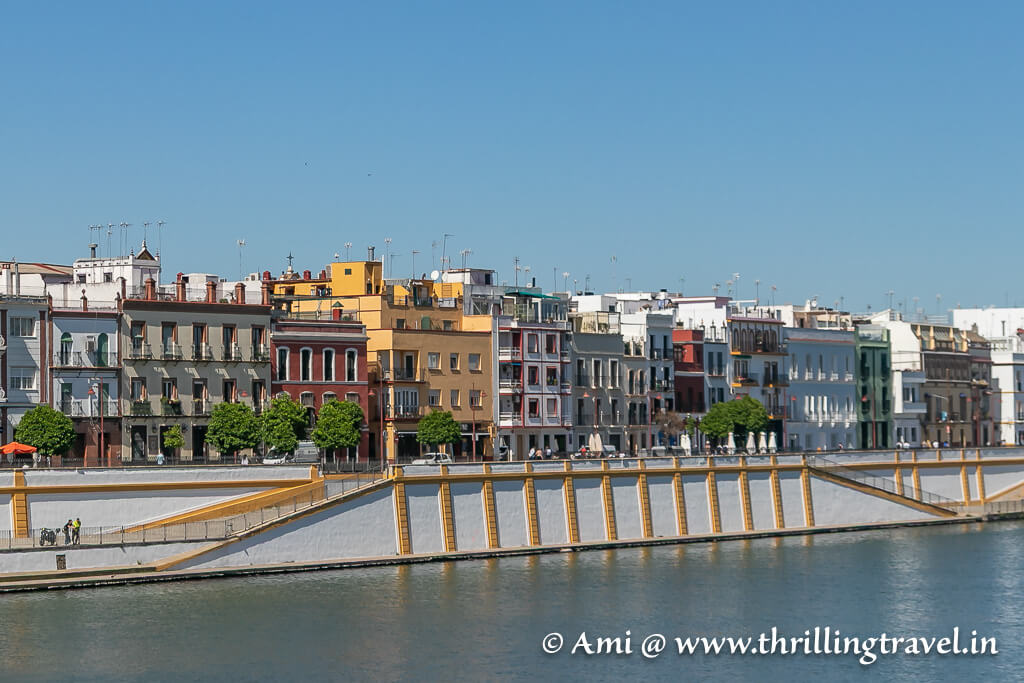
The hop-on hop-off bus drops you at Calle San Jacinto. Step off the bus and you know that you are in a different world. It is vibrant in a different way when you compare it to the Barrio Santa Cruz. Colorful and quirky is what I would describe as the settlement of Gitanos or Gypsies.
Triana, across the Guadalquivir River, was home to the sailors of Seville. It was also, the locality of artists, flamenco dancers and bull fighters. Add to this culturally rich heritage of this Seville neighborhood, the ceramic tile workshops and factories – the same one that you got a sight of in the popular Seville attractions like the Real Alcazar and Plaza Espana.
There are tons of stories lurking in the corners of Triana. Walk towards Plaza del Altozano and you can spot a statue of one of the most popular bullfighters – Juan Belmonte. Turns out he was an icon who changed the way bull-fighting was done and all thanks to his physical limitations.
Then, there is the Puente Isabel bridge, the iconic iron bridge that has connected this neighborhood to the historic centre since 1852. Before this bridge was built, the only way to cross the Guadalquivir was a pontoon made with boats. The deliberate separation between the main city of Seville and Triana explains why this space is so different.
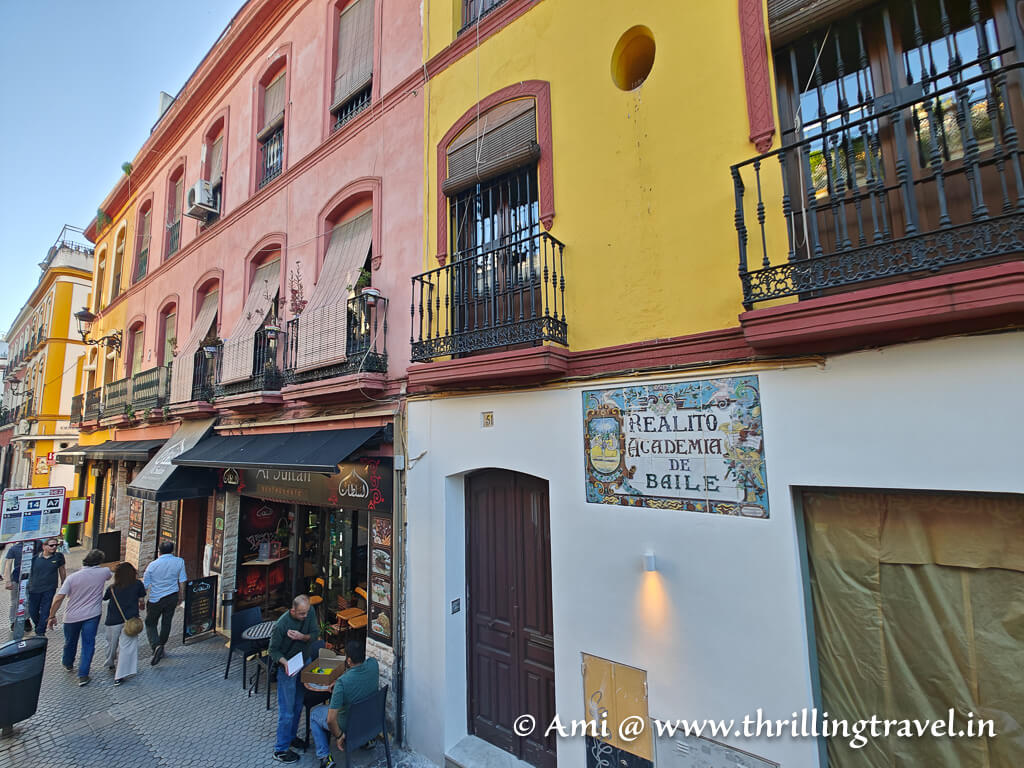
There are tons of other places to see in Seville’s Triana district. The oldest church – Iglesia de Santa Ana, which was built in the 1200s – from the base, the colorful buildings along Calle Betis and the Chapel of the sailors are just some attractions that you can add to your itinerary for two days in Seville.
I highly recommend a guided walking tour of Triana to cover all these and the tales that are around. If you have the time, then you should definitely sign up for a ceramic workshop that gives you a glimpse of its traditional art or a flamenco dance class. I wish I had planned my visit better, for I definitely would not have minded one of these.

Grab lunch at Mercado de Triana
There is so much to see in Triana and so many food options too. However, I recommend walking to Mercado de Triana, which is close to the Puente Isabel II, just steps from Plaza del Altozano. The place is a sensory delight – with all kinds of food options. From oysters to olives, fruits, cheese and yummy desserts, you will find it all here.
What makes this market particularly fascinating is what lies beneath it. The market was built on the ruins of the Castillo de San Jorge — the former headquarters of the Spanish Inquisition in Seville. There is a small archaeological museum in the basement that you can visit when you are here.
Take your time here. Go with small meals so that you can taste the best of everything. Relax by the river front and then get back on your Hop-on-Hop off bus tour. Honestly, after wo days of near-constant walking, this is a wonderfully effortless way to cover the remaining sights while letting your feet recover.
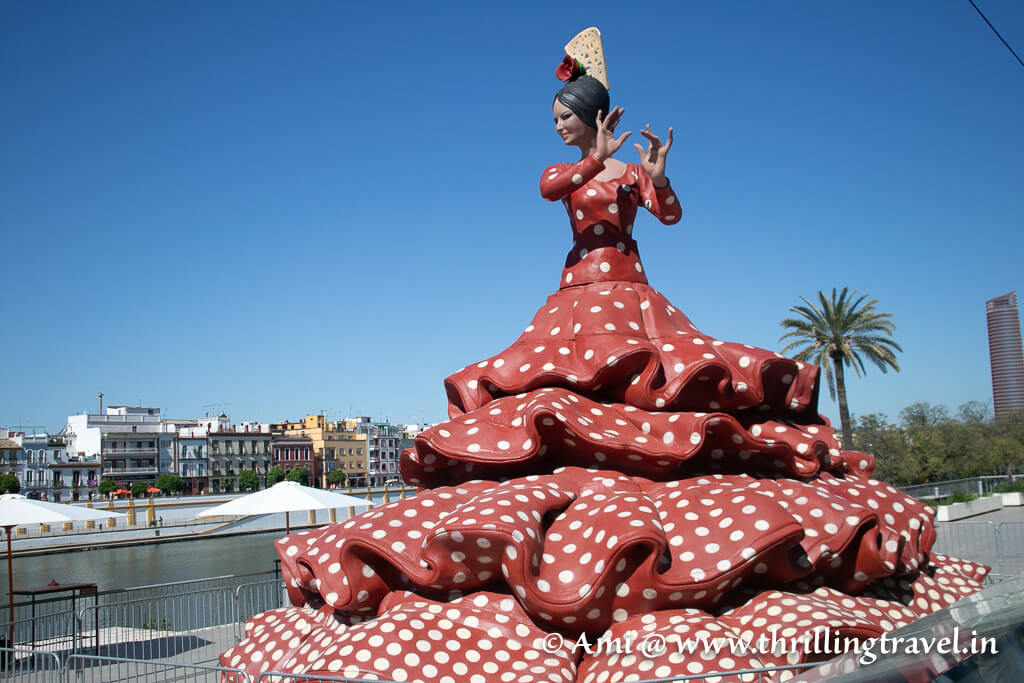
Enjoy an evening at the Setas de Sevilla (Metropol Parasol)
Don’t doze off on your bus ride and remember to get off at the Plaza del Duque. This was the stop recommended by my bus driver as the closest to Metropol Parasol or the famous Mushroom roof pavilion. It took me around 15 minutes by foot to reach what is believed to be the largest wooden structure in the world.

Since it looks like a mushroom canopy, the locals have renamed it as Setas (Mushroom) de Seville. You can choose to go right to the roof for some lovely views of the city or, like me, just explore the markets around. The walk on the roof is a ticketed activity that can be reserved online through this link.
Located in its basement is an antiquarium – a museum around the archaeological remains of the Roman and Almohad periods of Seville. You can include this in your tickets to the La Setas if you wish.
With that, I ended the last evening of my perfect 2 day tour of Seville. I am sure you agree that this itinerary covers major parts of Seville and a weekend is good enough for it.
What to do in Seville for 3 days?
Looking for the top things to do in Seville, Spain, for three days? You’re in for a treat.
You have quite a few unique things to do in Seville city for a day. Better still and one that I highly recommend, is that you sign up for one of the many day trips from Seville. Here are five that I considered during my Spain stay.
Day trip to Cordoba from Seville
Cordoba is one place that was high on my list. Less than 2 hours from Seville, this is a perfect day trip by road or train. Once here, you can explore the famous floral patios, the awe-inspiring Mezquita, and the other attractions on your own. Or join one of the many walking and cycling tours on offer.
Alternatively, you can sign up for the many full-day guided tours that depart directly from Seville and take the hassle out entirely. If you’re going independently, I highly recommend that you book your Mezquita tickets in advance. Much like the Alhambra in Granada, last-minute availability is rare, and you don’t want to miss it.

Seville day trip to Rhonda and the white villages
There is something enigmatic about that dramatic gorge and the clifftop old town. Add a trail of whitewashed villages (like Frigiliana that I have visited from Malaga) dotting the hillsides and what you get is an unforgettable day three of your 3 days in Seville itinerary.
There are quite a few guided day trips from Seville to Ronda covering a few of these villages. I recommend these for hassle-free transport and the local stories that they share during the journey.
Cadiz day trip from Seville
One of the oldest cities in Europe, Cadiz appealed to me for its heritage, ocean-facing promenades and. baroque architecture. It is just 1.5 hours from Seville and I am told that the train journey is a scenic affair – given that you will be chugging along the coastline.
I had shortlisted this guided tour from Seville for the historical context it added to the visit.
A hiking trip from Seville to Caminito del Rey
Caminito del Rey — translated as the King’s Little Path — is one of those experiences that stays with you long after you’ve done it. Built into the steep walls of a dramatic gorge in Málaga province, this walkway has a reputation for being one of the most thrillingly vertiginous trails in the world.
The trek itself isn’t technically difficult — the path is well-maintained and the route is manageable for most fitness levels. It’s the height that does things to you. I’ll admit I spent longer than I’d like to confess deliberating whether my nerves could handle it.
Book the same as early as possible as the spots fill up fast.
Tangier from Seville – a day trip to Africa from Seville.
A day trip to Tangier is perhaps the most unexpected thing you can do from Seville — and that’s exactly what makes it worth doing. Head down to Tarifa, the southernmost tip of Europe, hop on a short ferry across the Strait of Gibraltar, and within an hour you’re in Africa.
Tangier’s medina, souks, street food, and sheer sensory contrast to Andalucia make for an unforgettable day. I was seriously tempted by this guided tour that covers the key sights while giving you a real feel for Moroccan culture, food, and shopping — all in one go.

In addition to the above, another highly recommended addition to your 3-day Seville itinerary is the Alhambra tours from Seville. I did not add this to my shortlist as I was already heading to Granada for a 3-day stay. You can, however, consider that if Granada isn’t on your road trip list.
The day trips require you to start in the morning and you only get back by evening. However, if you do not want to sign up for any of these, then consider some of the activities in Seville that I have included in the next section.
Alternate things to do in Seville – that you can replace or include in your Seville itinerary

I have already shared three options (Plaza de Toros, Espacio Exploterra museum and Tapas crawl) to include or replace in your day one of the Seville in two days itinerary. Besides those, here are a few more options that you can consider –
- Sign up for a ceramic workshop in the Triana district
- Go for a class to experience authentic flamenco in Seville and visit the Flamenco museum
- Take a cruise along the River Guadalquivir – one of the relaxing things to do in Seville.
- Visit the Acuario de Sevilla or the aquarium. This is a great activity with the kids.
- Visit the Plaza de America, which is next to the Plaza Espana. Built around the same and for the same purpose, it now hosts a few museums and has a beautiful pavillion too.
What if I just have 24 hours in Seville?

If you just have one day in Seville, then stick to the Day one plan that I have recommended in this Seville travel guide. You can also, replace the Barrio Santa Cruz walk with time at the Maria Luisa Park and Plaza Espana. That way, you get to see the historic center as well as a different part of Seville.
Just to recap, your 1 day in Seville itinerary will look like this –
- Start the day at Maria Luisa park
- Discover Plaza Espana
- Head for lunch in Barrio Santa Cruz
- Explore the Real Alcazar, Cathedral and the Giralda.
- End the evening at the Tapas bar or with a Flamenco show.
Again, depending on the tickets that you buy for the Real Alcazar and Cathedral, you can swap your two day-parts.
How to get around Seville?
Seville finds a mention in one of the top walkable cities and honestly, I too can vouch for that. Over my two days in Seville, I found that most key sights are within comfortable walking distance of each other — especially in the historic centre. Even heading to Triana can be handled on foot.
That said, here are your options for getting around – especially if you are short of time or just have 24 hours in Seville.
Buses are the most reliable way to cover more ground. You can pick up a rechargeable bus card called the Tarjeta Multiviaje at most tobacco shops (Tabacos) or at the bus stops across the city. This is a smart option if you are travelling as a group or planning multiple journeys — the per-trip cost works out significantly cheaper than paying per ride (around € 0.75 per ride) If you prefer not to use a card, a single one-way journey on Seville’s city buses costs around €1.40 per adult.
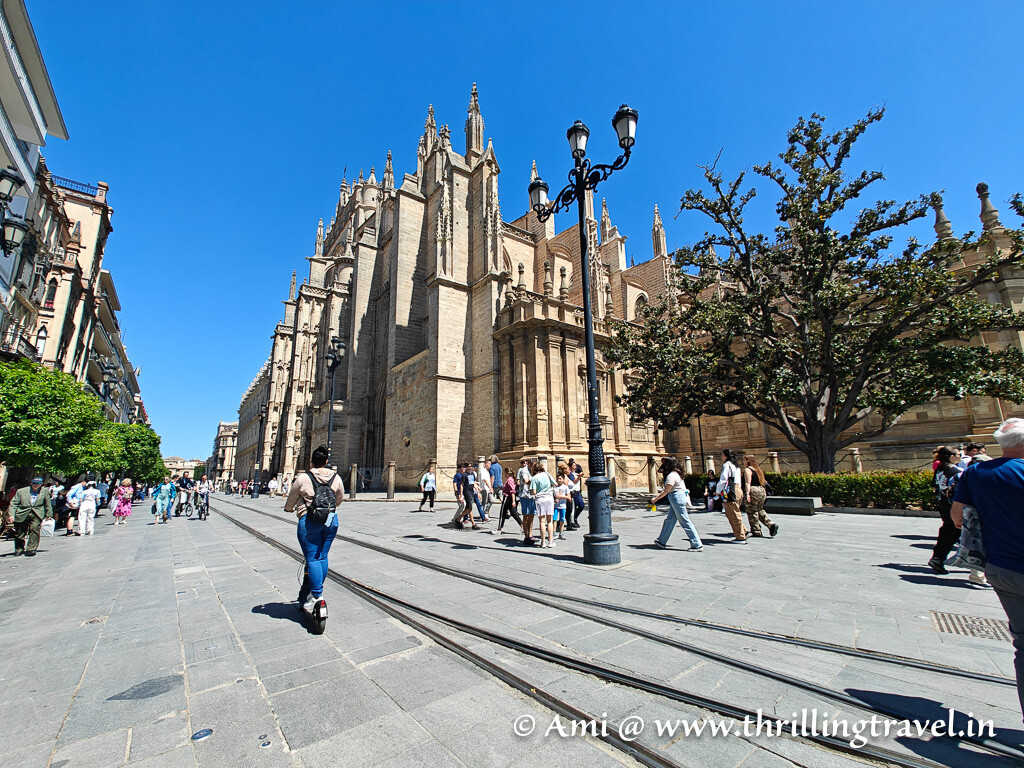
Seville also has a tram and metro system, though the metro has limited coverage and is more useful for reaching areas outside the centre. For most sightseeing purposes, the tram along the main boulevard and buses will serve you better. The Tarjeta Multiviaeje can be used for trams too.
Taxis and ride-hailing apps like Uber and Cabify are widely available but will cost more, so best to save for late nights or when you’re carrying luggage.
Self-driving in Seville is not recommended for first-time visitors. The historic centre has strict traffic restrictions, many streets are pedestrianized, and parking is both scarce and expensive.
Finally, this is one city where I would not say no to the Hop-on-Hop off buses. It takes you to the prime locations while giving you a good download of the surroundings. You can book your tickets online for either a 24-hour or a 48-hour pass. They cost you between €24 to € 40, depending on the benefits you want – ranging from multiple journeys to admission tickets, walking tours and more. I found it quite useful given the audio guide and the multiple entrances that were included. Plus, there were some discounts on cafes and shopping places too!
Is the Seville city card worth it? Should I buy one for my Seville trip?
I came across the City Pass Seville when I visited the tourist counter in Seville. I wish I had picked it up earlier as it had a lot of benefits like the Granada city card that I found invaluable during my stay there.
The card includes skip-the-line entry to the two monuments you absolutely cannot miss — the Real Alcázar and the Cathedral & Giralda Tower. Anyone who has tried booking these separately knows how quickly the queues can eat into your day. On top of that, you get a 24-hour hop-on hop-off bus tour, a digital audio guide covering over 100 points of interest across the city, and a 10% discount on additional experiences like flamenco shows and guided tours.

The pass is fully digital — no pickup required, no paper tickets. You book online, receive a QR code by email, and activate it on your phone on arrival. Do note that you will still need to pre-select entry time slots for the Alcázar and Cathedral, so book early, especially if you are visiting in peak season.
In my case, I had already booked the Alcazar tickets and had planned my own exploration. The city card did not make sense. Instead, taking a hop-on-hop-off bus worked out better.
With that, I conclude this mega Seville travel guide. I am sure you have most of the information that you need to plan a great Seville trip – whether for two days, three or just one.
Common FAQs about planning a Seville itinerary
What is the best time to visit Seville?
Spring months — March to May — and the early autumn months of September and October are the best time to visit Seville. I visited in April and it was just about perfect. The weather was warm and sunny without being overwhelming, temperatures hovering between 20 and 28 degrees Celsius.
June to August is peak summer in Seville and it can get seriously hot — temperatures regularly cross 40 degrees Celsius, making outdoor sightseeing quite challenging. If summer is your only option, plan your mornings early and keep afternoons indoors or in the shade.
Winters are mild compared to much of Europe — rarely dropping below 10 degrees — but the days are shorter and some outdoor attractions feel quieter.
One festival you absolutely should not miss is the Feria de Abril — the legendary April Fair that takes place two weeks after Semana Santa (Holy Week). It is one of the most spectacular festivals in Spain, with flamenco dancing, horse parades, traditional costumes, and casetas (decorated tents) that stay buzzing through the night. Semana Santa itself — the Easter processions through the old city — is deeply moving and draws visitors from across the world. If your dates align with either, plan around them. Just book your accommodation well in advance as the city fills up fast.
How many days do I need in Seville?
Two full days in Seville are more than enough to explore the city. An additional day is great if you want to base yourself here and do a few day trips from Seville.
Before you go, pin this


Popularly referred to as a Restless Ball of Energy. My Mom refuses to entertain my complaints about my equally restless daughter & assures my husband that I was born with a travel bug.
I am a Post-Graduate in Marketing by qualification and a travel blogger by passion. Besides travel, I enjoy photography and if you don’t find me at my desk, I would be out playing badminton or swimming or just running. I believe in planning for every long weekend through the year. And when I cannot travel physically, I travel virtually through this travel blog. My travel stories have also, got published on various websites and magazines including BBC Travel, Lonely Planet India and Jetwings. I have recently published my first book – When Places Come Alive – a collection of stories that are based on legends, landscapes, art and culture of a place which is available in both ebook and paperback format.
You might also like these posts –
- A complete guide to a day trip to Frigiliana – the prettiest village in Andalucia, Spain
- A travel guide for a day trip to Nerja, Spain
- Tips on picking the best Madrid cycling tours (& my experience of exploring the city)
- 15 amazing facts about Royal Palace of Madrid & reasons why it is worth visiting
- What to see inside Royal Palace of Madrid? History, Interiors & Tips for your visit
- All about Spain tourist visa for Indians (Schengen visa): how to apply, documents required and fees
- Madrid in two days | The best Madrid itinerary for 48 hours
- Best of Barcelona Attractions
- A perfect 3 days in Malaga itinerary – with the best things to do, stay & eat
- The ultimate 3 days in Granada itinerary – with best things to do, stay and other insider tips
I haven’t been to Seville before – this is a great guide! 🙂
Thanks…am glad you like it